 Currencies
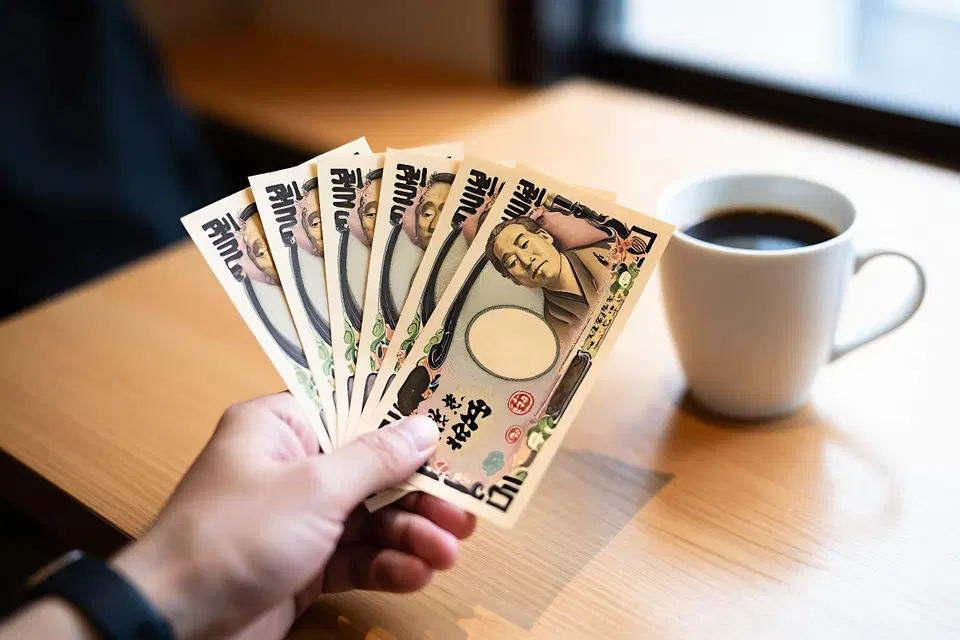
If you pull up a currency app and see USD/JPY at, say, 155.20, you are looking at one of the most watched numbers in global finance. It means one US dollar buys 155.20 Japanese yen at that moment. Simple enough. The trouble starts when you try to use that number at a bank counter, an airport kiosk, or a cash machine in Tokyo.
The usd jpy exchange rate today is not a single price. It is a market quote, and the rate you actually get depends on where you convert, how much you move, and what fees sit on top. A quote that looks 2% better can vanish once spreads and charges appear.
What the USD/JPY quote is actually telling you
Currency pairs are written base/quote. In USD/JPY, the dollar is the base and the yen is the quote. A rate of 155.20 means 1 USD = 155.20 JPY. If the number rises to 160, the dollar has strengthened against the yen. If it falls to 150, the dollar has weakened.
Small-looking moves matter. At 150, $100 converts to 15,000 yen. At 155, it converts to 15,500 yen. At 160, it converts to 16,000 yen. That 10-yen swing changes a $100 exchange by 1,000 yen, roughly the price of a bowl of ramen and a train ride. For a $2,000 hotel bill, the same swing is 20,000 yen.
If you want a concrete breakdown of what a $100 conversion looks like in practice, this guide to 100 USD to JPY and what it actually buys in Japan walks through the maths.
Why USD/JPY moves so much
Several forces push the pair around. The biggest over the past few years has been the gap between US and Japanese interest rates. When the Federal Reserve keeps rates high and the Bank of Japan stays low, money tends to flow toward dollar assets. That can lift USD/JPY. When markets expect the Fed to cut or the BOJ to tighten, the pair can fall quickly.
Energy prices and risk sentiment matter too. Japan imports most of its oil and gas, so a spike in crude can weigh on the yen. Global stress can send investors into the dollar as a safe haven. Then there is intervention risk. Japan's finance ministry has stepped into the market before when the yen weakened too fast, and traders watch its language closely.
If you are new to the pair, this guide to reading the US dollar to Japanese yen exchange rate before you change money explains the basics without the jargon.
The one-day trap
Daily headlines often treat a 0.4% move as a crisis. For most travellers and small businesses, a few yen either way is noise. A 5-yen move on a $500 conversion is 2,500 yen. That is worth noticing. A 0.2-yen move is not worth rebuilding your plans around.
The rate on the board is not the rate in your hand
Airport boards are built for convenience, not value. They show a single buy or sell number that already includes a markup. The mid-market rate, the midpoint between buy and sell prices on global markets, might be 155.00. A kiosk could offer 151.50. On $1,000, that gap costs 3,500 yen before any fixed fee.
The gap between the displayed rate and the actual rate is the subject of why the number on the board isn't the number you get. It is worth reading before you hand over a large sum.
Cards and ATMs are not free either. A card might use a rate close to mid-market but add a 1% to 3% foreign transaction fee. An ATM operator might charge 220 yen or $5 per withdrawal. Dynamic currency conversion, where the machine offers to charge you in dollars instead of yen, often hides another 3% to 6%.
Before you convert, compare four numbers:
- Mid-market USD/JPY from a source like Reuters, XE, or Google.
- The provider's exchange rate.
- Fixed fees in dollars or yen.
- Any ATM operator fee or card foreign transaction fee.
Add them up. A provider offering 154.80 with no fee can beat one offering 155.20 with a $10 fee on small amounts.
How to check the usd jpy exchange rate today
Start with a mid-market source and note the timestamp. Rates move every second during the trading week, and a quote from yesterday is not today's rate. Check two sources if the amount is large. Then ask your bank or card issuer what rate they will apply and when.
In Japan, cash still matters in smaller towns, ryokan, and some restaurants. A 7-Eleven ATM is often a better option than a hotel desk, but your home bank may add its own fee. This look at the dollar rate in Japan today and what the yen board really means for your wallet is useful if you are already in the country and deciding where to withdraw.
What a higher USD/JPY means in practice
For an American visitor, a higher USD/JPY is usually good news. At 150, $1,000 gives 150,000 yen. At 160, it gives 160,000 yen. That extra 10,000 yen can cover a few meals, a rail pass segment, or a night in a business hotel. Japanese exporters also tend to benefit when the yen is weak, because overseas revenue converts into more yen. Japanese households and importers feel the opposite through higher fuel and food costs.
For businesses, the rate affects pricing and payroll. A US company paying a Japanese contractor 500,000 yen a month pays about $3,333 at 150 and about $3,125 at 160. The invoice has not changed, but the dollar cost has. A Japanese company buying US software faces the reverse.
The 1 US dollar in Japanese yen explainer is a good sanity check on what small rate differences buy on the ground.
Practical ways to get a better USD/JPY deal
Use a mid-market benchmark. If a provider's rate is more than 2% away from mid-market for a major currency pair, you are paying a lot for the service. For small amounts, a 2% gap may be acceptable at an airport. For $5,000, it is worth a taxi ride to a better counter.
- Compare the all-in cost, not the headline rate.
- Decline dynamic currency conversion and pay in yen when in Japan.
- Withdraw larger amounts less often to reduce fixed ATM fees.
- Use a card with no foreign transaction fee for purchases, but keep some cash.
- Avoid converting money you will not spend. Convert in batches if the amount is large.
- Set a rate alert if you need a specific amount and do not want to watch screens all day.
A rate alert is not a strategy, but it stops you from checking five times a day. Pick a level that works for your budget, convert when it appears, and move on. The difference between a good and a bad currency exchange is rarely the direction of the market. It is usually the spread you accept without noticing.