
Loading article...
Slot ID: blog-post-top
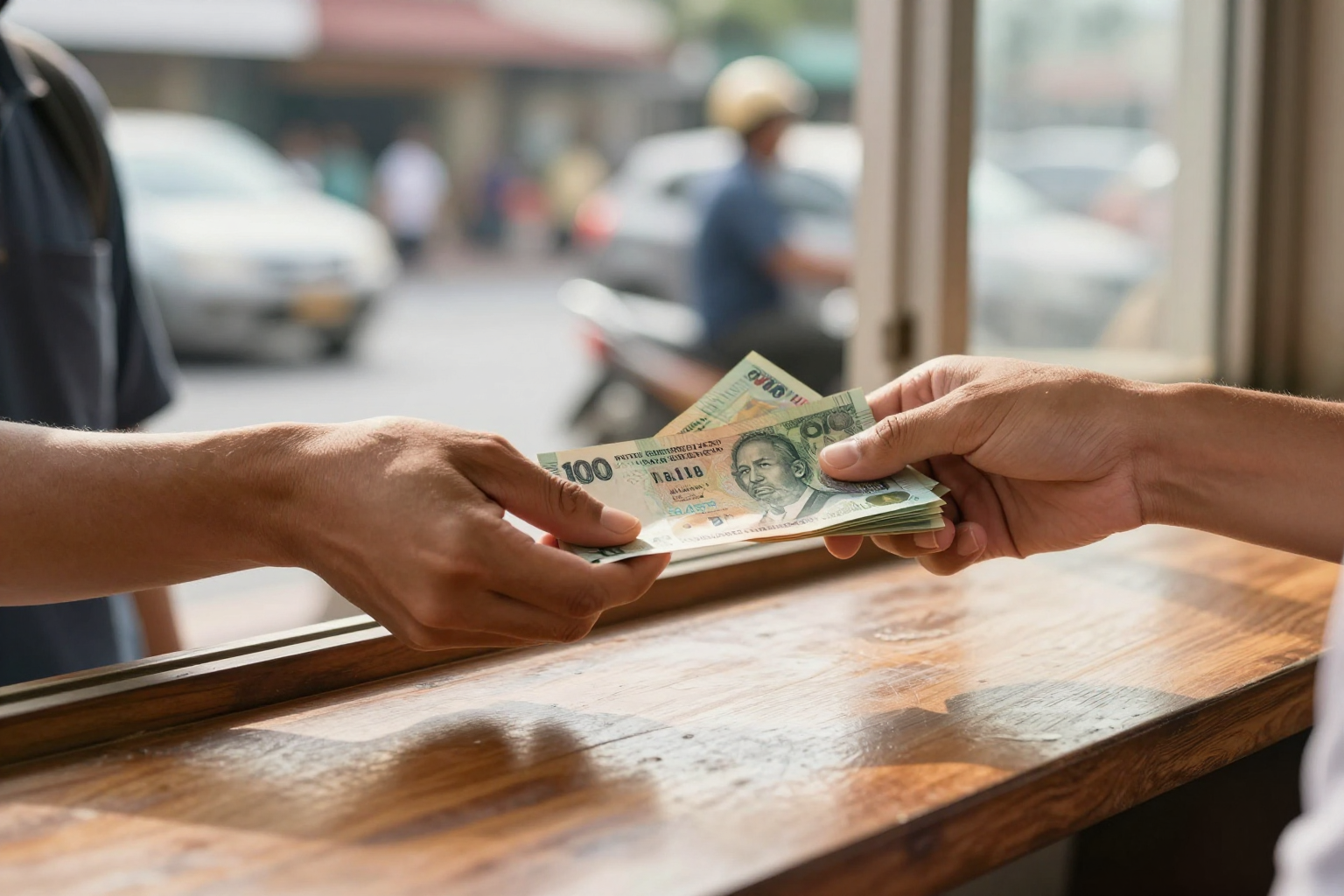
Two numbers sit behind every THB to USD conversion, and most people only ever see one of them. The first is the mid-market rate on a search result: something like 34 baht to the dollar. The second is the rate you actually get when you hand over cash, tap a card, or pull money from an ATM in Bangkok. The gap between those two numbers is where the real cost of converting baht to dollars lives, and it is often 3% to 6% of your money.
Closing that gap doesn't take an economics degree. It takes knowing which way the rate runs, why it moves, and which counters and apps give you a fair deal.
Exchange rates are ratios, so the same pair gets quoted two ways. Thai currency desks usually quote USD/THB, meaning how many baht one US dollar buys. If that number is 34, then one baht is worth about $0.0294 and 1,000 baht is roughly $29.40.
That framing matters because people read a "strong baht" as good news and a "weak baht" as bad, without asking whose side they are on. A rate of 38 baht to the dollar is excellent if you arrive holding dollars. It hurts if you are a Thai freelancer invoicing US clients. The same confusion shows up with the dollar-to-yen rate, where a rising number means opposite things to a tourist and an exporter.
Over the past decade the pair has ranged from roughly 29 to 38 to the dollar, a swing of about 25%. That is enough to turn a comfortable holiday budget into a tight one.
Thailand's economy gives the baht a distinctive personality, and three forces do most of the work.
Visitors arriving with dollars, euros and yuan create steady demand for baht, and Thailand runs a persistent current-account surplus, meaning more money flows in from exports and tourism than flows out. Surpluses tend to support a currency over time.
When the US Federal Reserve raises rates, dollar assets pay more and capital tends to leave emerging markets for America. The baht weakens. When the Fed cuts, that flow often reverses. The Bank of Thailand's own policy rate sets the other side of the see-saw.
Thailand is one of the world's busiest gold markets, and large bullion flows can move the baht independently of trade data. The country also holds foreign reserves north of $200 billion, which gives the central bank room to smooth sharp moves. In turbulent periods the baht often trades like a regional refuge, similar to the role the franc plays in Europe. That pattern is worth understanding if you follow what moves CHF/USD.
Before comparing quotes, work out what a good rate looks like for you.
A rate that looks generous on one side of the counter can be poor on the other. Get the direction right first, then shop.
Thai exchange counters are everywhere, and they are not created equal.
Booths at Suvarnabhumi and Don Mueang are convenient and almost always the worst deal in the country. A 3% to 5% margin below mid-market is normal. On 50,000 baht that is real money.
Bangkok's dedicated money changers work on much thinner margins, often under 1%, and the difference between the best and worst booth on the same street can be 2 baht per dollar.
The fee Thai ATMs charge foreign cards has climbed repeatedly and now sits at 220 baht per withdrawal at most banks, with caps usually somewhere between 20,000 and 30,000 baht. Take out 5,000 baht five times and you have paid 1,100 baht in fees before your home bank adds a 1% to 3% foreign transaction markup. The arithmetic is identical whether you are in Bangkok or Seoul, which is why our guide to the dollar-to-won rate covers the same trap.
Say you need 50,000 baht for a two-week trip and mid-market is 34.00.
Same amount of baht, four prices, a spread of nearly $80. That is a good dinner for two in Bangkok, or a second-class sleeper train to Chiang Mai.
For anything beyond spending money, wires and transfer apps beat cash. A traditional bank transfer between a US and Thai bank often involves a sending fee, a correspondent bank charge, and an incoming fee of 200 to 500 baht on the Thai side, on top of a rate margin that can reach 3%.
Specialist transfer services narrow that margin considerably and show the fee separately from the rate. The logic holds across markets, and the lessons in our breakdown of USD to Colombian peso transfers apply almost line for line to dollars and baht.
Expats, remote workers, and anyone with a Thai mortgage and a dollar income face a different problem: timing. Trying to catch the top of the range is a losing game for most people, because nobody rings a bell when the rate peaks.
What tends to work better:
Anyone running a cross-border life recognises the feeling, whether the pair is baht-dollar or USD/CAD.
First, screenshot the mid-market rate before you travel and keep it in your notes. It takes ten seconds and gives you a benchmark for every quote you see, so a friendly-looking 33.20 does not fool you when the real rate is 34.
Second, treat the fee and the rate as one number. A booth advertising "no commission" with a two-baht-worse rate is charging you far more than one with a small visible fee and a near-market rate. Do the division on your actual amount, every time, and the THB to USD question stops being guesswork.
Slot ID: blog-post-bottom