
Loading article...
Slot ID: blog-post-top
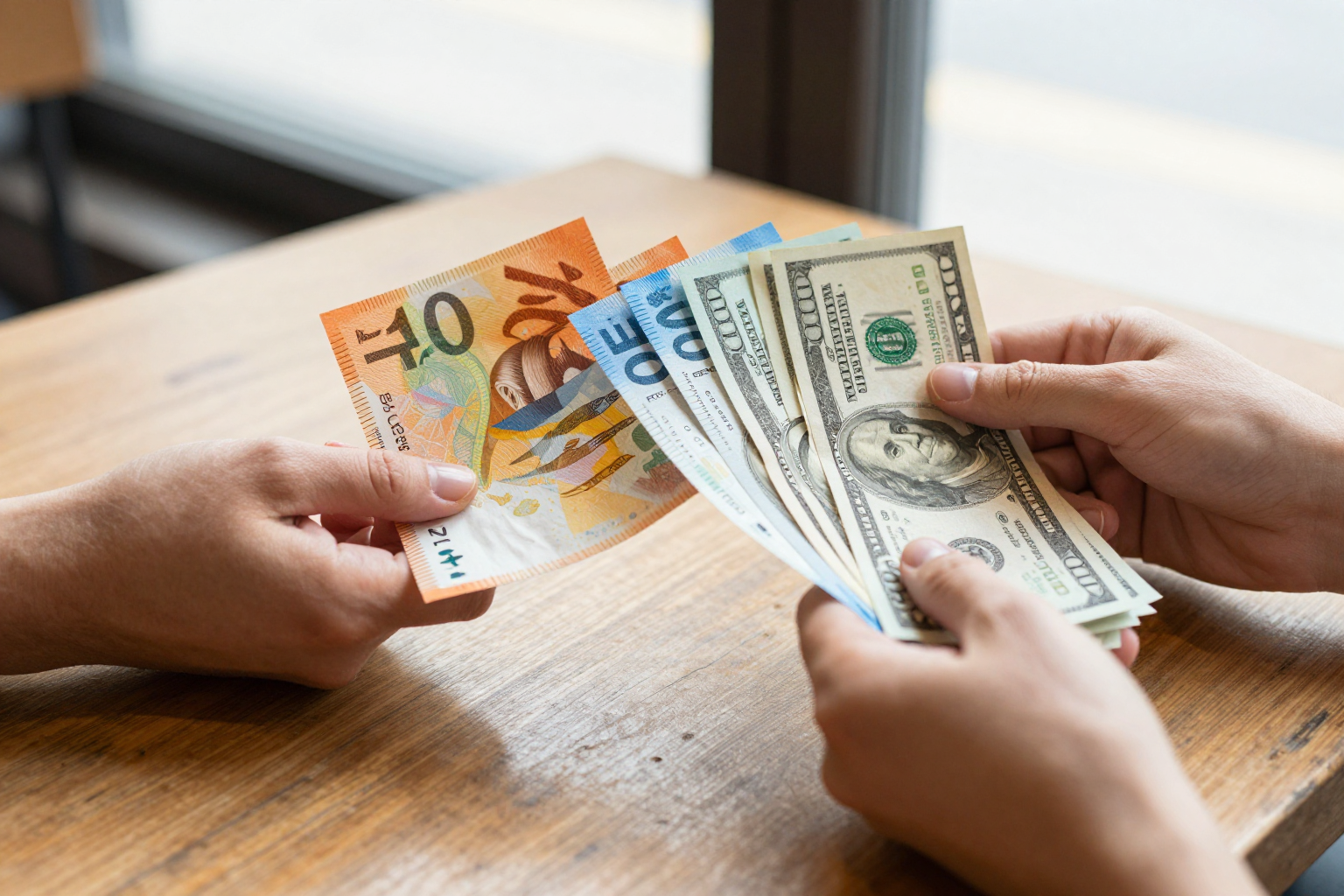
Say you've agreed to pay a CHF 5,000 invoice from a supplier in Zurich, or you're moving savings out of a Swiss account into a US one. The whole transaction rests on a single number: the Swiss franc to USD exchange rate. It looks simple enough on a screen, yet two people converting the same amount on the same day can end up hundreds of dollars apart.
Here's what sits behind that number, what pushes it around, and how to keep more of it.
A CHF/USD rate of 1.12 means one franc buys 1.12 dollars, so 1,000 francs gets you roughly $1,120. Banks and trading platforms often quote the inverse instead, shown as USD/CHF at about 0.89. Same market, opposite direction, and confusing the two is a quiet way to accept a rate that's worse than you assumed.
Small moves matter once real money is involved. A CHF 5,000 payment costs $5,500 at a rate of 1.10 and $5,800 at 1.16. That six-centime swing is $300, and it can happen inside a few weeks when central banks are making headlines.
The SNB intervenes in currency markets more openly than most central banks, and it has a long memory of painful franc strength. Swiss policymakers held interest rates below zero from 2015 to 2022 and spent heavily buying foreign currency to hold the franc down, because a small, export-heavy economy bleeds when its currency climbs too fast. When the SNB signals looser policy, the franc usually softens. When it sounds worried about inflation, the franc firms up.
Money drifts toward higher yields. When the Federal Reserve raises rates and the SNB holds steady, dollar deposits pay more and the USD tends to gain against the franc. When the Fed cuts and the SNB sits still, that flow reverses and the franc strengthens. This gap between the two policy paths is the single biggest driver of CHF/USD over any twelve-month stretch.
Both currencies attract nervous money, which makes this pair behave oddly in a crisis. During a market shock, francs and dollars are often bought at the same time, so CHF/USD can barely budge while both surge against the euro or emerging-market currencies. The Japanese yen plays a similar role, though what really drives the yen follows a completely different script, shaped by carry trades and decades of domestic deflation.
Switzerland runs a persistent current account surplus. Pharmaceuticals, precision machinery, luxury watches and insurance all sell abroad in francs, and foreign buyers have to convert their own currency to pay Swiss firms. That creates constant structural demand for the franc. Swiss inflation has also generally run below US inflation, which quietly supports the franc's purchasing power year after year.
Zoom out and the pattern is hard to ignore. The franc has appreciated against most major currencies for fifty years, with only occasional violent reversals. In 2011 it hit 1.38 against the dollar; a decade later it traded near 0.85. Anyone holding francs through that stretch gained buying power without doing a thing, which is exactly the story behind why the Swiss franc holds its value so well.
The headline rate you're shown is rarely the rate you get. What matters is the all-in cost, and it hides in several places at once.
Stack those together and a routine conversion can cost 4% or more. For a good sense of how quickly that adds up, it's worth seeing how easy it is to overpay on a dollar conversion without noticing.
Ask each provider one question: if I send 5,000 francs now, how many dollars land in my account? Compare that final figure. The provider with the highest number wins, regardless of how the fees are labelled or hidden. This single test cuts through all the marketing.
Multi-currency accounts and specialist transfer services quote close to the mid-market rate and charge a transparent fee instead of a hidden spread. High-street banks are convenient for small amounts and expensive for large ones. Airport kiosks and hotel desks should be treated as a last resort, since their markups often run 8% to 12%.
Nobody reliably calls short-term currency moves, and trying to catch the perfect rate usually costs more in stress than it saves in dollars. If you have a large payment coming, split it into three or four conversions spread over a few weeks. You average out the spikes instead of gambling on one day.
You need to convert 10,000 CHF. Bank A offers 1.09 with no stated fee, which produces $10,900. A specialist offers the mid-market rate of 1.115 minus a $25 fee, producing $11,125. Same francs, same afternoon, $225 more in your pocket, or just over 2% of the transfer.
If you're doing that every month, the gap reaches roughly $2,700 across a year. That is a holiday, a car payment, or a very decent chunk of a mortgage.
Set a rate alert through your banking app or a currency tracker rather than refreshing a quote page ten times a day. Decide in advance what rate you're happy with and act when it appears, instead of second-guessing the market after the fact.
Keep a small multi-currency balance if you regularly move money between Switzerland and the United States. Holding a few thousand francs means you can convert when it suits you rather than when a bill arrives. Watching what moves major pairs like GBP/USD won't tell you where CHF/USD goes next, but it trains you to read a quote properly and spot when a provider is padding it.
Write down the exact rate you received every time you convert. After six transactions you'll know your true average cost, and you'll notice immediately when a provider quietly widens its margin. That one line in a spreadsheet has saved people more money than any forecast ever will.
Slot ID: blog-post-bottom