 Currencies
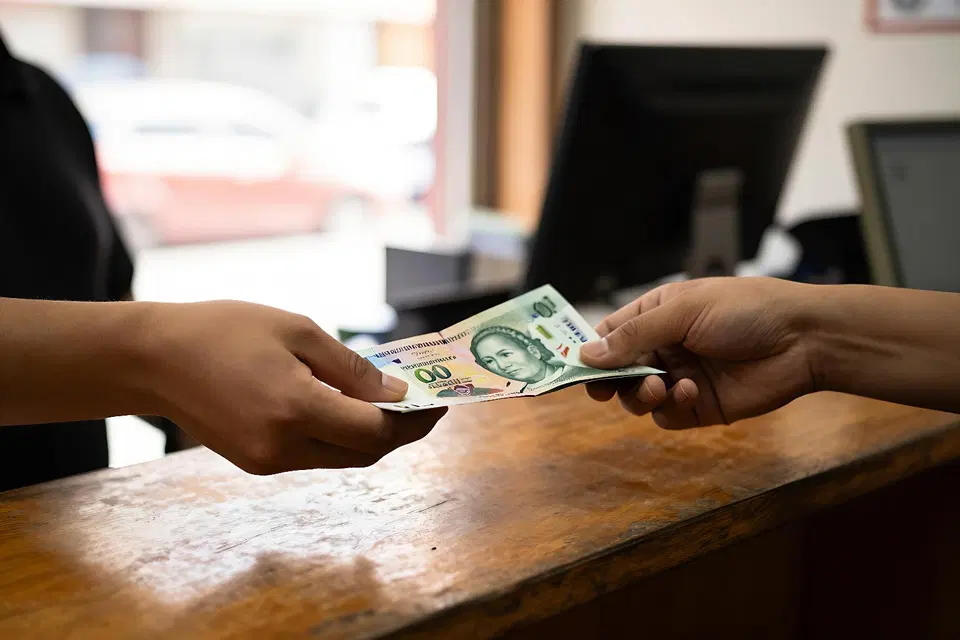
Type "western union vs western union" into a search bar and the results look like a typo. Same company, same yellow and black sign, same service. Who compares a brand to itself?
Plenty of people, as it turns out, because there isn't really one Western Union. There are several, and they charge different prices for identical transfers. A $500 send started in the app, funded from a bank account and collected as cash in Manila follows a completely different cost path from the same $500 handed over a counter in Chicago and deposited into a Philippine bank account. Fees, exchange rate markup and delivery time all move depending on the route you choose.
Same logo, three different price tags
Western Union sells its service through three storefronts: the mobile app, the website, and hundreds of thousands of agent locations in pharmacies, supermarkets and corner shops. Each has its own fee schedule and its own exchange rate markup. The app runs promotions that drop the fee to zero for a first transfer or for particular corridors. A counter agent rarely can, because that location has rent, staff and a commission to cover.
A $300 transfer from the US to the Philippines shows the gap. Paid by bank account through the app, the fee can sit near zero with a promo, with the exchange rate applying roughly 1% behind the mid-market rate. The same $300 at a grocery store counter might carry an $8 fee and a rate 2.5% off mid-market. That's about $13 more on a single transfer, before counting the queue.
None of it is technically hidden. It's just scattered across screens, receipts and country-specific pages. The full breakdown of Western Union transfer fees is worth reading once, because the charge that stings is usually the one added last, not the headline fee.
Funding and payout choices reshape the price
How you pay and how they collect change the quote more than most people expect. Here's roughly how the options stack up:
- Cash at an agent: the widest access anywhere in the world, the highest typical fee, and a rate set at the counter.
- Debit card in the app: fast and convenient, though some banks class these sends as cash advances. Worth a call to yours before you rely on it.
- Bank account funding: usually the cheapest way in, with fees reduced or waived in many corridors.
- Bank deposit payout: cheaper than cash pickup and slower, typically landing in one to three business days.
- Mobile wallet payout: common across parts of Africa and Southeast Asia, priced entirely by corridor.
Pick the cheapest funding method and the slowest payout, and you can often cut the total cost of a transfer by half compared with cash-in, cash-out at a counter.
Two quotes, same amount, different numbers
The fee is only half the story. Western Union earns on the exchange rate too, applying a margin to the mid-market rate before your recipient sees a number. That margin varies by currency pair, by channel and sometimes by the day of the week. Send $1,000 to a corridor with a 3% margin and you've paid $30 in invisible cost, on top of whatever the fee said.
The margin is also where the app and the counter diverge most sharply. A 2023-style comparison for a US-to-Mexico send often showed the online rate sitting a full percentage point or more ahead of the walk-in rate. On $1,000, that's $10 that vanishes without appearing on any receipt. If you want to understand what the number on the screen is really doing, this look at the Western Union exchange rate and the margin behind it explains the mechanics.
Speed depends on which rails you use
Cash pickup is still the fastest option in most corridors, frequently available within minutes once the transfer clears fraud review. Card-funded app transfers tend to clear faster than bank-funded ones, simply because bank transfers can take a day to settle on the funding side. Bank deposit to the recipient adds another one to three business days on top.
Weekends and public holidays stretch everything. A transfer started Friday evening in New York may not move until Monday morning if the funding leg needs a bank. The realistic timeline for a Western Union transfer is worth checking against your deadline before you assume "minutes" applies to your route.
Limits aren't the same across channels
Identity verification also differs. A new app user might be capped at a few hundred dollars until they upload ID and build history, while a long-standing counter customer can send far more in one go. Payout-side limits matter too: some receiving agents can't hand over large cash sums without notice, and mobile wallets have their own ceilings. If you're moving a meaningful amount, read up on what actually caps a Western Union send and receive so you don't discover the limit at the final screen.
When the comparison shouldn't be Western Union vs Western Union
Sometimes the honest answer is that neither version wins. For a regular monthly transfer of a few hundred dollars to a bank account, a specialist provider often beats both the app and the counter on the exchange rate alone. The gap is small on one transfer and considerable over a year.
Western Union still makes sense when speed matters, when the recipient has no bank account, or when the destination is somewhere other providers don't reach. For everything else, it's worth pricing a rival alongside it. This side-by-side of Western Union and Wise shows where each actually wins, and this guide to the cost, speed and trade-offs of an international transfer covers the cases where skipping Western Union entirely is the smarter move.
How to settle it in ten minutes
You don't need a spreadsheet. You need to compare like with like, which is where most people go wrong.
- Fix the variables: same amount, same destination, same payout method, same day. A cash-pickup quote and a bank-deposit quote are not comparable.
- Get one quote in the app and one at a counter within an hour of each other, and write down both fees and both exchange rates.
- Convert each to the number that matters: how much the recipient actually receives.
- Add the funding cost, including any bank fee for a card-funded send.
- Check the clock. If the cheap option arrives four days late, decide whether that's acceptable.
Run that once for your usual corridor and you'll know your default route permanently. For a $500 monthly send, choosing the app over the counter can easily save $15 to $25 a month, which is $180 to $300 a year for maybe eight extra minutes of setup the first time. The winner isn't the same for everyone, but it is consistent. Once you've found the cheaper Western Union, you stop having to think about it.