
Loading article...
Slot ID: blog-post-top
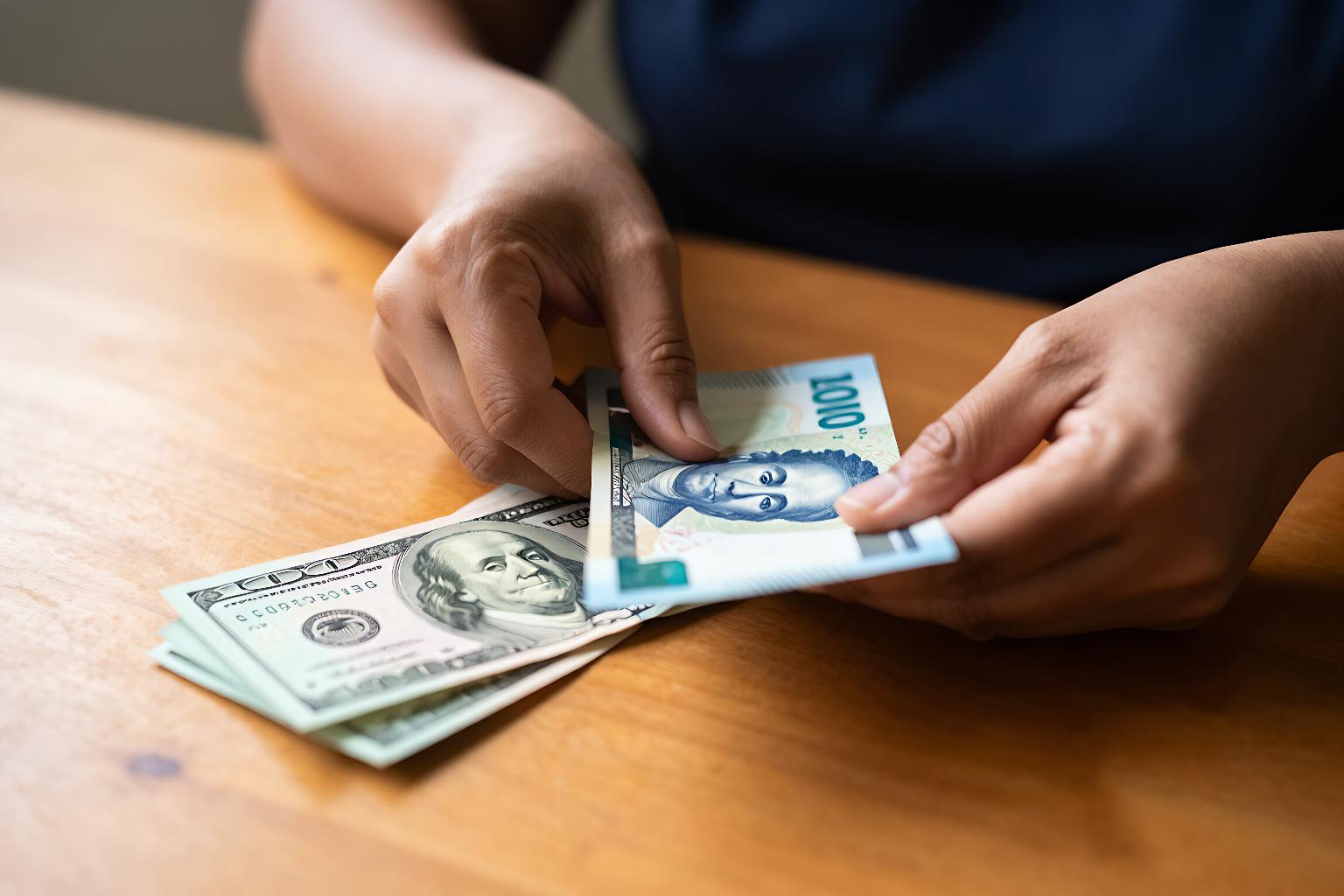
Punch ₱10,000 into a Philippines currency to USD converter and you'll see something like $172.41. That figure is accurate, and it is almost certainly not what you'll end up with. By the time the money clears into a US account, the spread, the sending fee and the receiving fee have all taken a bite, and the gap between the screen and your statement usually runs $8 to $15 on a transfer that size.
None of that means the converter is lying. It means you need to know which number you're looking at, and what happens to it between the quote and the cash.
The number at the top of most converters is the mid-market rate, sometimes called the interbank or spot rate. It's built from the point where global buyers and sellers of pesos agree to trade, and it's the rate you'll see quoted by Reuters or published as the Bangko Sentral ng Pilipinas reference rate each banking day.
Nobody sells pesos to you at the mid-market rate. It's a wholesale price, available to institutions moving millions. What you get is the mid-market rate plus a margin, and that margin is where the real cost of converting hides.
So the converter's job is narrow: it answers "if I converted right now, at the true global price, with no one taking a cut, what would this be worth?" Treat it as a benchmark, not a promise.
One US dollar buys roughly 58 pesos. That's easy to hold in your head. Run it the other way and one peso is worth about $0.0172, which is a much less friendly number to work with.
This is where small conversions go wrong. If you're moving ₱500, the difference between $8.62 and $8.55 looks like nothing. Multiply it across a year of monthly remittances or a property purchase and the odd seven cents becomes real money. Our guide to the 1 USD to PHP calculator walks through why the single-dollar view distorts the picture.
There's a second trap: rounding. Many converters display pesos per dollar to two decimals and dollars to four. Because the peso is the weaker side of the pair, errors compound faster when you convert to USD than when you convert from it. Working in larger units avoids most of it.
If you want to understand how to read the quoted figure properly rather than just accepting it, there's a useful breakdown in this piece on the Philippine peso to US dollar converter.
Every peso-to-dollar conversion passes through at least one business that needs to make money. Here's what gets shaved off along the way:
Our walkthrough of converting PHP to USD, the rate, the fees and what you walk away with goes deeper into each line item.
Say you need to move ₱50,000 to a US account. Mid-market sits at 58.00, so the converter shows $862.07.
A traditional bank might buy your pesos at 59.20, which produces $844.59. Add a $25 wire fee and a $12 receiving charge and you're holding $807.59. That's $54.48 gone, about 6.3% of the transfer, and none of it appeared on the converter screen.
An online service using the mid-market rate with a 0.5% fee would charge roughly $4.31 and deliver about $857.76, assuming no receiving fee. Same pesos, same day, $50 more in your pocket.
The lesson isn't that banks are villains. It's that the quote you see and the money you receive are two different measurements, and only one of them matters.
The right option depends on how much you're converting and whether you need cash or a bank deposit.
For large transfers going to a US bank account, a digital provider that quotes the mid-market rate and charges a transparent percentage is usually the cheapest path. For smaller amounts, money changers in Makati or Cebu can be competitive, but you'll be handling cash and the rates vary shop to shop. Philippine banks work fine if you value a counter you can walk into and complain to. There's more practical detail in this guide to converting USD to PHP without quietly losing money on the rate, which applies in both directions.
Whatever route you pick, ask two questions before you commit: what rate am I getting, and what total fee will be deducted? A provider that answers both clearly is usually the one worth using.
For a one-off transfer of a few hundred dollars, not much. The peso moves maybe 1% in a month in calm conditions, which is smaller than the fee difference between a bad provider and a good one. Getting the provider right beats getting the day right almost every time.
For larger sums, the peso's behaviour is worth watching. It has traded on either side of ₱56 to ₱59 against the dollar in recent cycles, and a swing from one end to the other changes a ₱1,000,000 conversion by around $900. If you have flexibility on timing, spreading the conversion across two or three transfers smooths out the worst of it. This explainer on the USD to PHP rate today covers how to read daily movements without overreacting to them.
Converting at the airport. Convenience counters routinely post spreads of 5% to 8%. Convert a small amount for immediate needs and do the rest elsewhere.
Accepting the ATM's conversion offer. When a Philippine ATM asks whether to charge you in pesos or in your home currency, always choose pesos. The machine's own conversion rate is a poor one, and the fee is invisible until you check your statement.
Ignoring the receiving side. People compare sending fees and forget that the US bank may take $15 on arrival. Check both ends before you assume one provider is cheaper.
Using cash for very large amounts. Walking into a money changer with ₱500,000 means accepting whatever rate is on the board. Digital transfers let you compare three or four quotes in the time it takes to boil water.
A decent converter does four things. It states the timestamp of its rate, so you know whether you're looking at a live quote or yesterday's close. It lets you flip the direction without reshaping the maths. It shows the source of its data. And it resists the temptation to bury a commission inside the rate.
If a site's rate sits two or three pesos away from the BSP reference rate published that morning, that gap is the fee, whether or not it's labelled as one. Compare the site's number against the BSP figure and the mid-market quote from a major financial data provider. Anything within about 0.3% is a genuine market rate. Anything wider is a product with a price attached.
Spend two minutes on that check before your next transfer. It's the cheapest two minutes in the whole process, and it's the difference between trusting a number and knowing what it means.
Slot ID: blog-post-bottom