
Loading article...
Slot ID: blog-post-top
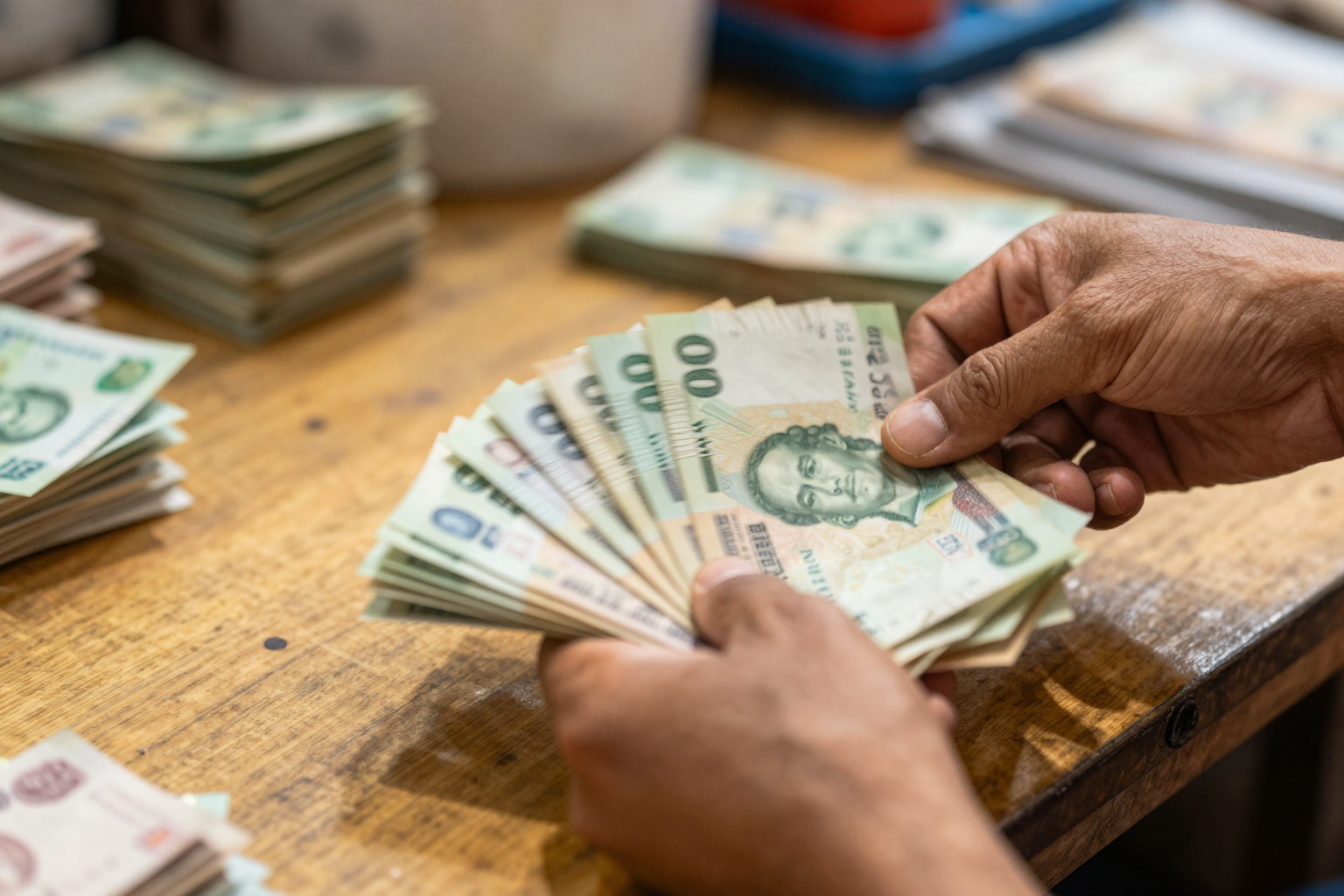
A converter tells you ₱10,000 is worth about $177. Your bank hands you $168. Nothing broke, and nobody cheated you. The gap between those two figures is the entire story of currency conversion, and it's worth understanding before you send money abroad, price a freelance invoice in dollars, or budget two weeks in Manila.
Every converter runs the same tiny calculation. It takes the exchange rate, quoted as pesos per dollar, and divides.
At a rate of 56.40, ₱25,000 ÷ 56.40 = $443.26. That's the whole trick. The rate itself comes from interbank trading, where pesos and dollars move in enormous volumes around the clock, and it drifts constantly. On a quiet Tuesday it might barely budge. In a week when the Bangko Sentral ng Pilipinas surprises the market, it can swing a peso or more across a handful of sessions.
The formula never changes. The rate plugged into it changes all the time, and that's where the money is won or lost.
This is the midpoint between what buyers and sellers are asking worldwide. It's the number on Reuters, XE, and most converter sites. Think of it as the honest baseline, not a promise. No consumer product hands it to you exactly, but it's the yardstick you measure everything else against.
Banks and money changers quote two prices. A money changer buying your dollars pays below mid-market. Selling you dollars costs above it. That spread is the margin and it's how the business survives. At a mall kiosk in Cebu the spread might be 2%. At an airport counter at 6am it can hit 7%.
Now add fees. A $5 flat fee on a $200 transfer is 2.5% before you even look at the exchange rate. The same $5 on a $2,000 transfer is 0.25%. Small conversions get eaten alive; large ones barely notice. This single fact explains most of the frustration people feel with converters.
Take ₱56,400, which is roughly $1,000 at a mid-market rate of 56.40. Here's what each route tends to leave in your hand.
That's a spread of maybe $60 on a single $1,000 conversion, purely from choosing one counter over another. On a monthly remittance, that's a decent chunk of a year's savings.
A converter publishes mid-market because that's the clean, defensible number. Your provider then applies a spread, adds a fee, and possibly rounds the result in their favour. Three small adjustments, each invisible on the quote page.
The pattern repeats across every currency pair. The gap between the screen and the receipt in a Pakistan currency to USD converter comes from exactly the same three ingredients, which is why the lesson travels well beyond the peso. If you want the long version of that story, there's a detailed breakdown of why the number on your screen isn't what you'll get once fees and spreads land.
Plenty of people use the converter in reverse, and the arithmetic flips. To convert dollars to pesos you multiply instead of divide. At 56.40, $500 becomes ₱28,200.
This is the direction that matters most for the roughly two million Filipinos working overseas. A $300 monthly remittance lands as roughly ₱16,900 at mid-market. At a 1.5% margin it lands as ₱16,650. Over a year that difference is close to ₱3,000, which is a month of groceries for a family in the provinces. If you want the mechanics laid out with worked numbers, this US dollar to Philippine peso converter explained with real numbers walks through it step by step.
One practical note: family members receiving money often quote the rate they saw on Facebook that morning, which was mid-market. Setting expectations before the transfer avoids a lot of unnecessary phone calls.
Convert ₱20,000 and the fees are noise. Convert ₱600,000 and the spread becomes the dominant cost, worth shopping around for. Anything above roughly $5,000 is worth a phone call to your bank's FX desk, because published retail rates are not always the best rate available.
At the bottom end, fixed fees dominate. Sending ₱10,000 through a service with a $4 fee and a 2% margin means paying about 6% all in. That's why small, frequent transfers are usually a bad idea and one larger transfer a month is better, assuming the recipient can budget that way. There's a useful reality check in what 10,000 pesos really gets you after the deductions are applied.
You won't always have a browser open. These shortcuts get you within a few percent:
Prices in Philippine shops are often written in round numbers, so memorising a handful of anchors makes mental math nearly instant.
Check the mid-market rate first and write it down. Then ask each provider a single question: how many dollars will arrive? Comparing received amounts rather than advertised fees cuts through every marketing claim, because the all-in number already contains the spread, the commission, and the rounding.
Watch the calendar too. Currency markets close on weekends, so a transfer initiated on a Friday evening often gets converted at a rate locked hours earlier, with a wider margin attached. Mid-week, mid-morning in Manila tends to be the most liquid window, and liquidity is what keeps spreads tight.
Finally, keep records. Freelancers invoicing US clients and overseas workers sending money home both benefit from a dated note of the rate used, whether for tax filing or simply for spotting the moment a provider quietly widened its margin. The converter is a tool, not an answer. Treat it as your reference point, then judge every offer by what actually arrives in the account.
Slot ID: blog-post-bottom