
Loading article...
Slot ID: blog-post-top
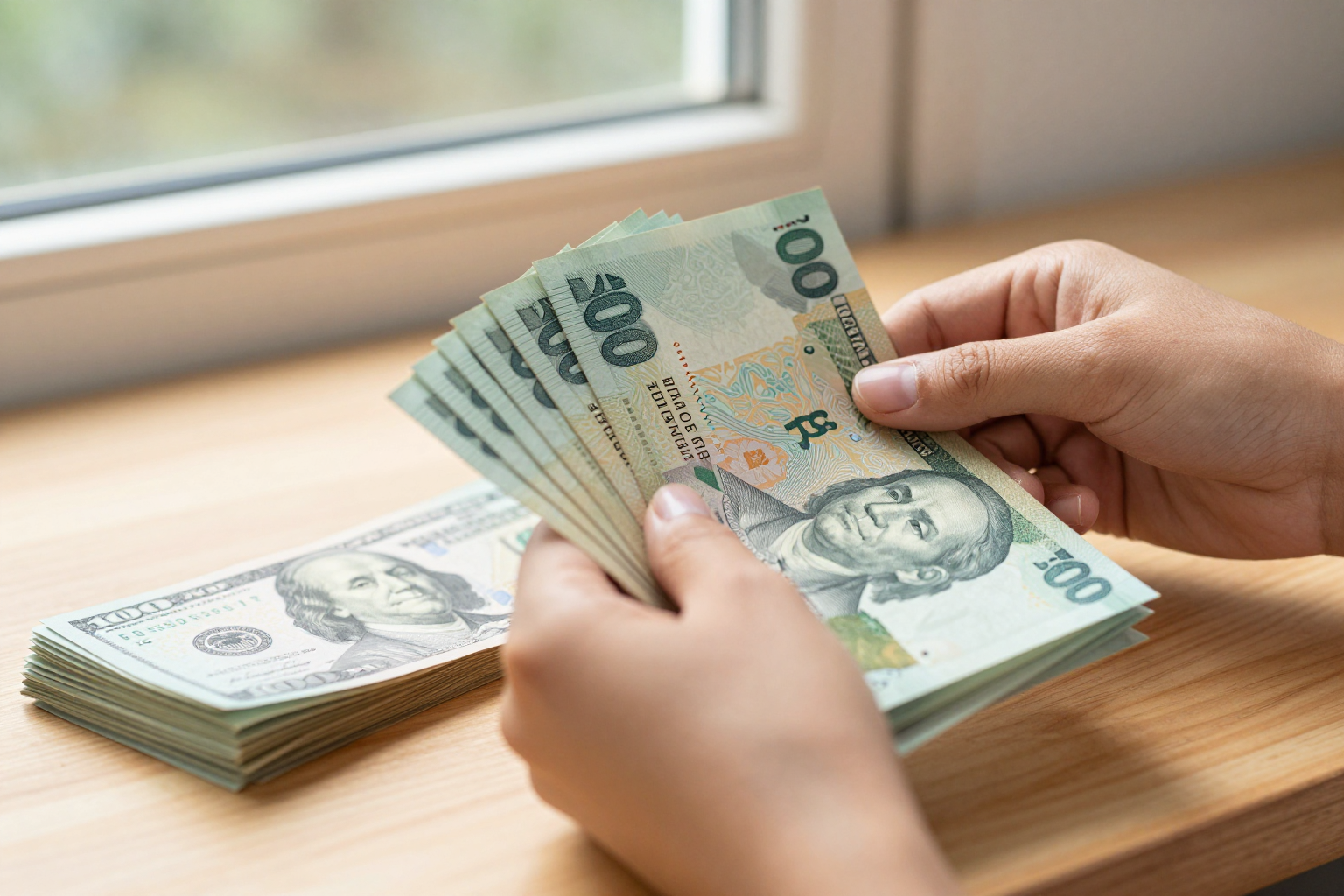
Ten thousand pesos sounds like a decent sum until you push it through a PHP to USD currency converter and see $172 sitting on the screen. That gap between the peso figure in your head and the dollar figure in front of you is where most people start asking questions, and where most converters quietly stop being helpful.
Here is what the tool is actually calculating, where the real-world number drifts away from it, and how to check a quote before you hand over any money.
Every PHP to USD conversion is a division. You take the peso amount and divide it by the current USD/PHP rate. At a rate of 58.00, that works out as 10,000 ÷ 58.00 = $172.41. Flip it around and a single peso is worth roughly $0.0172, which is why the PHP/USD figure looks so tiny next to the other one.
This trips people up constantly. Someone sees "1 PHP = 0.017 USD" and assumes the converter has glitched. It hasn't. Both quotes describe the same price from opposite ends of the same trade.
Most free converters pull a mid-market rate from a data feed that refreshes every few minutes, or a daily reference rate published by a central bank. Neither is a rate you can actually trade at. They are a midpoint between what buyers and sellers are asking, useful as a benchmark and nothing more.
The mid-market rate is the Google number. The rate on your bank's confirmation screen or the money changer's board is typically 1% to 3% worse. That difference is the spread, and it is how the provider earns money on the transaction.
A bank holds peso inventory, hedges currency risk, and pays people to process your transfer. A remittance app funds identity checks and compliance staff. The kiosk at the airport has rent to cover, which is precisely why airport rates are consistently the worst on offer. Spreads are not a scam, but they vary enormously between providers and nobody prints them in large type. The same mechanics show up in Pakistan currency to USD conversions, where the advertised rate and the settled rate also part ways.
Suppose you want 10,000 PHP to land in a US bank account. Three quotes come back the same morning:
Look closely at that middle line. The bank's exchange rate is only about 2% worse than mid-market, which sounds survivable. The flat fee turns it into a 16% hit on a transfer this size. On a $5,000 transfer the same $25 fee barely registers, which is why flat fees punish small conversions far harder than bad rates do. The effect is even starker at the bottom end, as a 1 USD to PKR calculator makes clear when a single dollar meets a fixed fee.
Converting pesos to dollars is not the mirror image of converting dollars to pesos, even at the identical rate. When you sell pesos, whoever buys them sets the price, and their margin gets baked into a rate you never see itemised. Fees also differ by direction: outbound wires, receiving-bank charges, and intermediary bank cuts all behave differently depending on which way the money moves.
If you have ever studied a US dollar to Philippine peso converter walked through with real numbers, you may have noticed the reverse rates do not reconcile neatly with the spread you were quoted going the other way. That is not a rounding error. Each leg of the trade is priced separately.
The Philippines received more than $34 billion in cash remittances in 2024, and a large share of that money starts as pesos earned by families or freelance clients. If you are moving money regularly, the cheapest route depends on the amount and rhythm, not on which app has the nicest design.
Flat fees dominate. Moving $50 a week through a wire is close to self-harm. Services that charge a percentage with a low floor win here, even if their quoted rate is slightly worse.
The rate is everything. A 1.5% spread on $20,000 is $300, which makes a $25 wire fee irrelevant. Shop two or three providers and ask outright what rate will be applied at settlement, not at quote.
Speed costs money. Instant transfers carry wider spreads than same-day or next-day options, and you are paying for liquidity, not for service quality.
A few charges hide in plain sight and rarely get disclosed upfront:
None of these are secrets, but they are spread across a rate table, a terms page, and a confirmation email. The only number worth comparing is the final dollar amount that arrives in the account.
You do not need a spreadsheet. You need four steps, in order.
First, look up the current mid-market rate from a neutral source. Second, divide your peso amount by it to get your benchmark in dollars. Third, subtract every fee the provider has mentioned, including the receiving charge. Fourth, compare the resulting figure against a second provider's figure for the identical peso amount.
If a quote lands within about 1% of the benchmark and the transfer is not urgent, that is a fair price. If it lands 4% or more below, you are paying for something, whether it is speed, convenience, or simply brand recognition. Ask which rate applies at settlement and whether the conversion happens in pesos or dollars, because those two answers alone can move the final number by a few percent. The difference between the displayed rate and the settled rate is almost always explainable once you know where to look, and it is rarely in your favour by accident.
Run the division yourself. Compare the delivered dollars. Everything else on the page is decoration.
Slot ID: blog-post-bottom