
Loading article...
Slot ID: blog-post-top
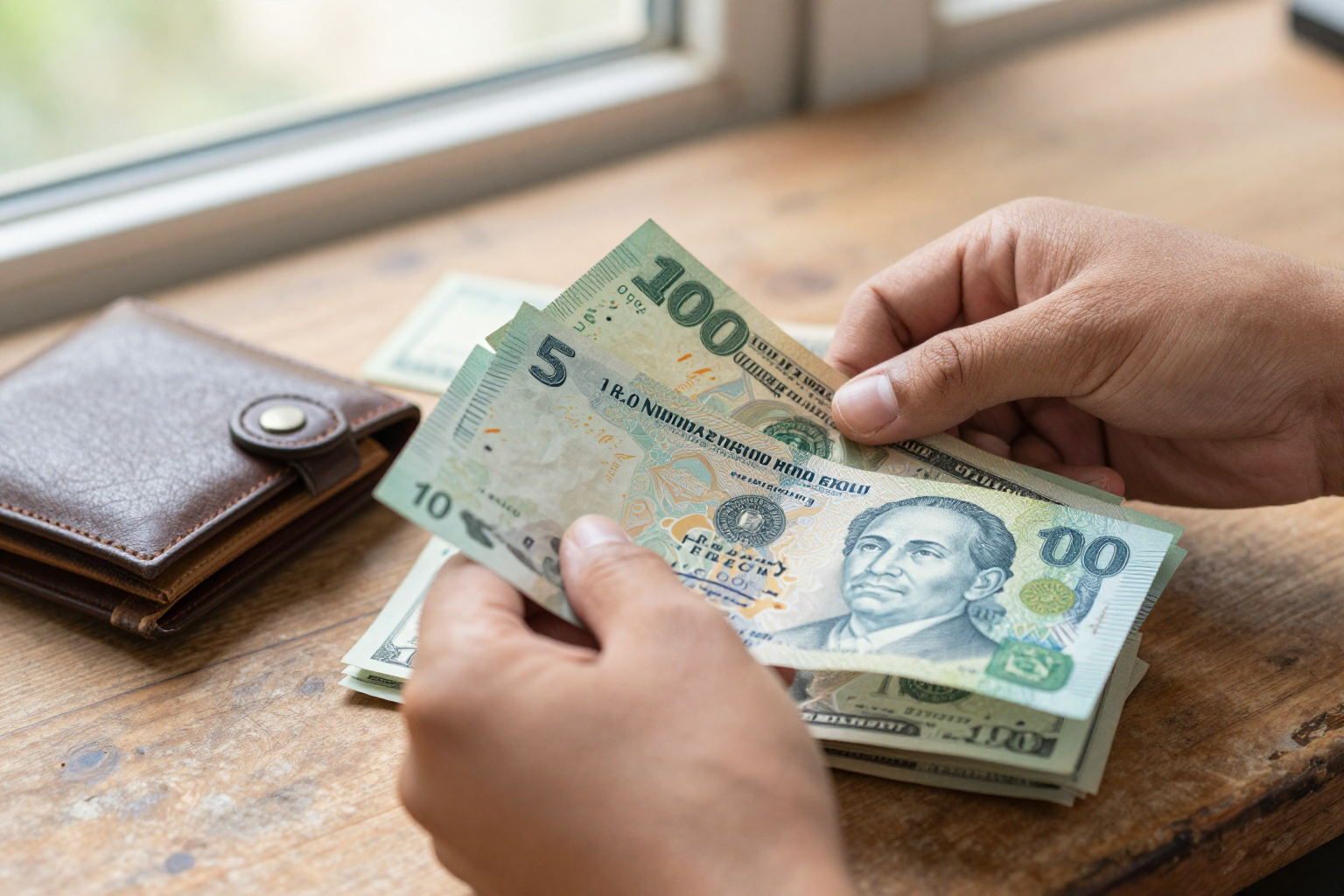
Type "1 usd to php calculator" into a search bar and you get an answer almost instantly. Something like 58.20. It looks finished, settled, like a fact. It isn't. That number is a starting point, and what happens between seeing it and holding peso notes in your hand is where most of the money gets decided.
Here's the useful way to think about it: one dollar is a scale factor, not a transaction. Nobody wires a single dollar to Manila. The reason people search for the one-dollar rate is that it's the clearest way to see the price of the peso, and once you understand that price, you can multiply it by any amount you're actually sending.
When a converter tells you 1 USD = 58.20 PHP, it's quoting the mid-market rate. That's the midpoint between what buyers and sellers of pesos are willing to accept in the global currency market at that moment. Big banks trade with each other close to this number. Retail customers, meaning you and me, almost never do.
Two things follow from that. First, the rate moves constantly, sometimes several times an hour during Asian trading sessions. The number you saw at 9am may be stale by lunch. Second, the mid-market figure is best treated as a reference point, a benchmark to measure your actual offer against, rather than a promise.
A quick gut check: if you're quoted 58.20 on a converter and your bank offers you 57.40, the gap isn't an error. It's the cost of the service, baked into the exchange rate instead of listed as a fee.
One dollar is easy math. Two hundred and fifty dollars is where people start to lose track.
Say you're sending $250 and the mid-market rate is 58.20. Straight multiplication gives you 14,550 pesos. Now apply a typical 1.5% markup from a provider: your effective rate becomes about 57.33, and you receive 14,332.50 pesos. The difference is 217.50 pesos. In Cebu or Davao, that's a couple of solid meals, or a week of jeepney fares, gone quietly without ever appearing as a line item on a receipt.
Scale that to $1,000 and the same 1.5% spread costs you roughly 870 pesos. At $3,000, it's over 2,600. The percentage stays constant; the peso amount stings more. That's why the one-dollar rate matters, it's the multiplier for every decision you make after it.
The gap between the quoted rate and your payout comes from three places, and they tend to hide in different corners of the transaction.
Providers buy pesos at wholesale and sell them to you at retail. The difference is the spread. On major currency pairs it's usually somewhere between 0.4% and 3% depending on who you're dealing with. Neobanks and specialist transfer services sit at the low end. Airport kiosks and hotel desks sit at the high end, sometimes higher than you'd believe.
Some services advertise "zero commission" and charge you through a weaker rate instead. Others charge an upfront fee and give you a near-market rate. These two models can land in very different places once you're sending real money, which is exactly the comparison why the number on your screen isn't what you'll actually get walks through in detail. The only honest comparison is the final peso amount in the recipient's account.
Philippine banks and e-wallets sometimes deduct their own handling charge before crediting. GCash, Maya, and the big commercial banks each handle inbound remittances a little differently. If your recipient gets 300 pesos less than your calculator predicted, this is usually the reason.
For a fuller breakdown of how the arithmetic plays out from the other direction, what 10,000 pesos really gets you is a useful mirror image, especially if you're converting back.
Open a converter, note the mid-market rate, then divide your quoted rate by it. If the result is 0.99 or above, you're getting a genuinely good deal. Between 0.985 and 0.99 is normal and fair. Below 0.97, start looking around.
Run that check on a $500 transfer at a 58.20 mid-market rate. A provider offering 57.90 scores 0.995, which is excellent. One offering 56.45 scores 0.97, meaning you're paying about 875 pesos for the privilege. Same headline "no fees," very different outcome. The USD to Philippine peso converter explained with real numbers takes this comparison further with worked examples.
The calculator itself is never wrong. The assumptions around it often are.
If you want the full picture on where costs accumulate on the outgoing side, converting USD to PHP without quietly losing money on the rate covers the practical mechanics from initiation to payout.
For budgeting, don't use the mid-market number and don't use the worst-case kiosk number. Use mid-market minus about 1.5%, then round down to a clean figure. If the converter shows 58.20, budget at 57 pesos to the dollar. That gives you a small cushion for rate drift and modest fees without inflating your assumptions so far that your plan becomes useless.
Then apply the same discipline to the timing. If you're paying tuition, a rental deposit, or a contractor in the Philippines, convert a little earlier than you think you need to, in one larger transfer rather than three smaller ones, and check the final credited amount against your calculator prediction every single time. Do that three or four times and you'll develop a reliable feel for what a fair deal looks like in your own circumstances, which is worth far more than any single rate quote.
The one-dollar figure on that calculator is a lens, not an answer. Use it to see the price of the peso clearly, then make every decision based on the pesos that actually arrive.
Slot ID: blog-post-bottom