
Loading article...
Slot ID: blog-post-top
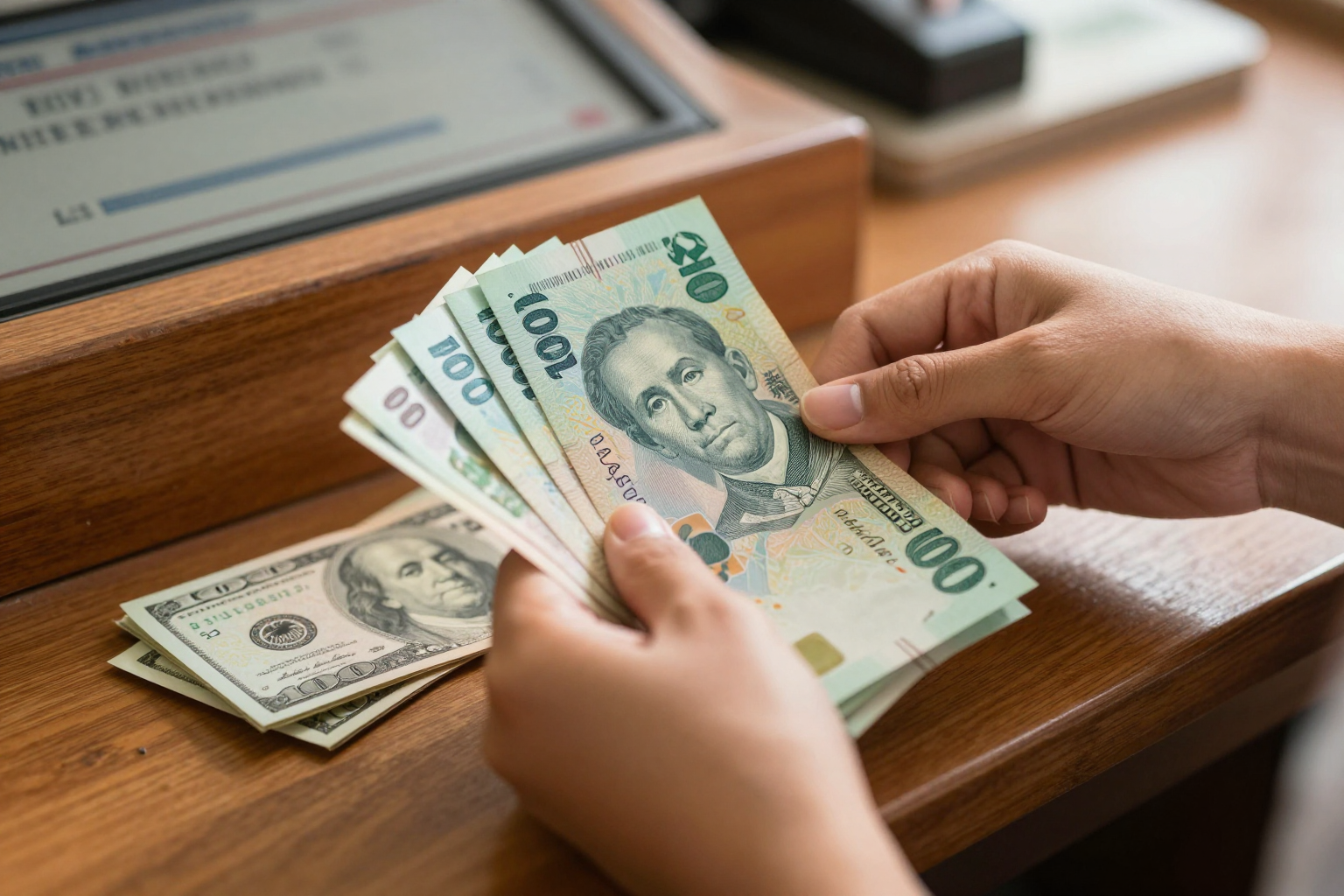
You land in Manila with $800 in cash and a hotel that wants a deposit. You open a converter, see 57.90, do the arithmetic, and expect roughly ₱46,300. The counter at the airport hands you ₱44,700. Nobody cheated you. You just met the spread, and it cost you about ₱1,600 before you'd cleared the terminal.
Learning to convert USD to PHP properly comes down to separating three numbers people constantly blur together: the mid-market rate on your screen, the rate a bank or money changer quotes you, and the amount that actually ends up in your hand. Once you can tell them apart, the whole exercise becomes boring and predictable, which is exactly what you want from a currency conversion.
The figure on Google or XE is the midpoint between what banks pay each other for dollars and what they charge. It's a real number, updated constantly from interbank trading, and almost no retail customer ever gets it. If the mid-market rate sits at 57.90, a typical Philippine bank might buy your dollars at 57.10 and sell them back out at 58.60.
That gap is how the institution earns on the transaction. It isn't a scam and it isn't avoidable. It is, however, something you can shop around, because the spread varies wildly from one counter to the next.
Walk past a money changer in Makati and you'll see two columns. One is the rate at which they buy your US dollars, the other is the rate at which they sell dollars to somebody else. When you're converting USD to PHP, only the buy column matters, and it is always the lower of the two. A board showing "USD Buy 57.15 / Sell 58.35" means your $100 becomes ₱5,715, not ₱5,835.
Say you want to convert $1,000. Counter A offers 57.15 with no commission. Counter B offers 57.60 but adds a flat ₱500 fee. Counter A hands you ₱57,150. Counter B hands you ₱57,600 minus ₱500, which is ₱57,100. The better headline rate is worse by ₱50. That's the classic trap, and it's covered in more depth in why the number on a USD to PHP converter isn't what you'll get.
The arithmetic itself is simple: dollars multiplied by the rate equals pesos. What isn't simple is that each peso of difference in the rate is worth real money at scale. On $1,000, a rate of 57.15 versus 58.15 is a ₱1,000 gap. On $10,000 it's ₱10,000, which is roughly two weeks of groceries in Metro Manila. If you want a slower, numbers-first walkthrough of the US dollar to Philippine peso converter, explained with real figures, it's worth twenty minutes before a large transfer.
Options range from excellent to actively bad, and the difference between the best and worst is often 4% of your money.
Withdraw ₱10,000 on a foreign card and you might pay ₱250 to the Philippine bank plus a 3% foreign transaction fee to yours. That's roughly ₱250 plus ₱170, so about ₱420, or 4.2% of the withdrawal. Take ₱20,000 instead and the fixed ₱250 gets spread thinner, dragging the effective cost down to around 3.2%. Always withdraw the largest amount the machine allows.
Then decline the offer to convert on your behalf. That screen, sometimes labelled dynamic currency conversion, applies a rate set by the machine's operator rather than your bank, and it's routinely 3% to 5% worse. Choose to be charged in pesos and let your own bank handle the conversion.
Plenty of people need the reverse, whether they're Filipino workers abroad or travelers leaving with leftover pesos in their wallet. The mechanics flip: the institution's sell rate becomes your buy rate and you lose the spread a second time. If you want a gut check on what a peso balance is really worth once that spread bites, what 10,000 pesos really gets you is a far more useful exercise than staring at a single rate.
Mostly no, and only at the margins. The USD/PHP pair moves on remittance flows, Bangko Sentral ng Pilipinas policy decisions, oil prices and broad dollar strength. It can swing 1% to 2% in a week and 5% across a year. If you're converting $500 for a holiday, a 1% swing is about ₱290. Worth a glance at the rate, not worth rearranging your trip.
Scale changes the calculus. Sending $10,000 for a property purchase at 57.20 instead of 58.00 costs ₱8,000, which is real money. Watching for a rate in the upper half of its recent range over a few weeks is a sensible habit, and reading the rate properly so you keep more of your money explains how to set that range rather than guessing at it.
Convert once, in a large batch, at a money changer you've compared against two others. Pay with a card that charges no foreign transaction fee whenever the merchant accepts cards, and take cash out in the biggest permitted chunks. Keep a small float of pesos for the first day so you never have to accept an airport rate out of exhaustion.
None of this requires forecasting the peso or checking charts at midnight. It requires knowing that the number on your screen is a reference point, that the counter's buy column is the one you're paying, and that flat fees hurt small conversions far more than big ones. Do that and a $1,000 conversion stops being a small leap of faith and becomes a transaction you can predict to within a few hundred pesos.
Slot ID: blog-post-bottom