
Loading article...
Slot ID: blog-post-top
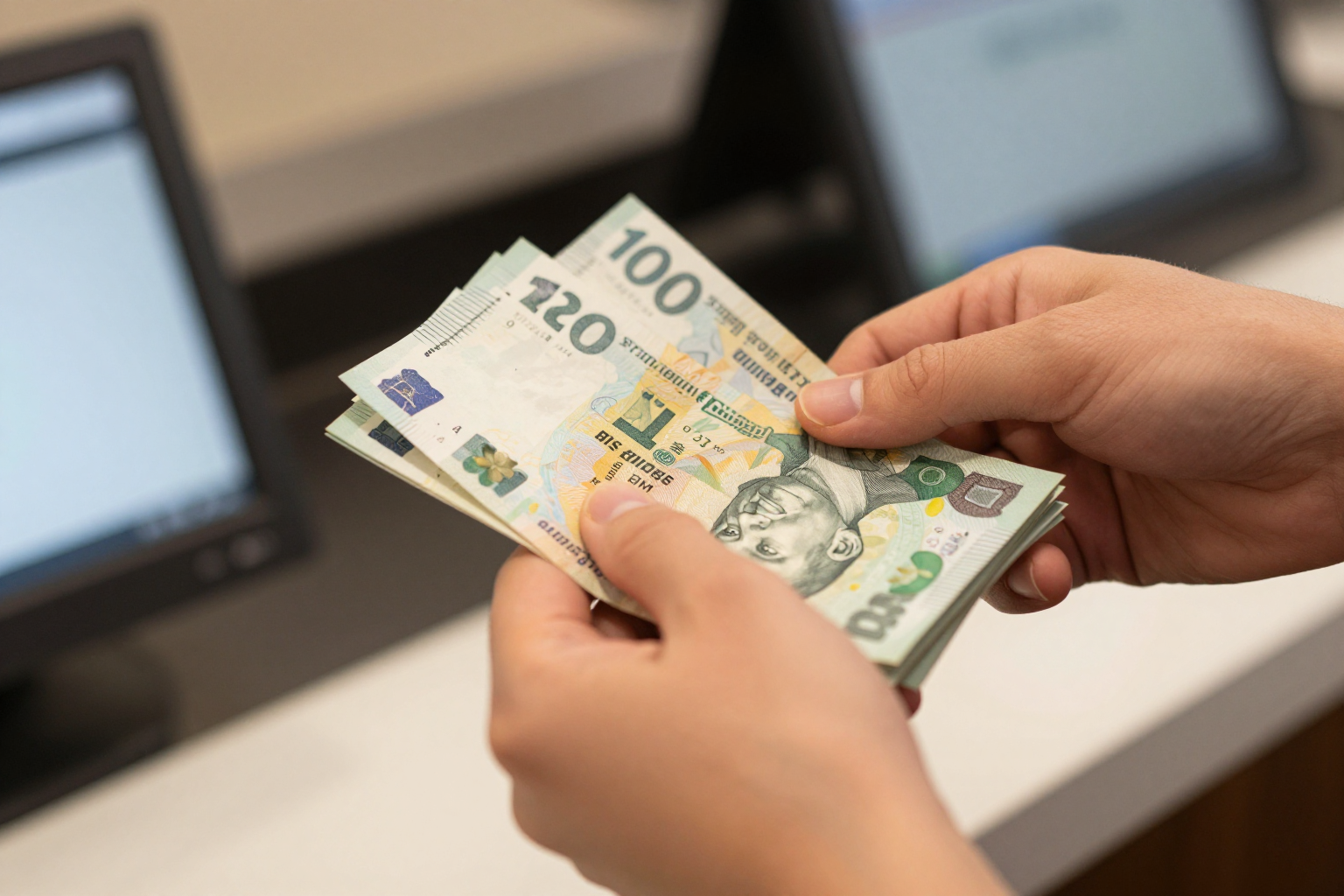
Money exchange is one of those things everyone does but few think about until the numbers stare back at them. You hand over a stack of home currency, the clerk pushes some foreign notes across the counter, and only later do you realise how much value quietly disappeared. The reason is that money exchange is not a single product. It's a set of alternatives, each with its own trade-offs between cost, convenience and safety.
Below is a practical comparison of the main ways to exchange money: bank counters, dedicated exchange kiosks, ATMs at your destination, prepaid travel cards and online services. The goal is to help you see which trade-offs make sense for your specific trip.
When you compare exchange options, the first thing you'll see is the rate. But the rate on the board is never the real rate. Every provider adds a margin on top of the interbank rate, which is the wholesale rate banks use to trade with each other. That margin is how most money exchange operations make money, and it varies widely.
Say you want to exchange $500 into euros. The mid-market rate is 0.92 euros per dollar, so your $500 should buy you €460. A bank might offer you 0.90, which gives you €450. An airport kiosk might show 0.87, handing you just €435. That difference of €25 is not a fee you see on a receipt. It's baked into the rate.
Airport kiosks are often the worst offenders because they know you're a captive audience. If you've ever exchanged money in a hurry at the departure gate, you've paid for that convenience in the exchange rate itself.
Some providers advertise "zero commission" but then hide their profit in a worse rate. Others charge a fixed fee that matters far more for small amounts. Exchanging $100 with a $10 flat fee is a 10% hit. Exchanging $1,000 with the same fee is only 1%. Before you choose, always ask what the total cost is, not just the advertised spread.
Banks tend to offer better rates than airport kiosks, but they often add their own layers of fees, especially for account holders at a different bank. If you're moving a larger amount, the gap between a bank and a digital service like Wise can be significant. This real cost comparison between Wise and traditional banks breaks down the line items you'd otherwise never see.
The cheapest option in theory is not always the best option in practice. If you're landing in a country at 2 a.m. with no open exchange offices, and no local bank card that works in foreign ATMs, that great rate is useless. Convenience is a trade-off, not a luxury.
Ordering currency from your home bank in advance is safe and predictable, but you'll lose a few days to delivery and you won't always get the best rate. Some banks offer home delivery if you order above a minimum, but the shipping fee can cancel out the savings. This option makes sense when you want a small amount of cash for a taxi or a meal right after arrival, and you're willing to pay a slight premium for certainty.
ATMs in the destination country often beat exchange counters because they use network rates instead of a teller's spread. But they come with their own trade-offs: your home bank may charge a foreign transaction fee of 1% to 3%, the ATM owner may add a surcharge, and you're exposed to card skimming or a blocked card if your bank detects unusual activity.
Still, for many travelers, the ATM is the sweet spot between cost and flexibility. The fees stack differently depending on the ATM network and your bank, and this breakdown of banks, ATMs, cards and kiosks shows exactly where the costs hide.
Handling physical cash has a risk that card payments don't. If you walk out of a kiosk with €1,000 in your pocket and lose it, that money is gone. If the kiosk gives you counterfeit notes, you often have no way to prove it once you're down the street. Cards and digital services offer some protection, but they come with their own vulnerabilities.
Prepaid travel cards, for instance, are convenient because you lock in a rate when you load them. But if the card issuer goes under or has a data breach, you could be stuck. Banks and online platforms are regulated and usually covered by fraud protection, but the terms differ. The practical guide to which local exchange option actually saves you the most also touches on the safety record of street kiosks versus regulated counters, which is worth reading before you trust a random shop.
Most savvy travelers don't pick just one method. They mix them. A common approach is to arrive with just enough local currency for your first few hours, then use a card or ATM for everything else. This limits the damage if you find yourself at a terrible rate out of necessity.
Another hybrid is to use a low-fee digital card for most purchases and withdraw cash once from a reputable ATM mid-trip. That single withdrawal covers the times when cards aren't accepted, without carrying a week's worth of money in your wallet. This approach also reduces the amount you need to exchange before you go, which can make the rate difference much less painful.
In some trips, you might not need to exchange much at all. Many places accept cards, mobile wallets and even foreign currency in tourist areas. If you're staying mostly in hotels, eating at restaurants and using ride-hailing apps, your card's exchange rate will often be better than what you'd get at a counter.
That said, cash is still king at market stalls, small cafes and anywhere a card terminal costs too much for the merchant. The critical question is how much cash you genuinely need, not how much you think you might need. When the answer is "a bit," the trade-off shifts again.
If you're sending money to yourself or someone else in another country, the rules change entirely. A wire transfer from a bank can cost $40 or more, while an app might move the same money for a fraction of that. The choices around banks, apps and cash pickup for international transfers involve not just fees but delivery speed and how the recipient gets the funds.
Imagine a one-week trip to Japan. You need about ¥50,000 in cash for the little ramen shops, temple entry fees and vending machines. The mid-market rate is 150 yen per dollar, so ¥50,000 costs about $333 if you exchange at the exactly fair rate.
Option one: your local bank's currency counter. They offer 144 yen per dollar, no commission. You get ¥48,000 for $333, losing $13 to the spread.
Option two: an airport kiosk at Narita. They offer 138 yen per dollar because you're in a hurry. The same $333 now yields ¥45,954. You lost more than $18 compared with the bank, and you hadn't even left the airport.
Option three: an ATM in Tokyo. Your bank charges a 2% foreign transaction fee and the local ATM charges a ¥200 fee. Assuming the ATM gives you 148 yen per dollar, you'd withdraw ¥50,000 for around $341. That's a loss of $8, but you did it at 3 p.m. without hunting for a bank branch.
Option four: a prepaid card loaded with yen at 149 yen per dollar, then cash withdrawal at a post office ATM. The card's loading online fee is 1%, but the ATM cash advance fee is higher, possibly ¥300 plus a 1.5% withdrawal fee. This quickly becomes the most expensive option if you actually take cash out, but if you only use it at stores, the rate stays good.
Now look at the totals: the bank counter is the cheapest physically exchanged cash. The airport kiosk is a compromise you'd only make for convenience. The ATM is competitive but adds fees. The prepaid card is great for card payments, poor for cash withdrawals. None of them is universally best, which is exactly the point.
If you want to see the full math worked through with a different pair of currencies, this step-by-step money exchange example with real dollar-to-euro figures walks through the same kind of decision with numbers you can check yourself.
The takeaway is not that one option always wins. It's that money exchange is a set of trade-offs. Once you know how much cash you actually need, how much you're paying in rate margin, and what the convenience is worth to you, the right choice becomes obvious. Ask the rate, look for hidden fees, and don't let a quick tap on the counter turn into a quiet loss.
Slot ID: blog-post-bottom