
Loading article...
Slot ID: blog-post-top
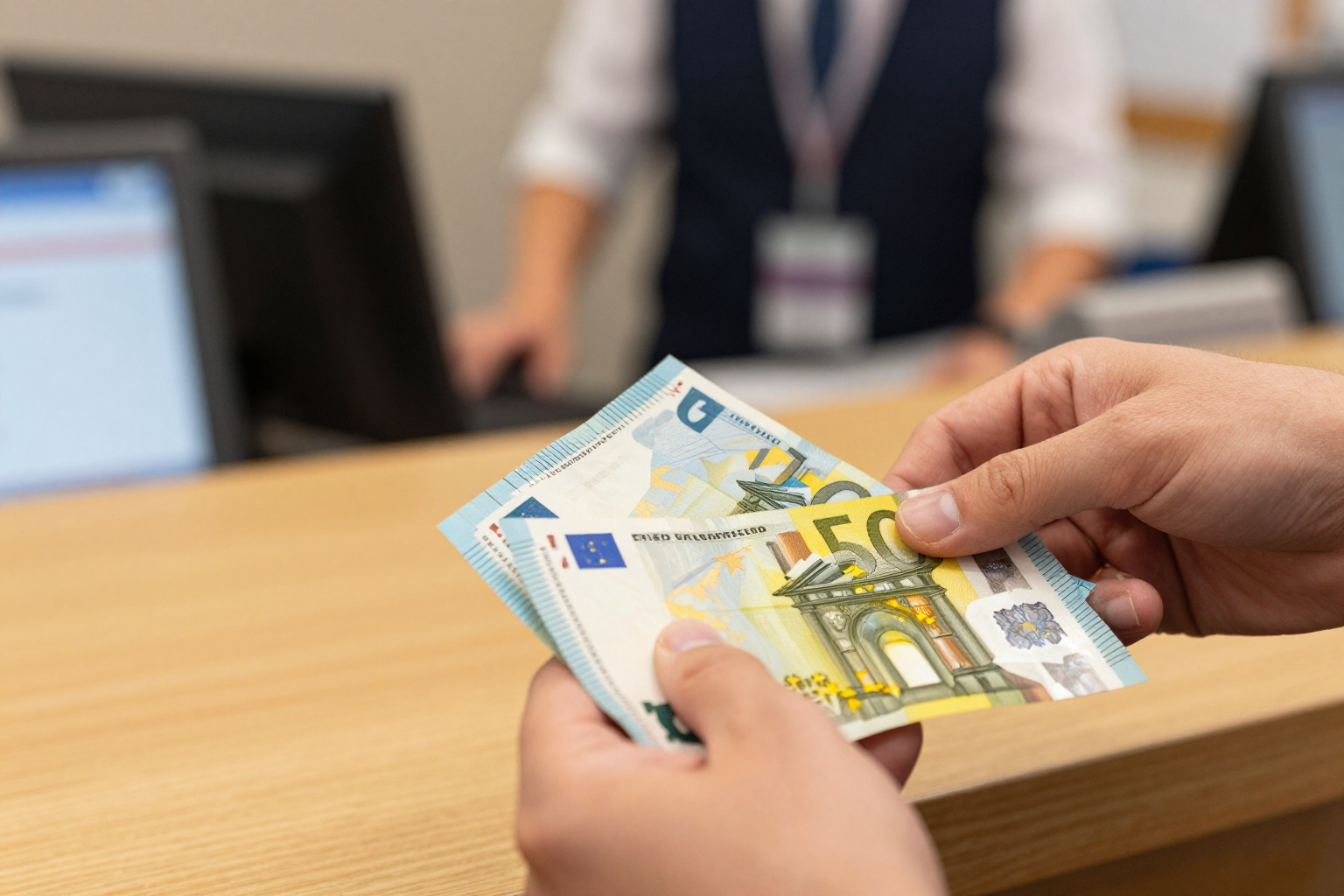
You searched "money exchange near me" on your phone, found a handful of shops with decent reviews, and now you're standing in front of a rate board that looks like it was designed by someone who doesn't want you to understand it. You're not alone. Most people walk into a currency exchange shop without a clue what a fair rate is, and they pay for it.
The good news is that you don't need to be a financial expert to get a fair deal. You just need a simple plan and a few minutes of preparation. This guide walks you through the entire process step by step — from checking the true rate at breakfast to counting your cash on the curb — with real numbers you can follow along.
Every money exchange shop builds its prices on the mid-market rate — the same rate you see when you Google "USD to EUR" or open an app like XE. This is the real wholesale rate that banks trade with each other. It changes every few seconds, so you need to know what it is right before you head out.
Let's say you want to convert $500 to euros. You look up the current mid-market rate and it reads 1 USD = 0.92 EUR. That number is your baseline. Any rate worse than that is the shop's profit.
If you're not completely comfortable with how the mid-market rate works or how to find it, this guide on how to exchange foreign currency without overpaying explains everything with clear examples. Spend five minutes there, and you'll know exactly why a rate of 0.88 is much worse than it sounds.
Don't just show up at the first shop that pops up on Google Maps. Pick up the phone and call three or four local exchange places. The conversation takes less than a minute.
Here's a script that works: "Hi, I'm looking to change $500 into euros. Can you tell me your current rate and whether you charge a fee?"
Most shops will quote you a rate like "0.88" or "0.86". Some will say "no fee" as if it's a huge deal. Write down the rate and the fee for each shop. That's your comparison list.
When you've got your list, you can decide which shop is actually worth a visit.
When you walk into a currency exchange shop, you'll usually see an electronic board with two columns: "Buy" and "Sell". But here's the trap: the buy and sell rates are from the shop's perspective, not yours.
In our example, the mid-market rate is 0.92. The shop's board might show "EUR Buy: 0.85" and "EUR Sell: 0.88". If you're buying euros, you'll get the sell rate, 0.88. That means the shop is keeping a 0.04 spread on every euro. On $500, that's €20 going into their pocket instead of yours.
If you want to see more real-world examples of how rate boards differ from shop to shop, this step-by-step walkthrough of getting the best rate at a currency exchange near you covers exactly what to look for.
Most local exchange shops are willing to negotiate, even if they don't advertise it. This is especially true on weekdays when business is slow. If the board shows 0.88, try asking, "Can you do 0.89 if I exchange $500?" You'd be surprised how often they say yes.
The key is to compare the final cost, not the rate alone. Some shops advertise a "zero commission" exchange but give you a terrible rate. Others charge a flat fee but give a better rate. The only way to compare apples to apples is to calculate how much foreign currency you'll actually get after all costs.
Here's the formula: Your US dollars × the quoted rate = what you receive. If a fee applies, subtract the fee (and make sure the fee is converted into the foreign currency if they charge it in that currency). Always ask for the total amount you'll receive, including any fees. Write it down.
Also, keep an eye on the minimum amount. Many shops have a "minimum exchange" of $100 or more, and the rate can be worse for small amounts. If you only need $50, a local shop might not be your best option.
This step is boring but crucial. Count the cash the clerk hands you, right there at the counter, before you pocket it. Match it to the receipt. Confirm that the rate shown on the receipt is the same one you agreed to — especially if you successfully negotiated a better rate. A slip of the hand can cost you real money.
It's also worth asking for the bills in undamaged condition. Some homes and businesses abroad refuse worn, torn, or heavily stamped currency. You don't want to find out after you've left the shop that your €100 note has a small tear and no one will accept it.
Local money exchange shops are convenient, but they're rarely the cheapest option for larger amounts or for transferring money internationally. If you're moving more than $1,000, or if the money is going to someone else's bank account, you should seriously consider an online service.
The foreign exchange playbook for moving money across borders without losing a fortune explains why payback rates on local transfers are so much worse than what platforms like Wise offer. On a $1,000 transfer, the difference between a local shop and an online provider can easily be $50 to $80.
Wise, for example, typically uses the mid-market rate and charges a small transparent fee. For a $500 transfer, it's often less than $10. That's a massive difference from the 6-8% spread you might pay at a shop. If you're sending money to family in another country, using a local exchange shop is almost always the wrong move. This step-by-step guide to sending money with Wise shows how to set up a transfer and exactly what you'll pay.
That said, online services take a day or two, and they don't deliver cash to your hand. When you need euros for tomorrow morning's flight, a local shop is the practical choice. The trick is to know which one to use, and that's exactly what the worked example below shows.
You need €460 for your trip tomorrow. You check the mid-market rate, which is 0.92. You call three shops and get these quotes:
Shop B is actually the best here, even with the fee, because it offers the highest rate. The spread between the best and worst offer is €15.50, which is enough for a good meal.
But compare that to an online service: Wise's rate might be 0.916 and the fee $4.20. You'd receive €456.80. That's €11.30 more than Shop B. Over a single exchange, the difference isn't enormous, but multiply it by several trips a year and it adds up.
The real takeaway: always compare the final amount, not just the headline rate or the "no fee" sign. A quick calculation with a phone calculator takes less than two minutes and can save you a surprising amount of money.
Now you know exactly how to handle your next local money exchange. Walk in with the mid-market rate in your mind, ask for the quoted rate with any fees, and don't be afraid to ask for a better deal. Your wallet will thank you.
Slot ID: blog-post-bottom