
Loading article...
Slot ID: blog-post-top
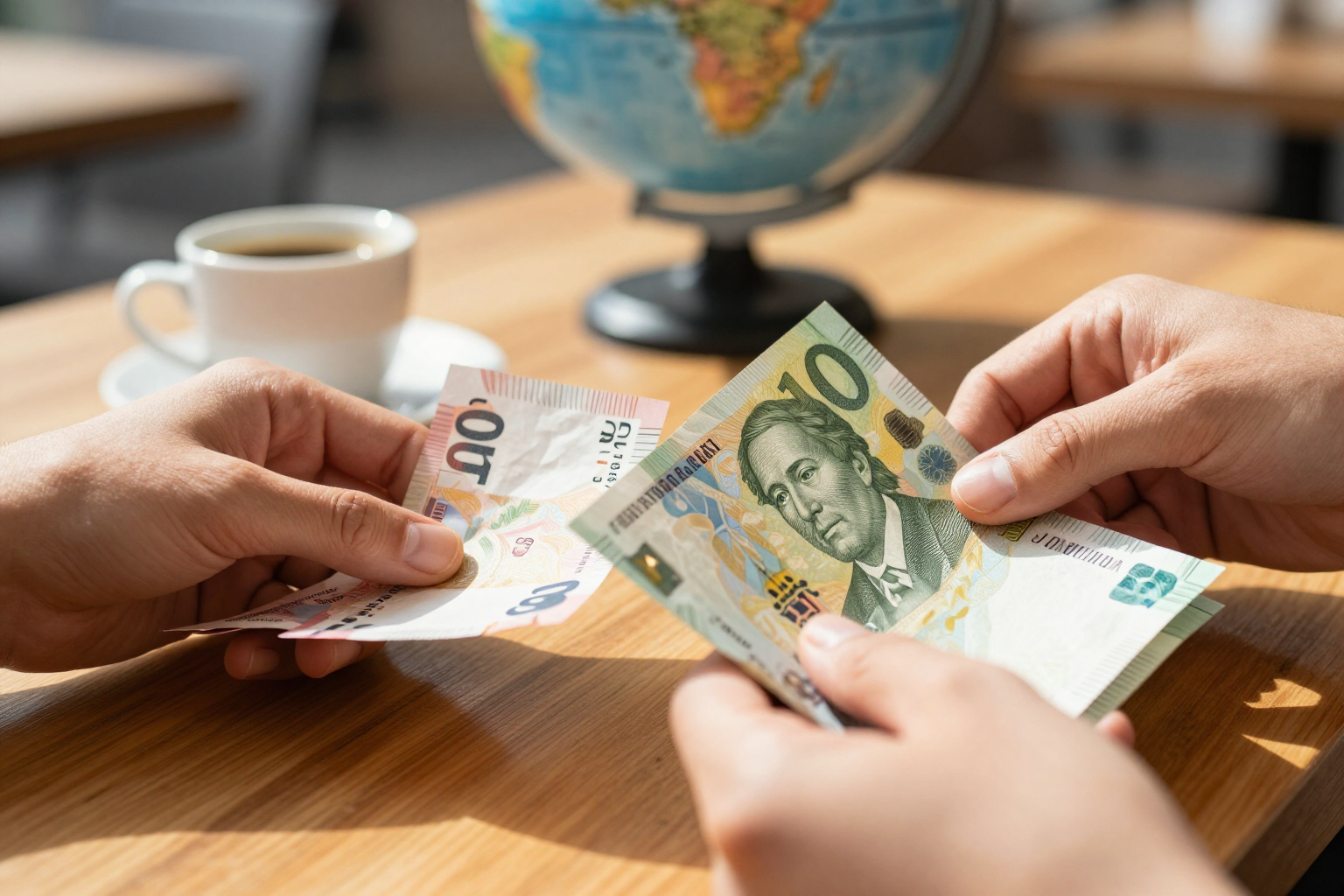
When you search for “currency exchange near me,” you’re likely looking for a quick answer. But the first result isn’t always the best deal. Exchange shops know most customers won’t shop around. The difference between a poor rate and a fair one can easily be enough to cover a proper meal on your trip. Here’s a step-by-step method to find the right place, ask the right questions, and get more local currency for your money.
Before you set foot in any exchange bureau, look up the live mid-market rate. For example, if you’re changing British pounds to euros, open any reliable converter and check the current rate. Suppose it shows 1.1689. That’s the real exchange rate between the two currencies – the one you’ll see in financial news. No retail shop will give you exactly that, but now you have a number to measure them against. If you want to understand how this rate is built and why you’re never going to get it at a cash desk, our guide to foreign exchange explained covers that in more depth.
Your search will return a mix of bank branches, independent bureaux, and perhaps the airport kiosk you’re trying to avoid. To narrow them down, look for stores that publish daily rates online or on a board outside. It’s a positive sign when a shop is comfortable showing its rates openly. Another useful approach is to compare what different types of providers charge. Our smart shopper’s guide to money exchange near me goes into the pros and cons of each option, from high-street chains to currency specialists.
Rates change by the hour, and the board outside can be out of date. Call three places on your shortlist and ask the same questions:
The way you get answered matters. If someone says, “No fee, but our rate is 1.05,” while another says, “There’s a 1.5% fee, and our rate is 1.16,” the second might still be more honest. The trick is to put both into a real calculation, which is your next step.
Let’s say you need 800 euros. Place A offers 1.14 and no commission. Place B offers 1.16 but charges 3% on the transaction. Which one actually costs you fewer pounds?
At Place A, dividing 800 by 1.14 gives you about £701.75. At Place B, dividing 800 by 1.16 gives you about £689.65 – but the 3% commission is added on top, which is 24 euros. That means you’ll only receive 776 euros if you pay £689.65. To get the full 800 euros, you’d need to spend around £710. In this scenario, the moment you add the fee, the “better” rate becomes the worse deal.
This is one of the easiest traps to miss, and it’s the centrepiece of our currency exchange playbook – a deeper look at how the spread and commissions interact at the counter.
Here’s a modern twist. That physical shop a ten-minute walk away is convenient, but it’s not the only place that can give you cash before a flight. Several online services offer far closer to the mid-market rate, and you can either collect the currency at a depot or have it delivered to your door. For small sums, the delivery fee might wipe out the benefit. For larger exchanges, the savings are often worth it.
This also applies if you’re sending money to a bank account rather than carrying bills. If you’re paying a deposit on a holiday apartment or reimbursing a friend abroad, our step-by-step guide to international money transfer is the better route, and usually more cost-effective than exchanging cash and then wiring it.
Once you’ve narrowed it down to one or two nearby places, do a small exchange first – say £50. Count the money at the counter, check the notes for condition, and see whether the rate on your receipt matches what you were quoted. If the shop gives you coins when you asked for notes, or pretends the quoted rate was “only for larger amounts,” that’s your cue to walk away.
Two friends, Chris and Sam, are both going to Lisbon and both search for “currency exchange near me” the day before their flight. Chris takes the first rate he sees at his bank’s branch: 1.08, no commission, and hands over £500. Sam checks three places and finds a small bureau in the city centre offering 1.12. Chris gets 540 euros. Sam gets 560 euros. That’s a 20-euro difference from a ten-minute search. Scale that to £2,000 for a family trip, and the gap becomes 80 euros – effectively a free dinner on the first night.
Even if the rate is perfect, the way you receive your cash matters. A handful of 50s or 100s might be fine for a hotel bill, but smaller shops, market stalls, and taxis often prefer 20s or 10s. Ask for a mix of denominations when you’re at the counter, and count the money before you leave. A reliable exchange won’t mind. In fact, a good cashier will often suggest a sensible split before you do.
Slot ID: blog-post-bottom