
Loading article...
Slot ID: blog-post-top
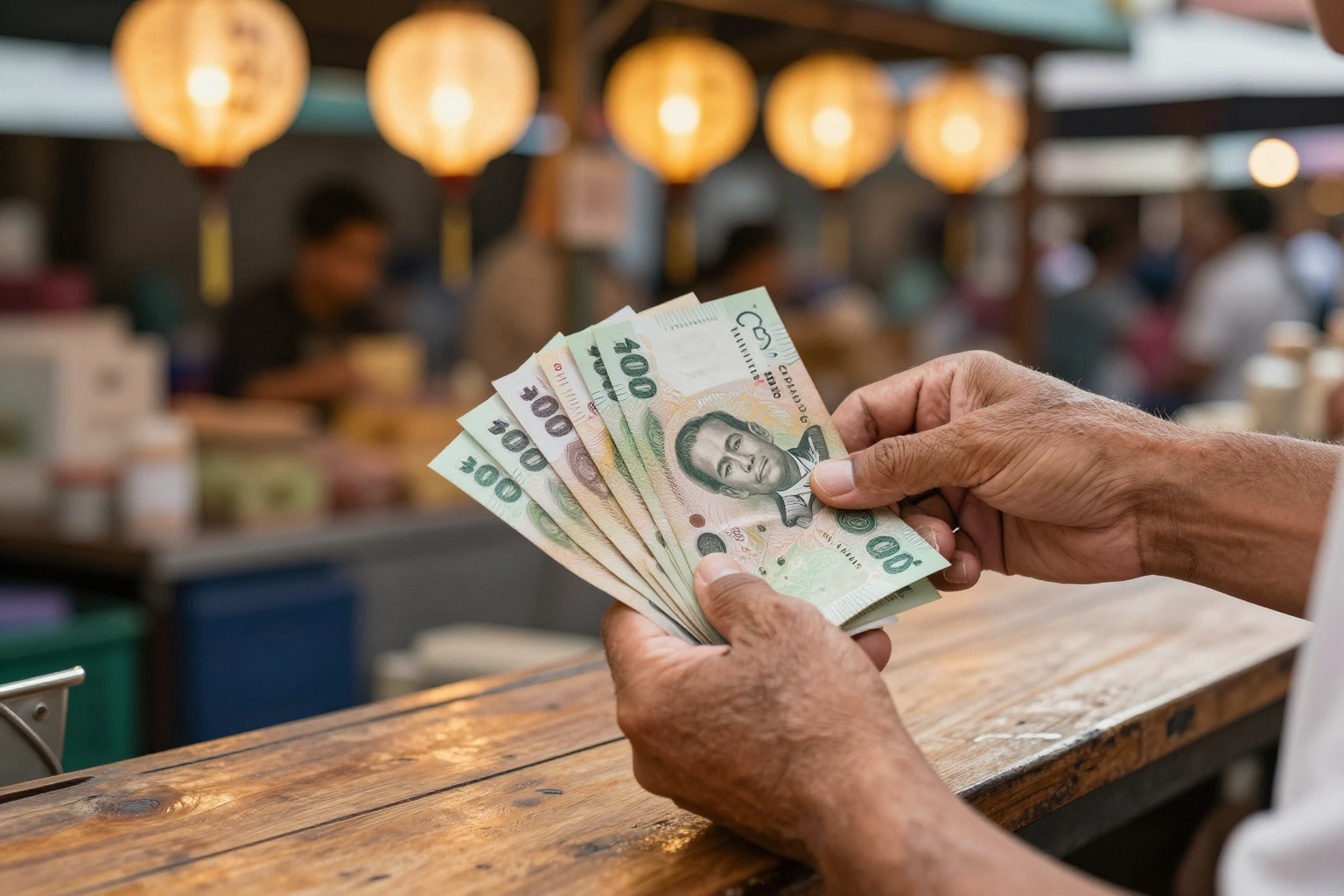
You land at Suvarnabhumi, you're jet-lagged, and the first currency booth you pass is offering 33.10 baht to the dollar. You hand over $500 without checking. The next morning, a money changer two blocks from your hotel is posting 34.35. That gap is 625 baht, about $18, gone in a ten-second transaction.
That's the whole puzzle of converting baht to usd. The headline number matters, but what you actually receive is that number minus whatever margin the person across the counter decides to take.
When you see USD/THB at 34.00, one US dollar buys 34 Thai baht. Simple enough. The confusion starts with the language around it. When a Bangkok newspaper says the baht strengthened, the number went down. You need fewer baht to buy a dollar, so each baht is worth more. When the baht weakened, the number went up.
Over the past decade the rate has swung from roughly 29 baht to the dollar in early 2019 to nearly 38 in late 2022. That's a 30% swing in the value of your holiday money, and it happened without the Thai economy collapsing in either direction.
Thailand drew about 35 million international arrivals in 2024, and every one of them swaps foreign currency for baht to pay for hotels, taxis, noodles and massages. Tourism is worth somewhere between 10% and 20% of GDP depending on how you count the knock-on spending, so a strong high season tends to support the currency. The Philippines runs a similar playbook, which is why the Philippine peso rate is driven by many of the same forces.
Money drifts toward the highest safe yield. The Bank of Thailand held its policy rate at 2.50% through most of 2024 before cutting as inflation undershot target, while the Fed was moving in its own direction. When the gap between Thai and US rates narrows, holding baht gets less attractive and the currency usually softens.
Not every currency gets to move like this. Places that peg to the dollar hand that decision to Washington, which is the story behind why the dirham-dollar rate barely budges. The baht floats, so it absorbs every shift in rate expectations.
Thailand is one of the world's busiest gold markets, and local traders moving size in dollars can push the baht around. Politics matters too, usually briefly. The 1997 crisis, when the peg broke and the baht fell from 25 to 56 to the dollar, is still the cautionary tale every Thai finance textbook opens with.
Google shows the mid-market rate, the midpoint between buy and sell prices in the interbank market. No consumer ever gets it. Banks, card networks and bureaux de change all buy from you at a weaker rate than they sell at, and that spread is how they get paid.
Thai ATMs charge a flat 220 baht fee on foreign cards, on top of your own bank's 1% to 3% foreign transaction fee. A wire transfer out of Thailand can cost 300 to 500 baht plus a margin baked into the rate. Airport kiosks take 3% to 5%. It's the same trap in every currency pair, and the gap between the rate you search and the rate you get is where most people quietly lose money.
Say the mid-market rate is 34.20. At an airport booth quoting 33.00, your $1,000 becomes 33,000 baht. At a city changer quoting 34.10, it becomes 34,100 baht. That's 1,100 baht, roughly $32, for walking ten minutes in the right direction.
Pull the same $1,000 from an ATM and you might get the network rate minus 1.5%, then pay 220 baht for the privilege. If your card charges 3%, total costs climb past 1,200 baht. The mechanics are identical everywhere: a spread, a fixed fee, and a mid-market rate you'll never quite reach. Anyone working out how to get more pesos for their money is solving exactly this problem with different numbers.
Plenty of people convert in the opposite direction. Thai freelancers billing US clients, expats leaving, students heading abroad. A bank transfer out of Thailand typically costs 300 to 500 baht plus a 0.25% to 0.5% margin, and correspondent banks in New York may shave a little more before the money lands.
For anything under a few thousand dollars, a specialist transfer service almost always beats a bank, because it quotes close to mid-market and shows the recipient's exact amount before you confirm. The same maths applies to sending money to or from a currency like the rupee, where comparing the all-in cost beats staring at the advertised rate.
The baht has been one of Asia's steadier currencies, but steady still means 3% to 5% swings in a quarter, which is real money on a $5,000 transfer. Three things are worth tracking.
The Fed-to-Bank-of-Thailand rate gap is the big one. Every hint from Washington about the pace of cuts moves USD/THB within minutes, and Thailand's own policy decisions do the rest. Monthly tourist arrival figures from the Ministry of Tourism and Sports are the second; a soft quarter tends to weigh on the baht. Gold is the wildcard, and Thai traders moving size in the international market have repeatedly shifted the currency when nothing else in the news explains the move.
None of this lets you predict tomorrow's rate with any confidence. What it does mean is that if you have a large conversion ahead, splitting it across a few weeks usually beats picking a single day. Either way, checking the spread before you hand over the cash will save you more than timing the market ever will.
Slot ID: blog-post-bottom