 Currencies
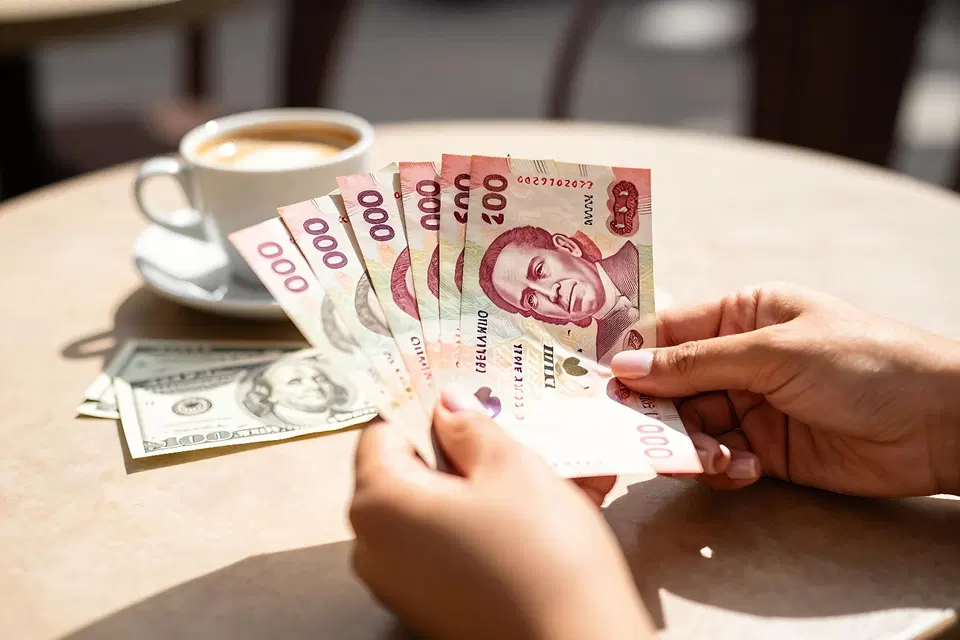
A hundred dollars is the number most people type into a currency converter before a trip to Mexico. It's a clean, round amount: enough for a few days of spending, a deposit on a rental, or the cash you hand to a relative at the airport. The trouble is that the number on the screen and the number of pesos in your hand are rarely the same.
Short version: if the mid-market rate sits at 18.40 pesos to the dollar, $100 converts to 1,840 MXN. Most travelers end up with somewhere between 1,730 and 1,810 MXN instead. That 30 to 110 peso gap is a plate of tacos, a couple of beers, or a taxi across town. Worth understanding before you hand over the bill.
The Math First: 100 USD to MXN at Realistic Rates
The peso has traded roughly between 16.5 and 21 to the dollar over the past several years, and it drifts constantly. Rather than memorizing one number, get comfortable with a range so you can sanity-check whatever a counter or an app quotes you.
- 17.00 MXN per USD — $100 = 1,700 pesos
- 18.00 MXN per USD — $100 = 1,800 pesos
- 19.00 MXN per USD — $100 = 1,900 pesos
- 20.00 MXN per USD — $100 = 2,000 pesos
Notice the shortcut: because you're converting a round 100, you just add two zeros to the rate. If the screen says 18.63, you have 1,863 pesos. That's the whole calculation, and it means you can do it in your head at a counter without pulling out a phone.
The confusion starts when two different rates show up in the same day. Your banking app shows one figure, the kiosk by baggage claim shows another, and neither matches what the machine actually dispenses. If you want a deeper walkthrough of why a single dollar behaves so differently depending on where you spend it, this breakdown of what one US dollar really gets you in Mexico covers the mechanics.
The Rate on the Screen Is Not the Rate at the Counter
Every published rate you see is a mid-market rate, the midpoint between what buyers and sellers are bidding. It's a real number, but it's a wholesale number. Nobody sells retail currency at wholesale prices any more than a shop sells milk at the farm gate price.
What you're charged instead is the mid-market rate minus a spread, and that spread is where the money leaks out. A typical airport kiosk builds in 5% to 9%. A bank branch in Mexico might use 2% to 4%. Some money changers advertise "no commission" and then quietly apply a spread double what the guy three blocks away is using. The commission line is marketing; the spread is the actual price.
This is why the sign outside a casa de cambio can look generous and still be worse than the number your card issuer uses. The post on what the dollar rate in Mexico today actually means at the counter is a useful gut-check the next time a rate board makes you do a double take.
What $100 Actually Buys You in Mexico
Once you've got your pesos, the amount stops being abstract. At around 1,800 MXN, here's a realistic sense of what that covers outside the most expensive pockets of Mexico City and Los Cabos:
- A sit-down dinner for two with drinks at a mid-range restaurant: 700 to 1,100 MXN
- A week of lunches from street stands and market stalls: 600 to 900 MXN
- A first-class bus from Mexico City to Puebla: roughly 250 to 350 MXN
- Three nights in a decent hostel dorm: 450 to 700 MXN
- A week of basic groceries for one person: 800 to 1,200 MXN
- Two or three 20-litre jugs of drinking water delivered: around 100 MXN
Small purchases add up fast. A coffee runs 35 to 55 MXN, a beer at a neighborhood bar 40 to 70, a metro ride in Mexico City about 5. Paying with a card for a 40-peso coffee is where foreign transaction fees quietly eat a chunk of your hundred. If you want to see how far the money stretches item by item, what that dollar figure really buys you in Mexican pesos breaks it down by category.
Airport Kiosk, Bank, ATM, or Card?
Converting $100 in cash is a small enough transaction that a percentage sounds trivial. It isn't, once the fixed costs land.
Airport currency kiosk
Convenient and consistently the most expensive. A 7% spread on $100 costs you about 129 pesos. On a small amount like this, that's a real bite.
Bank branch in Mexico
Generally a 2% to 4% spread, but you'll queue, need your passport, and branch hours are limited. On $100, a 3% spread is roughly 55 pesos.
ATM withdrawal
You get a near-market rate from the network, but the Mexican bank charges an operator fee of about 30 to 50 MXN, and your home bank may add a $5 foreign withdrawal fee plus 3% of the amount. Withdrawing only $100 is inefficient because those fixed fees get spread over a small sum. Take out 3,000 MXN instead and the same fees cost a fraction per peso.
Credit or debit card
A 0% foreign transaction fee card is the cheapest way to spend, close to the mid-market rate. A 3% fee card costs about 55 pesos per $100 in purchases. Always choose to be charged in pesos, never in dollars, when a terminal offers the choice.
The relative costs shift depending on the amount and the day, which is why a straight comparison of what the US dollar to Mexican peso rate really costs you is worth a read before you commit to one method.
How to Get the Most Pesos for Your $100
A few habits make a measurable difference, even on an amount this small:
- Convert in the city, not the airport. Bank branches and established casas de cambio in town routinely beat terminal kiosks by 3 to 5 percentage points.
- Ask the rate before handing over cash. "¿Cuál es el tipo de cambio?" takes two seconds and gives you the option to walk.
- Compare two counters. On a busy street in a tourist area, they cluster. The difference between the best and worst board can be 80 to 120 pesos on a hundred.
- Decline the currency choice. If a card terminal offers to charge you in USD, say no. That conversion is done at a rate you didn't agree to.
- Keep some small bills. Breaking a 500-peso note for a 30-peso purchase is a common irritation. Ask for change when you convert.
- Watch the buy/sell columns. The board shows two rates. You want the one labeled compra for dollars, and it will be lower than the number you saw online.
If reading a rate board still feels like guesswork, this guide to how to read the US dollar exchange rate in Mexico and beat the counter rate walks through the two-column layout and the mental math that keeps you from overpaying.
If You're Sending $100 Instead of Carrying It
A lot of people searching this phrase aren't packing a suitcase. They're sending money to family, paying a deposit on a rental, or splitting a bill with someone in Mexico. The math changes here because the fees are structural rather than a spread on cash.
Remittance services typically charge a flat fee of $0 to $6 on $100 and apply a margin of 0.5% to 3% on top of the mid-market rate. Banks are usually worse on both fronts, sometimes 4% to 6% once the wire fee and margin stack up. On a transfer of 1,840 pesos, a 4% margin is 74 pesos gone before anyone spends a centavo. Compare two or three providers at the moment you send, because remittance margins move more than people expect and the cheapest option last month may not be the cheapest today.
One habit that saves money either way: check the actual rate at the moment of the transaction, not the one you looked up yesterday. A hundred dollars is a small enough sum that a 3% difference sounds like nothing, but it's roughly a full meal in most of Mexico. Multiply that same percentage by a year of trips or transfers and the number stops being trivial.