 Currencies
The taxi stand outside Mexico City's airport quotes 220 pesos. Your phone says 1 USD to MXN is 17.90. Quick mental math: about twelve dollars. Then you tap your card and the charge posts at $13.40. Nothing shady happened. You just met the difference between the rate you read and the rate you got.
That gap is the whole story of turning dollars into pesos. The number itself takes four seconds to look up. Understanding what it means, why it wobbles, and how to keep more of it takes about ten minutes. This is that ten minutes.
What 1 USD to MXN is actually telling you
Currency quotes come in pairs. In USD/MXN, the dollar is the base currency and the peso is the quote currency. A rate of 17.90 means one US dollar buys 17.90 Mexican pesos. Multiply anything by that figure and you have pesos: 50 dollars is 895 pesos, 1,000 dollars is 17,900.
The reverse direction matters just as much. At that rate one peso is worth about 0.056 dollars, which is why a 220-peso taxi feels cheap right up until you realise you'll be dividing by eighteen for the rest of the week.
MXN is the ISO code, and each peso splits into 100 centavos. Coins run from 50 centavos up to 10 pesos, notes from 20 to 1,000. When a menu says 85, it means 85 pesos, and no one in Mexico will assume otherwise.
For a proper sense of how far a single dollar stretches on the ground, this breakdown of what the US dollar in Mexican pesos really buys you goes item by item.
Why the peso swings more than you'd expect
Mexico's currency is among the most heavily traded in the world, and it behaves like it. It is liquid, easy to short, and quick to react to anything that smells like risk. Over the past decade the rate has sat near 17 and spiked past 25 during the 2020 panic.
Interest rates do much of the work
Banxico, the central bank, has run one of the highest policy rates of any major economy in recent years, above 11% at points while the US Federal Reserve sat closer to 5%. That spread pays investors to hold pesos, a trade known as the carry trade. Shrink the gap and some of that money walks away, softening the peso.
Remittances and nearshoring
Mexico takes in well over $60 billion a year in remittances, mostly from the United States, and that steady river of dollars supports the currency. Factory relocations into northern states pile foreign investment on top. Both are structural props rather than daily drivers.
Headlines and election cycles
Mexican and US elections, judicial reform debates, tariff threats, Pemex's balance sheet. The peso prices all of it in real time. A two-peso move within a month is ordinary weather, not a storm.
What a dollar actually buys south of the border
Assuming a rate somewhere near 18, here's the rough shape of it:
- A Mexico City metro ride at 5 pesos works out to about 28 cents, so roughly three and a half rides per dollar
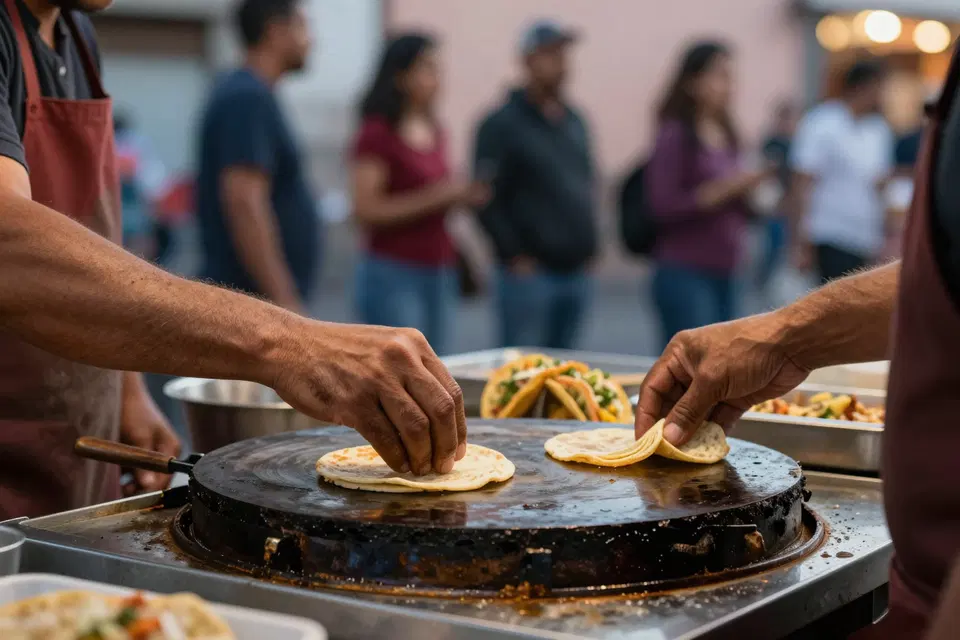
- One street taco, usually 18 to 25 pesos
- A tamale or a market-stall torta, 25 to 40 pesos
- A bottle of water from a corner shop, 12 to 18 pesos
- An agua fresca from a jug, around 20 pesos
- A domestic beer in a neighbourhood bar, 40 to 70 pesos
- A cappuccino at a cafe, 45 to 60 pesos
- A kilo of tomatoes at a local market, 25 to 35 pesos
None of this is fixed. Tourist corridors in Cancún or Los Cabos run two to three times city prices, and San Miguel de Allende has its own gravity entirely. Still, the mental model holds: a dollar is roughly one taco, half a beer, or a handful of metro rides.
The rate you see versus the rate you get
Headline mid-market rates come from interbank trading. You will essentially never get that exact number, because whoever hands you pesos takes a slice.
- Airport kiosks: often 8-15% worse than mid-market. Consistently the worst place to convert anywhere
- Hotel front desks: convenient, 5-10% off the real rate, sometimes with a minimum
- Mexican bank branches: closer to fair, but expect queues, passport checks, and short hours
- City casas de cambio: usually the best cash option, especially where several compete on the same street
- ATMs: give you close to the true rate but charge 30-100 pesos per withdrawal, plus whatever your home bank adds
- Card terminals offering to charge in dollars: always decline. That is dynamic currency conversion and it typically costs 3-7%
If you want the arithmetic behind those percentages, this walkthrough of what the USD to MXN rate really costs you runs the numbers on a worked example.
Getting closer to the real rate
- Withdraw larger sums less often. One 5,000-peso pull beats five 1,000-peso pulls if each costs 60 pesos in fees
- Use a debit card that refunds ATM fees and skips foreign transaction charges. That single choice saves more than any rate hunting
- Pay by card for hotels, restaurants, and bigger purchases, where the network rate beats any cash counter
- Keep cash for markets, taxis, street food, and smaller towns. Plenty of places still run cash-only
- Skip airport conversion beyond a 500-peso emergency stash
- Choose pesos whenever a terminal asks which currency you'd like to be charged in
Bring dollars or bring pesos?
Dollars get accepted in tourist corridors and border towns, but usually at a flat, unfriendly rate like 15 or 16 to one. You lose money and you mark yourself as a visitor. Pesos are the actual currency, so use them.
The same gap between headline number and real number shows up in every pair. If you've ever checked the USD/CAD exchange rate today before a trip north, you've seen the identical pattern: a clean figure online, a messier one at the counter.
Sending money rather than carrying it
Transfer apps and wire services quote a rate plus a fee, and the two are often bundled to look better than they are. Compare what actually lands in the recipient's account, not the advertised rate. A service quoting 17.95 with a $5 fee beats one quoting 18.10 with a $15 fee on a $200 transfer. On $2,000, that math flips. Run both scenarios before you commit.
Also worth knowing: bank deposits work fine, but plenty of recipients prefer cash pickup at chains like Elektra or Banco Azteca because they can collect within minutes of the transfer clearing.
Watching the rate without obsessing over it
If a large conversion is coming, whether a property purchase, tuition, or a year of rent, the difference between 17.50 and 18.50 on $20,000 is about $1,150. That is worth real attention.
Three forces move the needle most: Banxico's rate decisions, which arrive roughly every six weeks; US Federal Reserve policy; and overall risk appetite in global markets. When US rates stay high and volatility climbs, the peso usually weakens. When the carry trade is crowded and Mexico's fundamentals look steady, it strengthens.
Set a target rate and a deadline. If the market hits your number before the date, convert. If it doesn't, convert on the date anyway. That discipline beats trying to call the bottom, which even professional desks rarely manage with any consistency.
For everyday spending the rule is simpler. Know roughly what a dollar buys, avoid the airport kiosk, decline the dollar charge, and let the card network do the work. The rate will do whatever it does next.