
Loading article...
Slot ID: blog-post-top
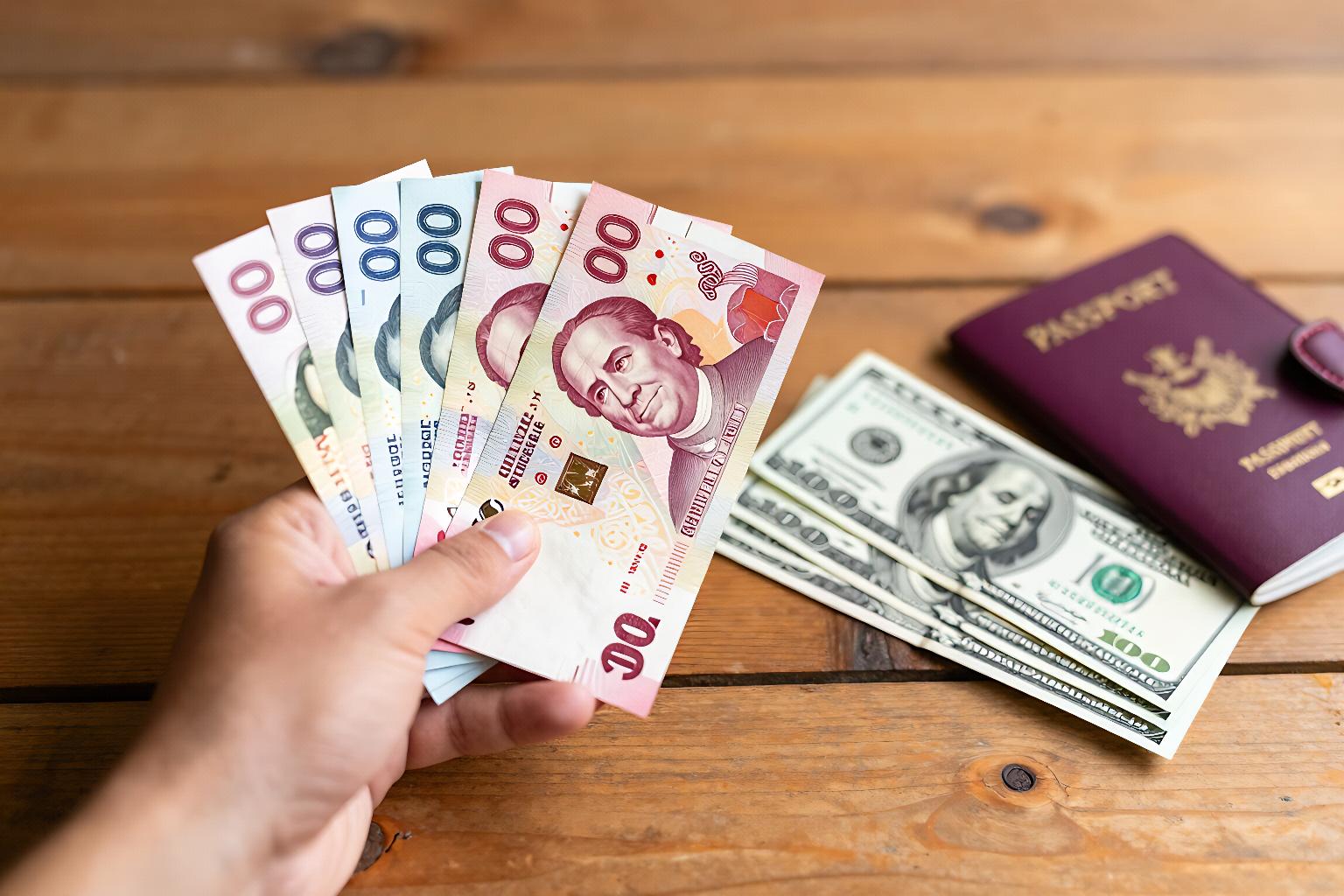
Let's say you're planning a two-week trip to Oaxaca, or you need to send money to a family member in Guadalajara. You've got $3,000 USD sitting in your bank account, and you want to turn it into Mexican pesos. The first thing you'll notice is that the rate you see on Google—the USD/MXN rate—is almost never the rate you actually get. That gap is where money quietly disappears. This guide walks through the whole process, step by step, using a real $3,000 conversion as the example. By the end, you'll know exactly how to compare offers, spot a bad deal, and end up with more pesos in your pocket.
Before you talk to any bank or exchange service, look up the mid-market rate. That's the midpoint between buy and sell prices on the global currency market. It's the fairest number you'll see, and it's the benchmark for everything else. On a typical day, it might be 1 USD = 17.50 MXN. You can find it on XE.com, Google, or Reuters. Write it down. This is your reference point.
If a provider offers you 16.80, you're losing almost 4% right off the bat. That might not sound like much, but on $3,000 it's about $120. For a quick way to tell if a rate is bad, there's a handy method in this guide to spotting a bad exchange rate in under a minute. It was written for pesos to dollars, but the logic works both ways.
Once you have the mid-market rate, it's time to compare where you can actually convert. Here are the main routes, roughly from worst to best for most people.
Convenient, but expensive. You'll often see spreads of 8–15% below the mid-market rate, plus flat fees. On $3,000, a 10% spread means you lose $300. Avoid unless it's an emergency.
Banks typically mark up the rate by 2–4% and may add a wire fee ($20–$40). Some also charge a foreign transaction fee if you're using a card. The rate isn't terrible, but it's rarely the best.
These services usually give you the mid-market rate or very close to it, and charge a transparent fee—often 0.4–1% of the amount. For $3,000, that's $12–$30. The catch: you need to plan ahead, as transfers can take a day or two.
Withdrawing pesos from an ATM using your US debit card can be a good option if you have a card that doesn't charge foreign transaction fees and rebates ATM fees. Otherwise, you'll pay a flat fee (often 30–50 MXN) plus a 2–3% foreign transaction fee. Daily withdrawal limits apply.
Typical cost on $3,000:
Notice how the same $3,000 can shrink by hundreds of dollars depending on where you go. That's why it pays to compare. The same principle applies whether you're converting dollars to pounds or Canadian dollars to US dollars—the fees and spreads are the enemy.
Let's put concrete numbers on it. Suppose the mid-market rate is 17.50 MXN per USD.
Option A: Your bank offers 16.90 MXN per USD and charges a $25 wire fee.
$3,000 × 16.90 = 50,700 MXN. After the $25 fee, you're left with 50,700 MXN (the fee is taken from the dollars before conversion, so effectively you convert $2,975: 2,975 × 16.90 = 50,277.5 MXN). Let's say 50,278 MXN.
Option B: An online service offers 17.48 MXN per USD with a $15 flat fee.
$3,000 - $15 = $2,985 to convert. 2,985 × 17.48 = 52,177.8 MXN. So about 52,178 MXN.
That's a difference of 1,900 MXN, or roughly $108. That's a nice dinner for two in Mexico City, or a few nights in a boutique hotel. The gap comes from both the rate and the fee. This is exactly the kind of math you should do before committing. If you want to see the same step-by-step process applied to another currency pair, this CAD to USD guide walks through a $5,000 example.
Two classic mistakes can cost you even more. The first is waiting until you land to exchange money. Airport kiosks know you're captive and desperate, so their rates are often 10–15% worse than what you'd get in the city. The second is dynamic currency conversion (DCC). This happens when you pay with a card in Mexico and the terminal asks if you want to be charged in USD or MXN. Always choose MXN. If you choose USD, the merchant's bank does the conversion at a terrible rate, often 5–7% worse. It's a sneaky fee that shows up on your statement as a slightly higher charge. Decline it every time.
Currency markets move constantly. In 2024, USD/MXN ranged from about 16.5 to 18.5. That's a big swing. If you're converting a large amount, a 2% move can mean hundreds of dollars. But trying to time the market is a fool's errand for most people. Instead, consider a limit order with your bank or transfer service. You set a target rate—say 17.80—and the conversion happens automatically if the rate hits that level. If it doesn't, you keep your dollars. This can be useful if you're not in a hurry. For smaller amounts, just convert when you need to. The difference over a few weeks is usually small, and the stress isn't worth it.
Even if you get a great rate, fees can eat into your pesos. Here are the ones that often fly under the radar:
This guide to converting won to USD covers similar traps with fees, and the lessons apply to any currency pair. Read the fine print. A service that advertises "0% commission" might still make money on the exchange rate.
Let's say you want to send $3,000 to a friend in Mexico who will withdraw it in pesos. Here's how to do it without losing sleep.
If you're withdrawing cash instead, use an ATM from a major bank (BBVA, Santander) during business hours. Decline the ATM's offered conversion rate—it will ask if you want to accept their rate in USD; say no and let your bank handle it. Withdraw the maximum allowed (often 6,000–9,000 MXN per transaction) to minimize flat fees.
Before you commit to any conversion, run through this quick checklist:
Do these five things and you'll keep more of your money—whether you're converting $300 or $30,000.
Slot ID: blog-post-bottom