
Loading article...
Slot ID: blog-post-top
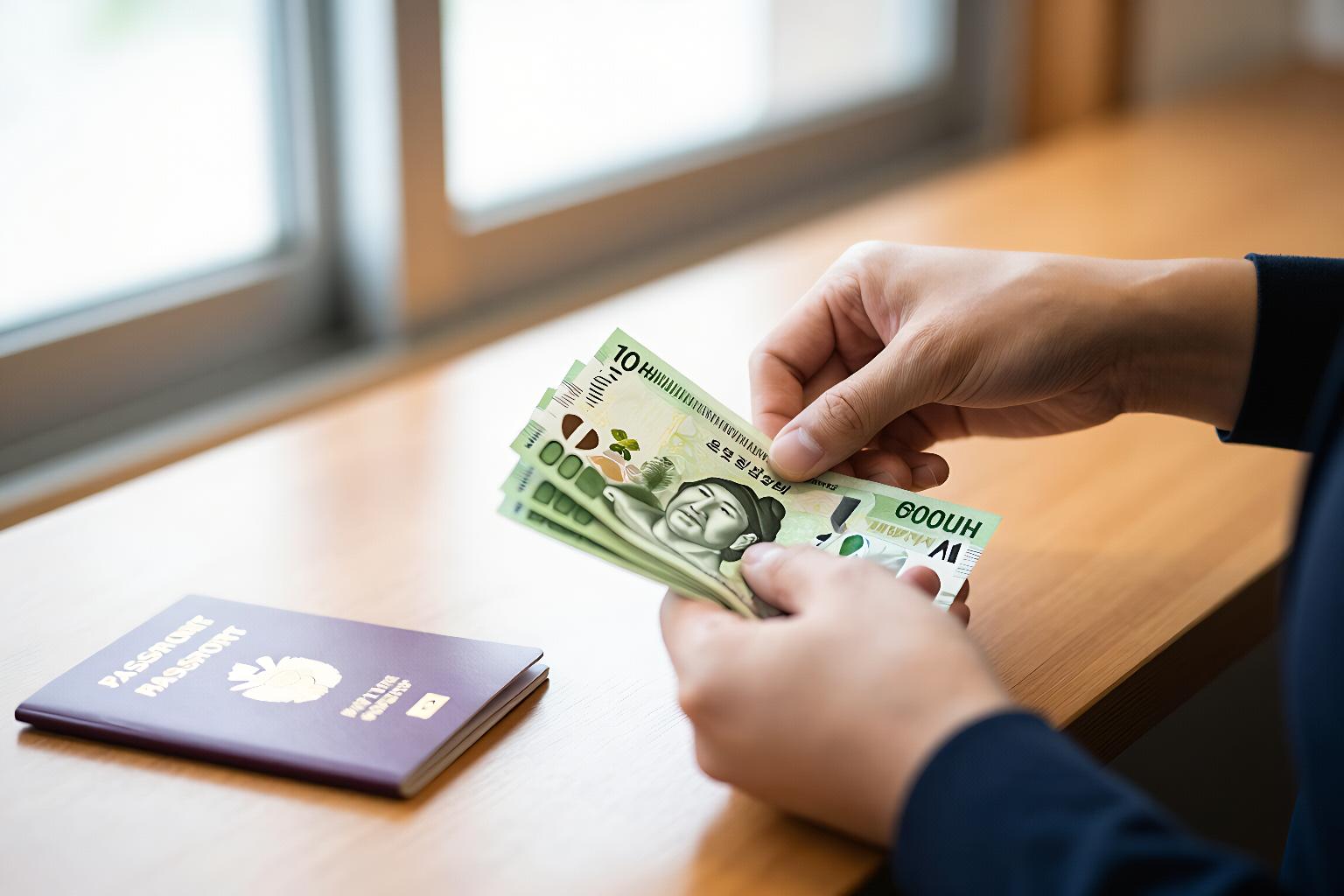
A reader once emailed me from Incheon airport with 870,000 won left from a two-week trip and a departures-board exchange rate that felt, in her words, "made up." She wasn't wrong. The gap between that posted rate and the real market rate was costing her about $30 on a stack of notes that fit in her jacket pocket.
Moving Korean won into US dollars isn't complicated. The trouble is that every step has a little margin baked into it, and those margins add up quietly. Here's the whole process, in order, with numbers you can swap for your own.
The mid-market rate is the midpoint between buyers and sellers on the global currency market. You will never get it exactly, but it's the ruler you measure every quote against. Look it up the same day you plan to convert, because USD/KRW moves daily.
Say the mid-market rate is 1,380. That means one dollar buys 1,380 won. Flip it around and you get the figures worth memorising:
Lock the 10,000-won number into your head and you can price almost anything in a Korean shop in under two seconds. A 14,000-won bowl of naengmyeon is about $10.15. A 45,000-won taxi ride from Incheon to central Seoul is roughly $32.60.
When you sell won, the dealer quotes you a higher number than mid-market, because it now takes more won to buy a single dollar. The gap is their cut. If mid-market sits at 1,380 and your bank offers 1,412, that's a margin of about 2.3%. Run the arithmetic before you agree to anything:
That last one is a haircut of just over 5%. Sixty seconds with a calculator tells you whether a rate is fair, and the habit transfers to every currency you'll ever handle. If you want the general version of that instinct rather than the won-specific one, this breakdown on how to spot a bad exchange rate in 60 seconds is worth ten minutes of your time.
This is where people burn effort. Cash in your wallet and won in a Korean bank account are two completely different problems.
Your realistic options are a Korean bank branch, a licensed money changer in Myeongdong or Namdaemun, or an airport counter. Most US banks either won't accept KRW notes or will quote you something brutal, so flying home with the cash and sorting it out later is usually the worst plan. Airport kiosks are the most convenient and the most expensive. Bank branches downtown are slower but noticeably cheaper.
One detail that catches people out: Korean banks sometimes refuse, or heavily discount, notes that are torn, badly creased, or marked. Keep your bills crisp and you'll avoid an argument at the counter.
Now you're doing an international transfer, not a cash exchange, and the tools are different. Online multi-currency services generally beat a traditional wire on both rate and fee for anything under roughly $10,000. The mechanics are the same as any cross-border move, so if you've shifted money between other pairs, a walkthrough like this CAD to USD conversion guide with a real $5,000 example will feel familiar. Replace the loonie with the won and the steps barely change.
Send the account balance electronically while the rate is decent, and hang onto the cash for your next trip. Won is easy to spend in Seoul, and for a few months the notes will hold their value better than most people expect.
The quoted rate is only the headline. Four costs typically decide what actually lands in your account:
Take a 5,000,000-won balance. At 1,380 that's $3,623.19. A service charging a 0.45% margin and a $4 flat fee pays out around $3,603. A bank charging a 2.5% margin plus a $25 wire fee leaves you roughly $3,511. Same pile of won, about $92 apart.
USD/KRW is one of the livelier major pairs. Through 2024 it traded roughly between 1,300 and 1,450. On a 5,000,000-won conversion, the difference between 1,320 and 1,440 is around $315. That's real money, but it's also a reminder that nobody reliably calls the top.
A workable approach: if you're moving a large sum, split it into two or three transfers across a few weeks and take the average. You give up the chance of a perfect rate in exchange for never getting the worst one. Won isn't the only pair that behaves this way either, which is exactly why guides like this USD to AUD step-by-step breakdown push the same averaging strategy.
If the amount is under about $1,000, convert when you need the cash and stop refreshing the ticker.
Back to that 870,000 won in your jacket pocket. Here's what each route pays:
The kiosk and the bank are $18.21 apart. If you're already through security with 20 minutes before boarding, that's a convenience premium you might reasonably pay. If your last day is free, walk into a branch instead.
Now scale it up. A freelancer finishing a three-month contract with 8,700,000 won faces a $182 gap between those two routes. At that size, an hour spent opening an account with an online transfer provider is the best-paid hour of the month.
Don't convert won to dollars and then straight into a third currency. Every hop charges its own margin, and two hops can easily cost you 5–8% combined. If your next stop is Europe, price the direct won-to-euro route against what a standard dollar-to-euro conversion would run, because those two margins are not symmetrical and the difference is often larger than the fee you were trying to dodge.
Four lines of arithmetic, one comparison, and one decision about where to stand when you do it. That's the whole job, and it's the difference between losing 2% of your trip budget and losing nothing at all.
Slot ID: blog-post-bottom