
Loading article...
Slot ID: blog-post-top
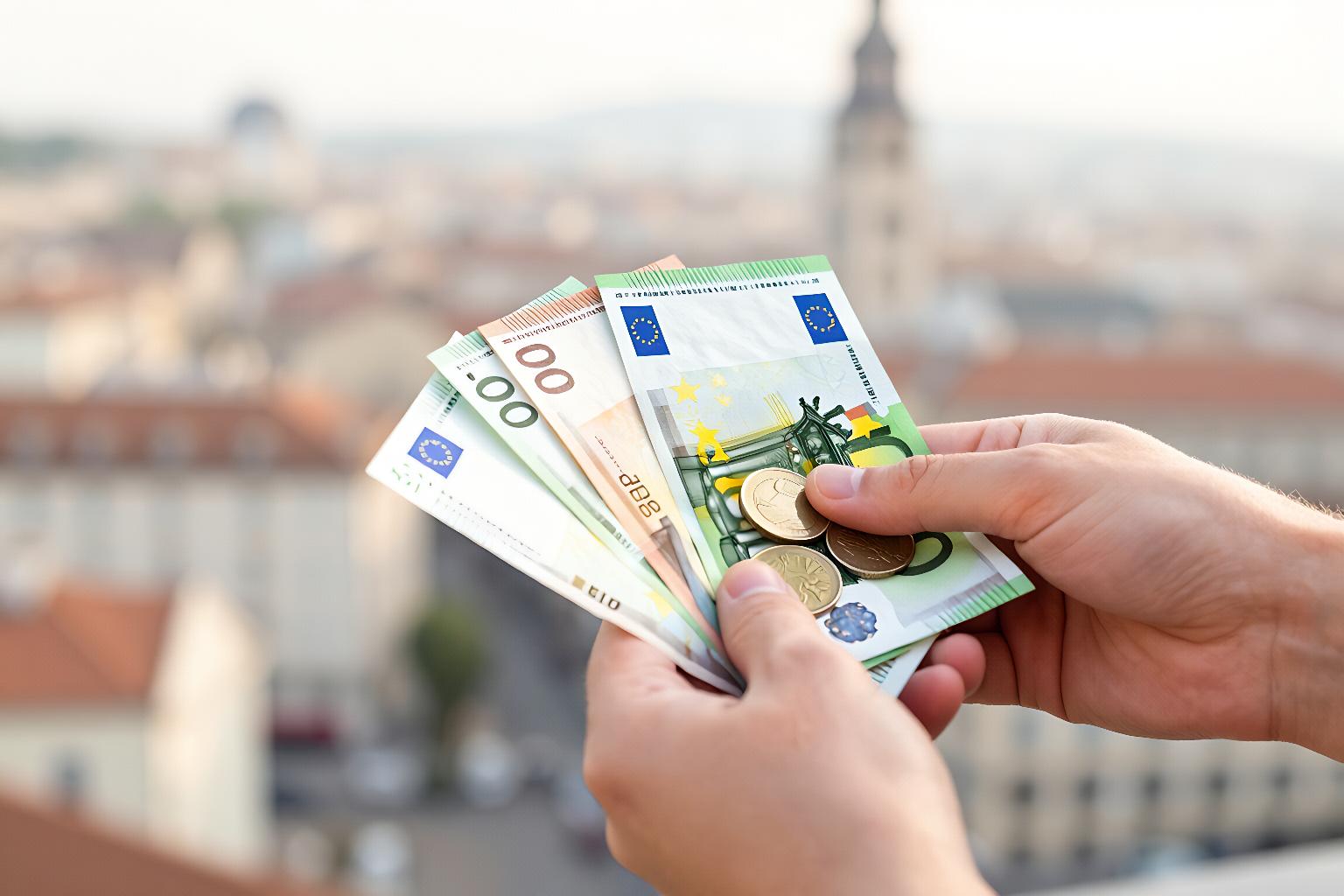
Picture this: you're about to book a trip to Lisbon. Your banking app shows a euro exchange rate of 1.08, so you expect to get €925 for your $1,000. When you finally transfer the money, you receive €890 instead. That's not a rounding error — it's the difference between the mid-market rate and the rate your provider actually offers. This guide walks through the steps to narrow that gap, with real numbers so you can apply it to your own transfers, trips, and payments.
The euro exchange rate is quoted in pairs, like EUR/USD. That number represents the price of one euro in US dollars. The rate you see on Google or a finance site is the interbank mid-market rate — the average of what banks charge each other for large transactions. No one is going to offer you that exact rate, because they need to make money. But it's the benchmark you need to know.
For example, if the mid-market rate is 1.0850, a provider might sell euros at 1.0980 — a 1.2% markup. On €1,000, that's €12 lost. Understanding how this works is the first big step. If you're unsure what the buy and sell rates mean, read our guide on how to read an exchange rate with real math. And to make sure you're looking at the right number, check the live euro exchange rate from a reliable source rather than a random website.
Too many people choose an exchange service based on the headline rate alone. But a slightly better rate might be wiped out by fees. Suppose you want to buy €500 with US dollars. Provider A sells euros at $1.08 per euro, no fee. That costs 500 × 1.08 = $540. Provider B sells at $1.06 per euro but charges a $25 flat fee. The math says 500 × 1.06 = $530, plus $25, so your total is $555. Provider A is the better deal by $15, even though the posted rate looks less attractive.
Always ask for the final amount in your home currency, including every fee. If you're planning a larger transfer, it's even more important. For a detailed comparison strategy, see our step-by-step guide to getting a better deal on currency exchange.
Currency converters are tools for estimating, not guarantees. The mid-market rate they use is not your rate. If you're budgeting for a trip, take the converter's number and add 2–4% to see what you'll likely pay. For example, with a mid-market rate of 1.0850, a bank with a 3% margin will give you 1.1175. Changing $2,000 would buy you €1,789 instead of €1,843 — a difference of €54.
The good news is that many online services show you the exact rate they'll give you before you commit. You can also use a professional-grade tool like OANDA's currency converter to check the mid-market rate for any pair, and see how it moves in real time. Just remember the margin will still be applied by your provider.
Airport kiosks and hotel desks are the most expensive places to buy euros. In my experience, an airport kiosk at Barcelona airport was selling euros at 1.16 when the interbank rate was 1.08 — a markup of 7.4%. If you're changing €500, you'd lose €35 to the exchange.
Using a local ATM is often much cheaper, but with two important rules. First, always choose to be charged in euros, not your home currency. Dynamic currency conversion (DCC) looks convenient but typically adds a markup of 4–8%. Second, check your bank's foreign transaction fee. For instance, if your bank charges 1.5% and the ATM offers you a rate that's 6% worse, you're still better off using the ATM. A traveler I know withdrew €200 in Rome, chose the ATM's 'charge in dollars' option, and paid $238 instead of the $216 his bank would have charged. That's $22 lost in a single transaction.
If you're making a big transfer or buying property, the euro exchange rate on a single day can matter a lot. Suppose you need to send €10,000 to a contractor. At a rate of 1.10, that costs $11,000. If the rate moves to 1.08, it costs $10,800 — a $200 difference. Setting a rate alert lets you know when your target rate is available. Many online money transfer services offer this feature for free.
But don't try to predict where the euro is heading. Instead, use alerts as a way to time your exchange within a range that works for you. You can also use a forward contract to lock in a rate for a future date, but that's usually for businesses. For most personal exchanges, a simple alert is enough.
The phrase '0% commission' is a red flag. Providers who don't charge an explicit fee often hide their profit in the exchange rate. For example, a currency exchange shop might advertise 'no commission' while selling euros at $1.14 when the interbank rate is $1.08. That's a 5.5% markup disguised as a free service.
Always calculate the effective exchange rate by dividing the total amount you pay by the amount you receive. If a provider won't tell you the rate you'll get until you sign in, be suspicious. You deserve to know exactly what one euro will cost you before you hand over any money.
Before you finalize any currency exchange, run through this list. It takes two minutes and can save you dozens of dollars.
Using this routine, you'll stop relying on whatever rate happens to be on the board and start making decisions based on actual numbers. The next time someone quotes you a euro exchange rate, you'll know exactly what to do with it.
Slot ID: blog-post-bottom