
Loading article...
Slot ID: blog-post-top
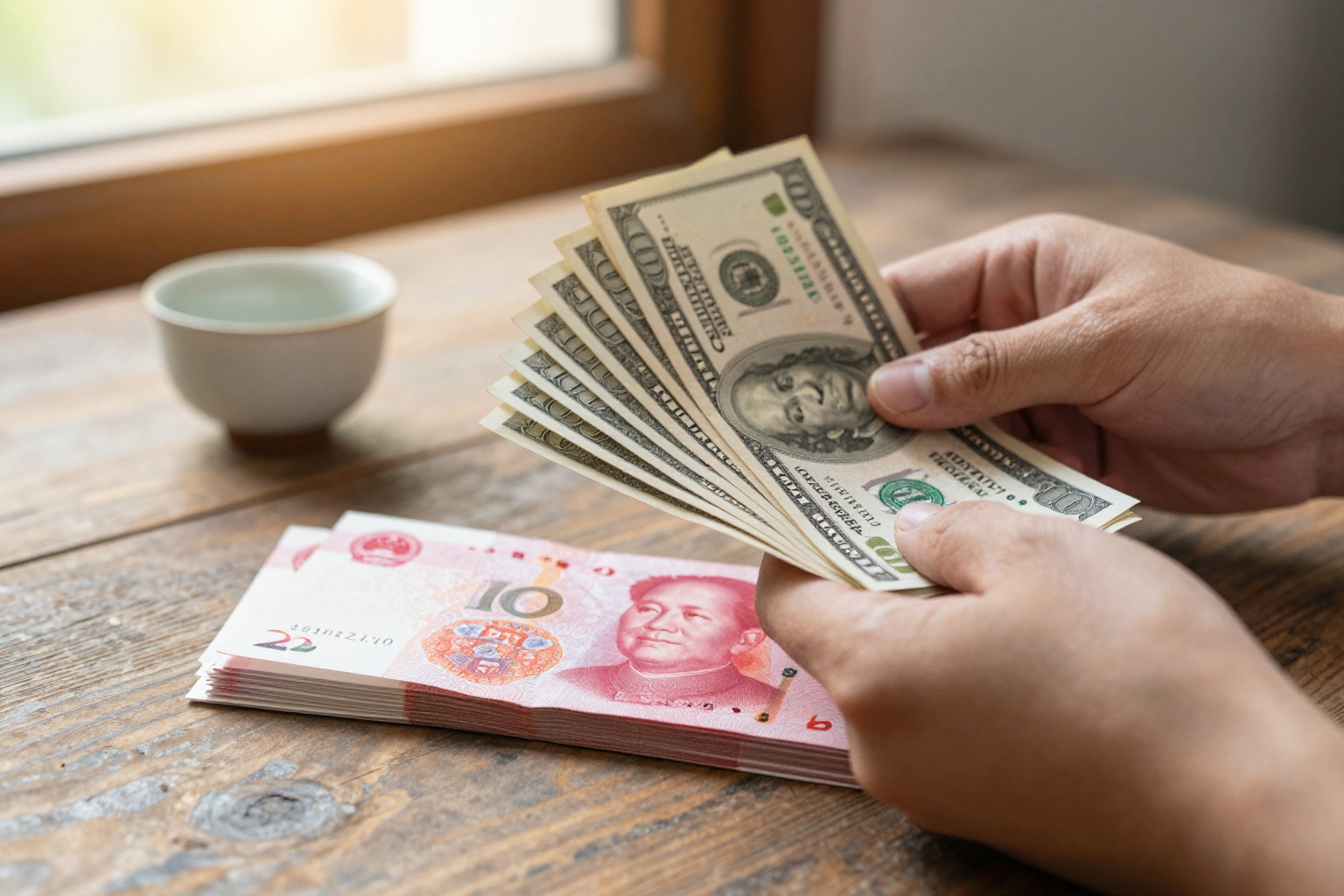
Type "usd to chinese yuan" into a search box and you'll get a clean-looking number: something in the region of 7.1 to 7.3 yuan for every dollar, depending on the week. Simple enough. The catch is that this headline figure is almost never the rate you actually get, and the gap between the two can quietly cost you hundreds of dollars on a large transfer.
China's currency also works differently from most. It's tightly managed, it trades at two separate prices depending on where you are, and spreads on the dollar-yuan pair are wider than on almost any other major currency. Understanding the machinery turns a confusing number into something you can plan around.
A quote of 1 USD = 7.15 CNY means one US dollar buys 7.15 Chinese yuan. When that number climbs, the dollar is gaining and the yuan is weakening, so your money stretches further on anything priced in yuan. When it slips toward 7.00 or below, the yuan has strengthened and your dollars buy less.
It's tempting to read a rising number as bad news, especially if you follow coverage of how the yuan exchange rate shapes what your money is worth. Direction only matters relative to what you're doing. If you're buying yuan, a higher number is good for you. If you're a Chinese exporter converting dollar revenue back into local currency, it's the reverse. Same rate, opposite verdict.
The People's Bank of China publishes a reference rate each morning, usually around 9:15 Beijing time. Onshore trading is then permitted to move no more than 2% either side of that fixing. The band is rarely tested, but its existence tells you something important: the PBOC has a view on where the yuan should sit, and it intervenes through state banks, liquidity operations and direct buying when the market disagrees too hard.
China also keeps capital controls in place. Individuals face an annual quota for converting yuan into foreign currency, and large corporate flows get scrutinised. Fewer participants moving money freely means less price discovery, which is one reason the dollar-yuan rate can look oddly calm for months and then lurch in a single week.
Two yuan prices exist. CNY trades inside mainland China and stays within the band. CNH trades in Hong Kong, Singapore and London, where it moves freely. Normally the two sit within a few hundredths of each other. Under stress the gap widens, and that gap is worth watching, because a persistently weaker CNH often signals pressure building on the mainland rate before it shows up in the official number.
Say you need 14,000 yuan for a rental deposit in Chengdu, or to top up a relative's account. At a mid-market rate of 7.15, that takes $1,958. Here's what the main routes actually charge:
On a few hundred dollars the difference is a coffee. On $20,000 it's the price of a decent holiday. The pattern repeats right across Asia, and it's the same trap whether you're checking won exchange rates before a trip to Seoul or working out what your dollar really buys in Thailand.
Ask for two numbers, not one. Every quote carries a buy rate and a sell rate. If a bank sells you yuan at 7.08 and buys it back at 7.02, the mid-point is 7.05 and their margin is roughly 0.4% in each direction. That's reasonable. A 0.3 gap on either side is not, and it usually means someone is padding the rate instead of charging a visible fee.
Second check: flip the pair. One divided by 7.15 is 0.1399, so a single yuan is worth about 14 US cents. If a provider's inverse quote looks far off that, the cost is buried in the rate rather than sitting on a fee line where you can see it.
Third: mind the weekend. Most card networks and transfer services freeze Friday's rate until Monday, so a Saturday conversion can land 0.5–1% worse for no obvious reason.
Recipients often care about the yuan amount, not the percentage. That's why it pays to quote the total in yuan after all fees, then compare providers side by side. A service advertising "zero fees" that converts at 6.98 versus one charging a flat $8 at 7.13 is not a close call on a $3,000 transfer.
Carry a small amount of cash for the first day and rely on a card for the rest. Domestic Chinese payments run almost entirely through WeChat Pay and Alipay, and both now accept foreign cards in many cities, so you may need less physical cash than you expect. Draw from an ATM only at bank branches, where the spread is tighter than at standalone machines in tourist districts.
Freelancers and small exporters invoicing in yuan carry real exposure. A 3% swing on a $50,000 invoice is $1,500, which is more than most people budget for. If you regularly receive yuan, it's worth understanding what the exchange rate really means for your money in China before deciding when to convert and when to hold.
The PBOC fixing lands around 9:15am Beijing time, which is late evening in New York and early afternoon in London. That single number sets the tone for the day, and it's published free on the central bank's site.
Beyond that, three recurring events move the dollar-yuan rate more than anything else: US inflation prints and Fed meetings, China's monthly trade figures released around the seventh, and quarterly GDP. If you have a large transfer coming up, set a rate alert rather than checking the number every morning. Pick a target that reflects a sensible budget rather than a perfect top, because trying to catch the exact peak on a managed currency is a game even professional desks lose more often than they win.
For most people converting a few thousand dollars, the practical wins are boring and reliable: skip the airport, compare the all-in yuan amount across two or three providers, and avoid converting at the weekend. Do those three things and you'll usually land within half a percent of the best available rate.
Slot ID: blog-post-bottom