
Loading article...
Slot ID: blog-post-top
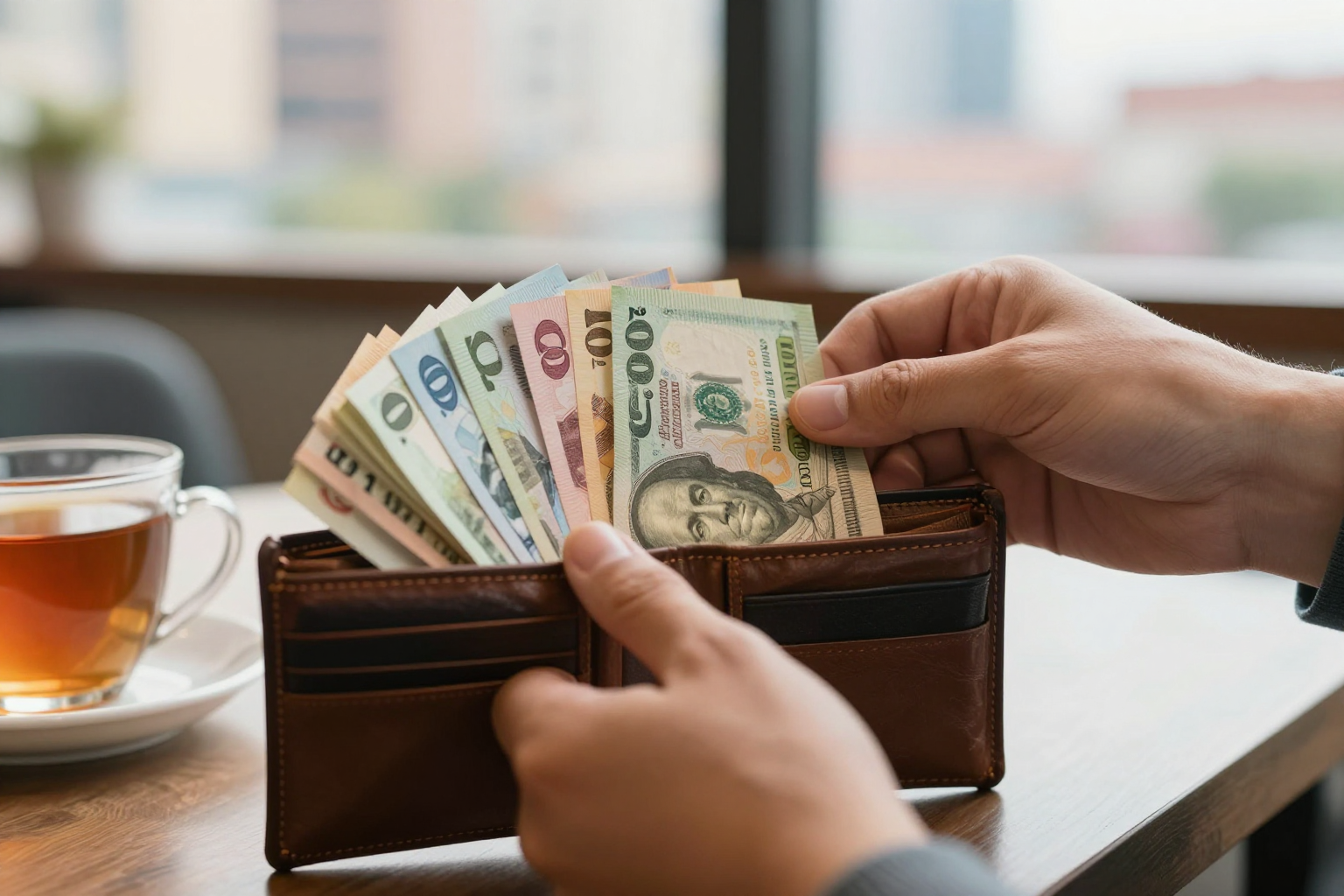
You type “dollar to RMB” into a search bar, see 7.24, and assume that’s the rate you’ll get when you hand over $500 at a bank counter in Shanghai. Then the teller gives you a number that feels 2% lighter. That gap is the real story of converting US dollars into Chinese yuan. The quoted rate is a midpoint between buyers and sellers, not a retail price. What you actually pay depends on where you convert, how you pay, and how much you move.
RMB stands for renminbi, the official currency of China. The yuan is its unit, the way “pound” is the unit of British sterling. In everyday speech, people use RMB and yuan interchangeably. Currency codes matter more: USD/CNY is the onshore rate traded inside mainland China, while USD/CNH is the offshore rate used in Hong Kong and other markets. For a traveler or small business, CNY is the number that usually shows up on a bank screen.
That number is not fixed. In recent years USD/CNY has traded roughly between 6.3 and 7.3, shaped by Federal Reserve policy, China’s central bank, trade flows, and investor sentiment. A move from 7.10 to 7.25 means one dollar buys 15 fen more, or 0.15 yuan. On $1,000, that’s an extra 150 RMB, enough for a decent dinner in Chengdu.
Say the mid-market rate is 7.25. You walk into a bank in the US or China and ask for RMB.
Airport counters are the most expensive place to change money. The convenience premium can push the effective rate to 7.00 or lower. If you need 200 RMB for a taxi and a bottle of water, fine. Don’t convert your whole trip there. The same logic applies in Japan, where getting the best dollar-to-yen rate takes a little planning, and in Thailand, where the Thai baht rate can cost you real dollars at the airport.
Bank of China, ICBC, China Construction Bank, and other major banks can exchange USD for RMB at branches. Bring your passport. Rates are usually better than airports, and the process is straightforward at larger city branches. Smaller branches may not keep much foreign cash, so call ahead or visit a main office.
Withdrawing RMB from an ATM is often the simplest route. Look for ATMs at Bank of China, ICBC, or China Construction Bank that display the UnionPay or international card logos. You’ll get a rate close to the wholesale rate, minus your bank’s foreign transaction fee. Daily limits vary, but 2,000 to 3,000 RMB per withdrawal is common. Take out larger amounts less often to reduce flat fees.
Alipay and WeChat Pay now let foreign visitors link international cards. You scan a QR code, pay in RMB, and your card issuer handles the conversion. Small transactions often carry no extra fee, while larger ones may add around 3%. This is convenient for meals, metro rides, and small shops. For big purchases, a bank or ATM withdrawal may still be cheaper.
Hotels can change money for guests, but the rate is rarely competitive. Airports are worse. If you land in Beijing with no RMB and need to get to your hotel, change $50 to $100, then find a bank or ATM the next day.
A few habits separate a fair conversion from an expensive one.
For smaller amounts, the difference between a good and a bad conversion might be a few dollars. For $10,000, it can be hundreds. The same math applies whether you’re changing dollars to RMB, rupees, or yen. If you want to see how exchange-rate margins play out in another major market, our breakdown of what the exchange rate really means for your money is a useful comparison.
If you’re paying a supplier, supporting family, or moving savings, you probably don’t want to fly with a stack of cash. Bank wires are secure but slow and fee-heavy. Specialist services like Wise, Remitly, or Western Union often give a better rate and lower fees, though they may not support every Chinese bank. Compare the total cost: exchange rate margin plus transfer fee plus any receiving fee.
For business payments, the offshore CNH market offers more flexibility. Companies can hedge with forward contracts, locking in a dollar-to-RMB rate for a future date. Individuals usually don’t need that complexity. Just avoid converting everything on a day when the rate spikes in the wrong direction out of panic.
Exchange rates change what your trip feels like. At 7.25 RMB per dollar, 500 RMB costs about $69. At 7.00, it costs $71.43. That’s small on a single meal, but over two weeks of hotels, trains, and museum tickets, it adds up.
China isn’t the only place where this math matters. In India, for example, the rupee-dollar rate shapes everything from street food to train tickets. Our article on what one dollar really buys in India right now gives a ground-level view of that purchasing power.
Headlines about the yuan can be noisy. “Yuan weakens” means USD/CNY is rising, so your dollars buy more RMB. “Yuan strengthens” means the opposite. For a trip or a one-time payment, don’t try to time the market. Check the rate a week before you convert, set a target if you’re moving a large amount, and accept that nobody reliably predicts short-term currency moves.
If you’re converting regularly, keep an eye on the US Federal Reserve and the People’s Bank of China. Interest rate decisions, trade data, and policy signals move the dollar-to-RMB rate. But for most people, the fees and spread you pay matter more than catching a 0.1% swing. For a related example, our explainer on what the yen-dollar exchange rate really means covers the same trade-off between timing and transaction costs.
Do this quick check: look up the mid-market USD/CNY rate, find out your bank’s foreign transaction fee, and decide whether you need cash, an ATM withdrawal, or a digital wallet. If you’re carrying more than a few hundred dollars, split your money between an ATM card, a credit card, and a small amount of cash. That way a lost card or a blocked transaction doesn’t derail your trip.
For large transfers, get at least two quotes and compare the final amount that lands in RMB, not just the advertised rate. The provider with the “best” headline rate may charge a fee that wipes out the advantage. The right dollar-to-RMB conversion is rarely the first one you find. It’s the one where you know the mid-market rate, understand the margin, and choose the method that costs you least.
Slot ID: blog-post-bottom