
Loading article...
Slot ID: blog-post-top
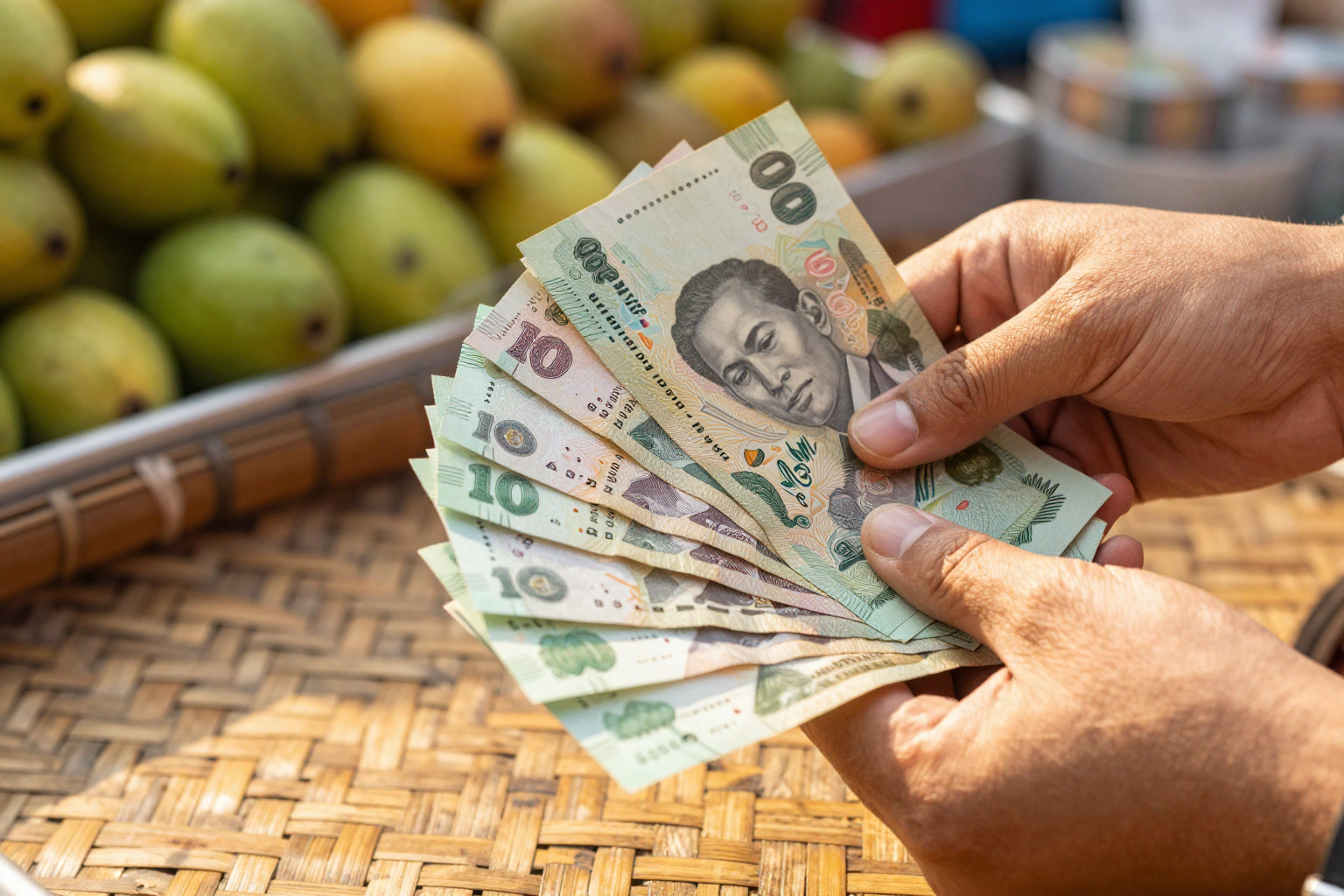
Search "US to baht" and you'll get a tidy number, maybe 34.80. That figure is the mid-market rate, the midpoint between what banks pay to buy dollars and what they charge to sell them. It lives on trading screens in Singapore, London and Bangkok. Nobody hands it to you at a counter.
What you actually receive depends on where you convert, and the gap can be brutal. A hotel desk in Phuket might offer 32.50. An airport booth at Suvarnabhumi might give you 33.60. A SuperRich branch in central Bangkok gets you within half a percent of mid-market, so roughly 34.60 on that same afternoon. Across a $2,000 travel budget, that spread is about 4,200 baht — a week of street food and Skytrain rides.
Thailand is a cash economy in the places most visitors spend their money, so the conversion rate you accept quietly sets the price of everything for the rest of the trip. Four costs do most of the damage.
Add it up and a careless traveller can lose 6% to 8% of their spending money without ever seeing it on a receipt.
Thailand doesn't let the baht float entirely free. The Bank of Thailand manages it, smoothing sharp swings rather than defending a fixed level. So the rate is a tug of war between market flows and what the central bank finds comfortable.
Thailand has run a current account surplus for most of the past two decades. Electronics, cars and auto parts, rice, rubber, plus a tourism industry that drew close to 40 million visitors in 2019, all bring foreign currency in. That steady structural demand for baht keeps it firmer than you'd expect from an emerging-market currency.
When the Federal Reserve raises rates, dollars become more attractive to hold and capital flows out of emerging markets. In 2022 the baht slid to roughly 38 to the dollar, its weakest level in over a decade, mostly on the back of that. Thai exporters weren't unhappy about it.
Thailand is one of the world's busiest gold trading hubs, and flows in and out of Thai gold shops can shift the baht in ways that have nothing to do with tourism. China matters too, since it's Thailand's largest trading partner. When the dollar to RMB rate moves sharply, the baht usually feels it within days.
Before July 1997 the baht was pegged at about 25 to the dollar. The peg broke that month, and by January 1998 the currency had collapsed to around 56. It has traded loosely between 30 and 45 ever since, with long stretches of calm.
The past decade shows how much room that leaves. In 2019 the baht strengthened to just under 30, its best level in years, which made Thailand noticeably expensive for dollar-holders. By late 2022 it had fallen to about 38. Recent years have settled in the low-to-mid 30s, drifting on Fed policy, Chinese growth and the tourist season.
Ranked roughly from best to worst:
The same logic that governs how you get the best deal on the US dollar to Philippine peso applies here: the further you are from a competitive money-changing district, the more you pay for the convenience of not walking ten minutes.
Two details matter more than people expect. Thai changers pay noticeably more for clean, unmarked $100 and $50 notes than for $20s and $10s, and they'll refuse torn or heavily written-on bills outright. Bring large, crisp notes and you'll get a better rate than someone handing over a folded stack of twenties. If you need to move a large sum — a condo deposit, a long stay — a service like Wise uses the mid-market rate with a small visible fee, which usually beats carrying cash.
With a dollar worth roughly 34 to 35 baht, everyday life in Thailand still prices out cheaply, even after Bangkok's decade of inflation.
A Skytrain ride costs 17 to 45 baht. Pad Thai from a street cart runs 50 to 70. A large bottle of water at 7-Eleven is around 14 baht. An hour-long Thai massage is 250 to 400. A Chang beer at a bar sets you back 80 to 120. Basic guesthouses start near 500 baht a night, while a solid mid-range hotel with a pool lands somewhere between 1,500 and 3,000. Set that against the purchasing power of one US dollar in India and Thailand reads as mid-priced for Asia: no longer the bargain it was in 2010, still well under Singapore or Seoul.
Asian currencies tend to move in packs. When the dollar strengthens globally, the baht, the Philippine peso, the Indian rupee and the Korean won's exchange rate against the dollar all weaken together, though by different amounts and at different speeds.
That's useful if you're planning a multi-country trip. Watch one rate for a few weeks and you'll get a decent read on the others. It's also why a region-wide dollar rally can wipe out the savings from a cheap flight fairly quickly.
Nobody reliably calls currency moves, and anyone who says otherwise is selling something. What you can control is how much of your money is exposed to a single day's rate.
If you're moving a meaningful amount, split it. Convert a third when you arrive, a third two weeks later, and the rest when you need it. If you're planning a trip months out and the rate crosses 35, locking in more than you normally would is a reasonable bet — that's a level the baht has struggled to hold in recent years. And if you're weighing a trip now, remember that the currency is only one line in the budget. A baht at 33 instead of 36 costs roughly 8% more on the ground, which is real money, but rarely enough to cancel a holiday over.
The habit worth building is simpler: check mid-market before you fly, know what a good spread looks like, and never accept an offer to be charged in dollars. Do those three things and you'll keep the baht you earned.
Slot ID: blog-post-bottom