
Loading article...
Slot ID: blog-post-top
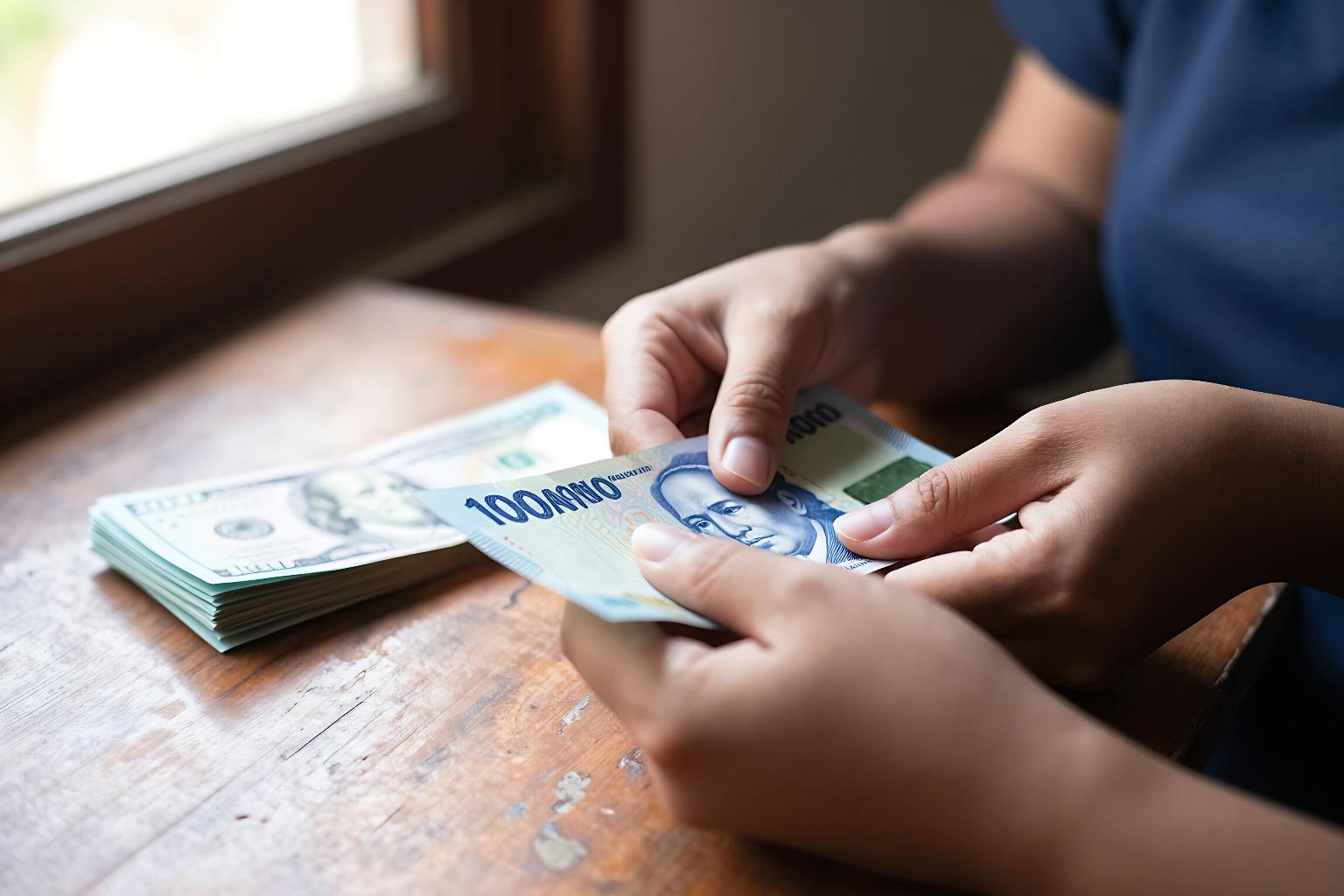
You check the rate on your phone, see ₱57.10 to the dollar, hand ₱100,000 across the counter, and walk away with less than the maths on your screen promised. Nothing shady happened. You just met the difference between the market rate and the retail rate, and that gap quietly trims a few percent off every conversion you'll ever make: a holiday fund, a semester of US tuition, a supplier invoice your small business needs to settle by Friday.
Here's how PHP to USD actually works, where the money leaks, and what to check before you hand anything over.
PHP is the ISO code for the Philippine peso. USD is the US dollar. Rates are almost always written as USD/PHP, which answers one question: how many pesos does it take to buy a single dollar?
That convention trips up more people than any fee does. If the quote moves from 56 to 58, the peso has weakened. Your ₱10,000 now buys about $172 instead of roughly $178. If it falls to 55, the peso is stronger and your money stretches further.
So for anyone converting pesos into dollars, a lower number is better. Headlines about "the peso falling" are just commentary on this one figure, and they mean the opposite of good news when you're the one buying dollars.
What Google, XE and Bloomberg show is the mid-market rate, also called the interbank or spot rate. It's the midpoint between what the biggest banks will buy and sell dollars for when they're trading tens of millions at a time. No retail counter can offer it, because no retail customer is moving institutional volume.
It's a useful reference point and nothing more. The same is true of the yen to USD rate you see on your screen, or any other pair you look up. The screen tells you where the market is, not what a teller will count into your hand.
Every bank and money changer quotes two prices: one to buy dollars from you, one to sell dollars to you. The gap between them is the spread, and it's the single biggest cost in a typical cash conversion.
Say the mid-market rate is 57.00. A retail counter might sell you dollars at 58.20. On ₱100,000 that's $1,718 instead of $1,754. You've paid about $36, or roughly 2%, without anyone mentioning a fee.
A counter advertising no commission is almost always recovering it through a wider spread. It's the same trick that makes USD to MXN conversions look cheaper than they really are. A service that charges ₱250 explicitly but trades close to mid-market often beats the "free" option.
There's only one question worth asking: how many dollars do I receive in total?
Spreads widen at weekends, on Philippine holidays, and outside Manila trading hours. They also widen for small amounts, because the fixed cost of processing gets spread over fewer pesos. Converting ₱5,000 twice costs noticeably more than converting ₱10,000 once.
At a mid-market rate of 57.00, ₱100,000 is $1,754.39. At a bank's 58.20, it's $1,718.21. That's a gap of $36.18 on one transaction. Scale it to a family paying a year of US tuition, or a business converting ₱2 million every quarter, and the difference runs into hundreds of dollars annually.
Currencies with large numbers per dollar can disguise the damage. The Vietnamese dong, hovering near 25,000 to the dollar, makes a 2% spread feel like pocket change when it's the same proportion of your money as anywhere else.
Four forces do most of the work:
Big, liquid pairs respond to the same ingredients. Movements in pound sterling to USD are driven largely by rate differentials and growth expectations, not by anything mystical about the currency itself.
Get an all-in quote from at least three places on the same day: your bank, a reputable changer, and an online service. Ask each one the same question: if I hand you ₱100,000 right now, how many dollars do I walk away with? The advertised rate matters less than the number at the end of the sentence.
A few habits that reliably help:
One habit outperforms everything else. Before you hand over cash, divide the pesos you're giving up by the dollars you're getting back. Compare that figure to the mid-market rate you saw on your phone. A difference under 1% means you've found a good deal. Above 3%, keep walking, because on ₱100,000 that gap is the price of a decent weekend away.
Slot ID: blog-post-bottom