
Loading article...
Slot ID: blog-post-top
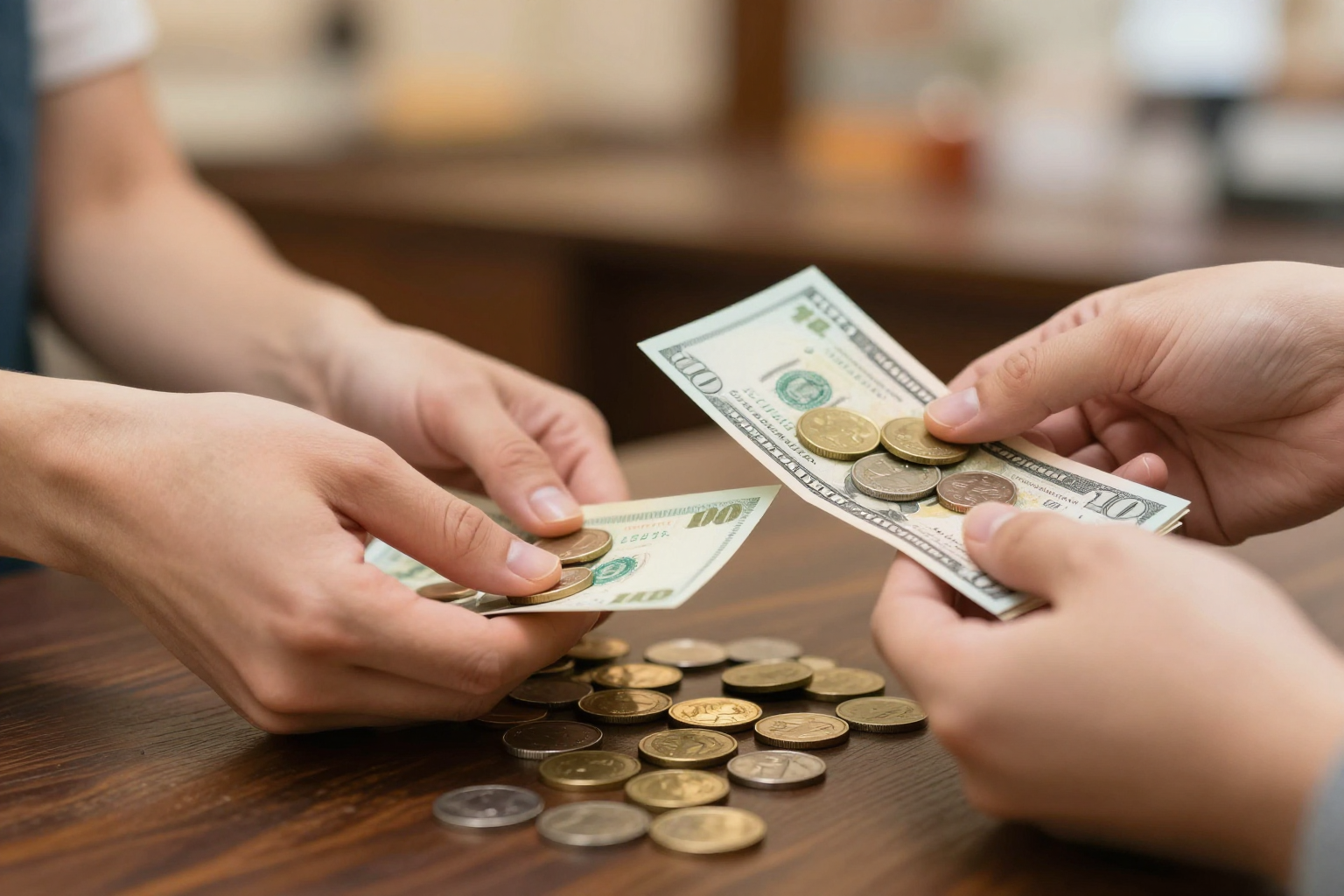
I once watched a traveler at the airport exchange $500 and lose $30 to a bad rate because they didn't plan. Thirty dollars is a meal, a museum ticket, or half a day of fun. The fix isn't hard — you just need a clear process. Here's the step-by-step process I use for every money exchange, with real numbers.
When you search "USD to EUR" on your phone, you get the mid-market rate — the rate banks use to trade with each other. You won't get that exact rate when exchanging physical cash. Businesses need to make money, so they add a markup called a spread. On top of that, some charge fees. Your job is to find the smallest total slippage between the mid-market rate and what you actually receive.
This is the core idea: you're not just comparing exchange rates; you're comparing the total cost of getting your money from one currency into another.
Before doing anything, decide how much cash you actually need. Let's use a concrete example: You're going to Tokyo for two weeks. You estimate you'll need ¥90,000, which is about $600 if the exchange rate is 150 yen per dollar. Write that number down. Do not go to a currency exchange shop and improvise — you'll be more likely to accept a bad deal.
Consider whether you even need that much cash. In Japan, cash is still king for small purchases, but many stores accept cards. If you're traveling to Sweden, you might get away with almost no cash at all. Your first step is to know your own spending habits and the card acceptance situation at your destination.
If you underestimate, you might be forced to withdraw cash at airport ATMs with terrible rates. Overestimate, and you'll now have leftover foreign currency that costs you money to convert back. Estimate to within 20% of your actual needs.
Open XE.com, Google, or your financial app, and find the current mid-market rate for the pair you need. For USD to JPY, let's say it's 150. For USD to EUR, maybe 0.92. Write this down along with the date. This is your benchmark.
Every offer you get later should be compared against this number. Let's say a currency exchange booth advertises 0.89 for USD/EUR. That means for every dollar, you get €0.89 instead of €0.92. That's a 3.26% markup. If they also charge a $5 fee, your actual cost is even higher.
For a deep dive into the mechanics of avoiding overpaying, check out how to exchange foreign currency without overpaying, which covers the same principles with more examples.
Most people check their bank and maybe the airport kiosk, then stop. There are actually five common channels:
If you're planning to use a brick-and-mortar shop, you'll want to read this currency exchange near me walkthrough to understand how to vet a shop before you step inside.
Don't just ask for the rate. Ask:
The answers will reveal the true cost.
Let's put all this together in a realistic scenario. You need €800 for a trip to Lisbon. The mid-market rate is 1 USD = 0.92 EUR. You have three options:
Option A: Local currency exchange store — Rate 0.89, no commission.
Option B: Online service like Wise — Rate 0.919, flat fee $10.
Option C: Your bank — Rate 0.90, but charges a $15 exchange fee.
To find how many dollars you need for €800:
Option A: 800 ÷ 0.89 = $898.88
Option B: (800 ÷ 0.919) + 10 = $870.51 + $10 = $880.51
Option C: (800 ÷ 0.90) + 15 = $888.89 + $15 = $903.89
So the cheapest is Option B, saving you $18 compared to Option A, and $23 compared to the bank. The bank actually ends up being the most expensive here, even though its advertised rate looks better than the local store's, because the $15 fee kills it.
This is why you must always do the full calculation with your exact amount.
After the math, you'll have a winner. Let's look at the nuances of each choice.
If you need money when you arrive, you can often send it to yourself via a service like Wise, with a much tighter rate than physical exchange counters. For example, you could transfer from your US bank account and then withdraw the local currency from a linked international account or have it deposited into a local bank account you've just opened. It's a little more setup, but the savings add up.
If you're sending money to a foreign bank account for this purpose, the process is similar to a regular international transfer. This international money transfer guide explains the steps and hidden fees you should watch for.
The best option for many travelers is simply using their debit card at an ATM in their destination country, provided their card has no foreign transaction fee and their bank doesn't charge an international ATM fee. The exchange rate is set by Visa or Mastercard, which is usually within 1% of mid-market. Check ahead: if your bank charges both a 3% international transaction fee and a $3 ATM fee, that's often worse than a physical exchange store. Do the same math as above with your specific fees.
For many places, you can survive on plastic alone. Credit cards that charge no foreign transaction fees are excellent. You get the mid-market rate plus a fee that's typically between 0% and 1%. If you do need cash, you can use a credit card cash advance, but that often has high interest. Better to bring a small bill for emergencies and rely on the card for everything else.
You've done the numbers, you've chosen a method — now execute without fumbling.
Set up your account, verify your identity, and transfer funds. Watch for the "rate lock" feature, which protects you against rate jumps for a few hours. Always double-check the recipient details, especially if you're sending money to your own account abroad.
Call ahead and ask for a quote. Some shops won't quote over the phone, but many will. When you arrive, if the rate is significantly different from the mid-market, simply say no thank you and leave. You're not obligated to accept. Look for shops that display their rates clearly and ask if they have any hidden fees. This Wise money transfer guide shows how online providers structure their pricing, which is a useful reference for comparing against local stores.
Choose an ATM attached to a bank branch, not a random street kiosk. When the screen asks if you want to accept the exchange rate, always choose to be charged in the local currency, not your home currency. The home currency conversion is a trap with a terrible markup.
The sneakiest money exchange cost is converting your leftover cash back to your home currency when you return. You'll pay the spread on the way in and again on the way out — effectively double fees. To avoid this, keep your cash amount slightly lower than you think you need and use your credit card as a buffer. If you do end up with a couple hundred yen left over, store it for your next trip rather than exchanging it back. Those bills don't expire, and they'll save you the round-trip spread.
By following this step-by-step process — from knowing your exact amount, to comparing total costs, to executing smartly — you can reliably get within 1-2% of the mid-market rate, instead of losing 8-10% at the airport. The only thing you're spending is twenty minutes of planning.
Slot ID: blog-post-bottom