
Loading article...
Slot ID: blog-post-top
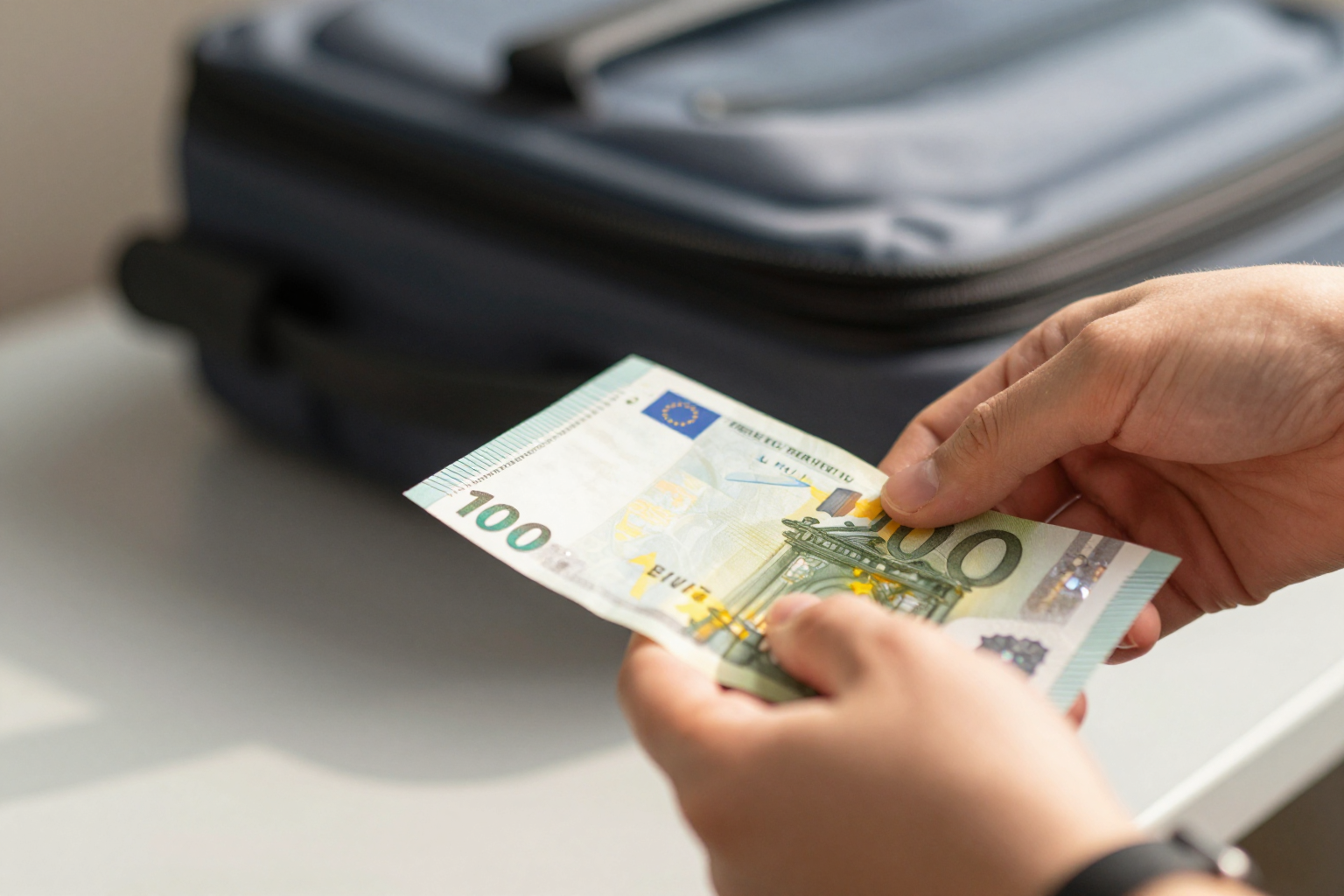
You need euros for an upcoming trip. You see that EUR/USD is trading at 1.10, which means one euro costs $1.10. So with $600, you figure you should get around €545. At the counter, however, they hand you €520. Where did that €25 go?
This is the first lesson in foreign currency exchange: the rate you see online isn't the rate most people pay. This page is a beginner's primer on the mechanics behind that gap and the total cost of converting money. No jargon, no unnecessary theory, just the real numbers.
At the most basic level, foreign currency exchange is the trade of one currency for another. You're always buying one and selling the other at the same time. When you exchange dollars for euros, you're buying euros and selling dollars. The two currencies together form a pair, and the exchange rate states the price of one unit of the first currency in terms of the second.
For example, EUR/USD = 1.10 means it takes 1.10 US dollars to buy one euro. If the rate moves to 1.20, the euro has strengthened, because it now costs more dollars. That matters even for a weekend trip because the rate decides how many euros your dollars will become.
You might assume a government or a central authority announces a daily rate. In fact, there isn't one. The figures you see on financial websites come from the interbank market, where global banks buy and sell currencies nearly 24 hours a day. They quote each other constantly, and the average of all these wholesale prices becomes the midpoint.
That midpoint is called the mid-market rate. It's the cleanest price available, but it's not directly accessible to individuals. It's the reference point that everyone from airport kiosks to mobile apps builds upon.
Mid-market rates change every second, so any rate you see is a snapshot from a moment in time. This constant flow is normal. Markets react to interest rate decisions, inflation reports, election outcomes, natural disasters, and even central-bank speeches. A slight change in sentiment can shift the rate by fractions of a cent, which adds up when you're exchanging large sums.
If the mid-market rate for euros is, say, 1.10, why does a booth quote you a different number? Because the booth needs to profit. It might sell you euros at a rate of 1.13, meaning you pay $1.13 for each euro. The difference between 1.10 and 1.13 is the spread, and it covers the provider's margin plus operational costs.
Here's a concrete example. Mid-market is EUR/USD 1.10. You want to spend $1,000. At the true rate, your math would be $1,000 ÷ 1.10 = €909.09. But an exchange counter sells euros at 1.13, so you receive $1,000 ÷ 1.13 = €884.96. That's roughly €24 less. Add a $5 service fee and you lose another $5 of buying power. A difference of this size is common; retail currency exchange visits often carry a 2% to 5% margin over the interbank rate.
Some providers advertise no commission but boost the spread to make a profit. Others show a fair rate and then hit you with a service charge. Many do both. You should only focus on the combined result: how many euros do you actually receive for your dollars? That total, measured against the mid-market rate, tells you how much the transaction really costs.
To spot the full cost, ask these three questions:
If you don't ask, you'll be quoted numbers that are easy to misunderstand.
When you're dealing with foreign currency exchange, you won't compare advertised rates, because every provider quotes a slightly different rate for the same moment. Instead, compare the total cost for a fixed amount.
Take a $1,000 conversion. Provider A offers EUR/USD at 1.110 with no fee. You'd receive $1,000 ÷ 1.110 = €900.90. Provider B posts 1.125 and charges $10. You'd receive ($1,000 - $10) ÷ 1.125 = $990 ÷ 1.125 = €880.00. In this example, Provider A wins, even though its rate looks similar on the surface.
It's easy to overlook a hidden fee. The long list of mistakes that quietly eat into your travel cash shows how often that happens. Read it before you stand in line; you'll start spotting the traps immediately.
Rates move because supply and demand never sleep. If European stocks are rallying, global investors might pile their money into euros, pushing the euro up against other currencies. If the US inflation report tops expectations, traders may expect the Federal Reserve to raise interest rates, which often strengthens the dollar. These shifts are often small, but for a big transaction, they can change the final amount significantly.
You don't need to follow market forecasts as a tourist. Just understand that movements of a few percent are completely normal. If you have time flexibility, you may want to time the trade. If you don't, focus on avoiding unnecessary fees.
The same logic carries over to electronic transfers. When you send money online rather than carrying cash, you're still dealing with exchange rates. But provider pricing works differently. The differences between a cash swap and a digital transfer are explained in our plain-English guide to sending money abroad; it's the best place to turn if your money needs to cross a border without physically traveling with you.
Not all channels give you the same deal. Here's a quick rundown:
Airport margins are often the highest. If you have no other option, that's fine; only swap a small amount there to get into town, then use a better option for the rest.
Before you commit to any of these, read our checklist of the rates, fees, and terms you should verify beforehand in our guide on what to check before you swap cash at an exchange desk.
Let's take a real-life scenario:
The mid-market rate is EUR/USD 1.10. A street exchange shop quotes 1.12 for physical cash and says it is a no-commission operation. You want to exchange $700 into euros.
At mid-market, you should receive $700 ÷ 1.10 = €636.36. At the quoted 1.12, you actually receive $700 ÷ 1.12 = €625.00. That's €11.36 less than the clean amount, which means your real cost is more than 1.8% of the transaction.
If the shop had added a €4 handling fee, your final cost would be even higher. That is why it pays to calculate the total cost before you hand over cash.
Set a single habit before you ever approach a counter: take out your phone and search for the current mid-market rate. Input the exact amount you plan to exchange. When the cashier gives you their rate, your phone gives you an instant comparison. If the provider's rate is off by more than 2-3%, you can politely walk away.
The mathematics of foreign currency exchange and money transfers are often buried under confusing advertisements about zero margins. The fundamentals are simple: you're trading one currency for another at a price set by global markets. Only you can make sure you're not overpaying for that privilege.
If you want practical, step-by-step instructions for your first physical swap, the tutorial on currency exchange for absolute beginners walks through a real counter transaction without skipping a detail.
Slot ID: blog-post-bottom