 Currencies
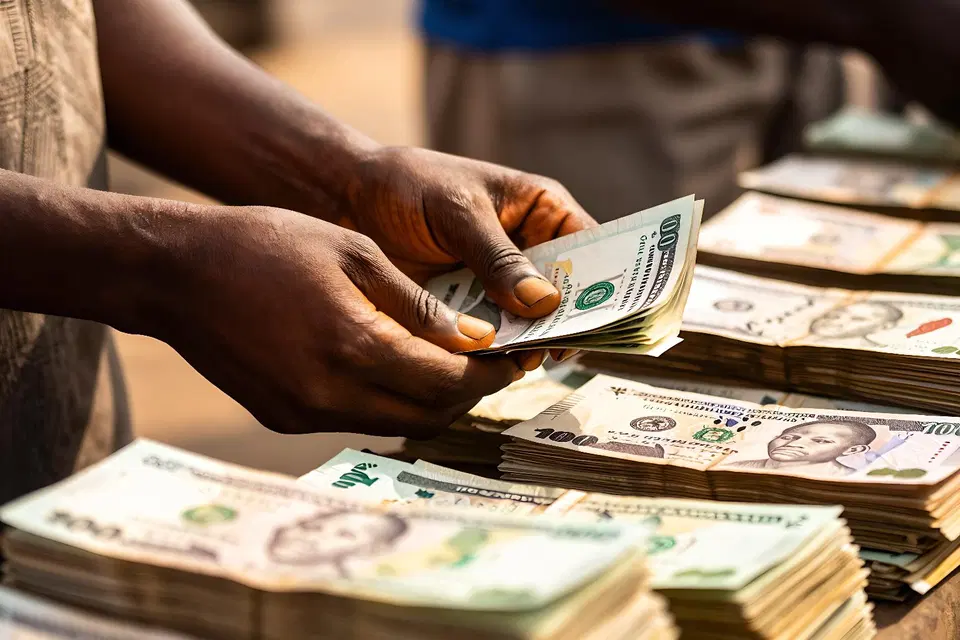
Type 100 into any USD to NGN converter and you get a clean, confident answer: ₦155,000, maybe. Then the alert lands and it reads ₦148,900. Nothing broke. Nobody stole anything, at least not in a way you could report. The converter answered a simple question — what is $100 worth? — while the actual transaction answered a harder one: what does $100 become after every party in the chain takes a slice?
Closing that gap takes about five minutes of attention. It's worth more than the fee you'd save by shopping around for an hour.
What $100 Converts to in Naira Right Now
Take a mid-market rate of ₦1,550 to the dollar. One hundred dollars is ₦155,000. At ₦1,480 it's ₦148,000. That ₦7,000 difference between two rates that both existed within a few months of each other is bigger than most transfer fees, which tells you where your attention should go.
The naira doesn't sit still. In mid-2023 the official rate hovered near ₦460 while street traders quoted ₦750 or more. By late 2024 the two had converged around ₦1,600, then drifted again. A converter is a snapshot, not a promise. If the page you're reading hasn't stamped a time on its rate, treat the figure as fiction until proven otherwise.
Four Rates for the Same Hundred Dollars
- Official window rate. The number banks and the central bank quote. Used for formal transactions, letters of credit, and anything with paperwork attached to it.
- Bureau de change rate. What you get at a BDC or from a street trader. Often better for cash, sometimes worse, and rarely identical on two consecutive days.
- Card rate. What Visa or Mastercard applies when you buy something abroad or pay a foreign subscription. It includes a conversion markup, usually somewhere between 1% and 3%.
- Remittance app rate. What Wise, Remitly, or a local fintech offers. This is the number that actually lands in someone's account, and it's usually the mid-market rate minus a margin.
Those four numbers can sit within 1% of each other, or 8% apart, depending on the week. The naira figure on your screen isn't what you get — the figure after the margin is.
The Spread Is Where Your Money Goes
Every provider makes money one of three ways: a visible fee, an invisible margin baked into the rate, or both at once. A service advertising zero fees is almost never free. It's charging you 4% on the rate instead, and on a hundred dollars that's ₦6,200 removed before you notice. A provider charging a flat $3 at mid-market converts $97 and hands over ₦150,350. The one with the visible fee is ahead by ₦1,550.
That's the counterintuitive part. A named fee can be cheaper than no fee at all. Converting USD to NGN without losing money on the rate comes down to comparing what lands, never what's advertised.
Worked example: three apps, one hundred dollars
- App A: rate ₦1,545, fee $0. You receive ₦154,500.
- App B: rate ₦1,545, fee $2.99. You convert $97.01 and receive ₦149,880.
- App C: rate ₦1,492, fee $0. You receive ₦149,200.
App C markets itself as free and delivers almost exactly what App B delivers while charging three dollars. Both trail App A by more than ₦4,600. The headline fee told you nothing useful in any of these cases.
Flip the Direction to Catch a Markup
Most converters give you one leg and stop. Flip it. If USD to NGN shows 1,550 while NGN to USD shows 0.000600, those two numbers describe different worlds. The second implies ₦1,666 to the dollar, roughly 7.5% worse than the first. Some sites keep both directions honest. Plenty don't, and the return leg is where the padding hides.
A converter that quietly pads the return leg is telling you exactly how it plans to treat your money. Believe it the first time.
Fixed Fees Bite Hardest on Small Transfers
A $5 fee on $100 is 5%. On $1,000 it's 0.5%. On $50 it's 10%. There's no clever way around that arithmetic — the same flat charge that's trivial on a rent payment is punishing on a birthday gift. If you send $100 regularly, a provider with a decent rate and a $0.99 fee will beat one with a slightly better rate and a $6 fee, even though the second one advertises louder and has the nicer app.
The same logic runs the other direction when someone in Nigeria is sending dollars out. Getting a fair rate rather than the one on your screen matters just as much on the way out as on the way in.
Doing the Maths in Your Head
You don't need a calculator for a rough check. Round the rate to the nearest fifty and multiply.
- $100 at ₦1,550: 100 × 1,550 = ₦155,000
- $250 at ₦1,550: 250 × 1,550 = ₦387,500, or simply 2.5 × 155,000
- $37 at ₦1,550: 37 × 1,550 = ₦57,350, close enough to ₦57,000 for a sanity check
A shortcut worth memorising: each dollar is roughly ₦1,500 plus change. So $100 lands near ₦150,000, $500 near ₦750,000, and $1,000 near ₦1.5 million. If a quoted figure is more than about 3% away from that estimate, something is being taken somewhere in the chain. Reading what that naira number actually means goes deeper into the interpretation.
What a Converter Page Should Show You
- The exact timestamp on the rate, not just the date.
- Which rate it is: mid-market, official, or a provider's own.
- Whether fees are included in the figure or added on top.
- The reverse direction, so you can spot padding in seconds.
- A named source for the data.
A page showing a number with no source and no date is decoration. It might be accurate. It might be quoting a rate from three weeks ago. You have no way to tell, and neither does the person waiting for your money.
Before You Send That Hundred Dollars
- Open two providers side by side and note what actually lands, not the headline rate.
- Check whether the fee comes out of the principal or gets added on top. It changes the maths more than you'd expect.
- Ask the recipient which bank they use. Some local banks credit remittances faster, and a few charge a receiving fee at their end.
- For anything above a few hundred dollars, watch the rate across two days. The naira moves enough that timing can be worth more than provider-shopping.
- Keep the reference number. If a transfer goes sideways, it matters more than any screenshot.
Cash versus transfer
If you're physically in Nigeria holding dollars, the BDC rate is what counts and the converter is a rough guide at best. If you're abroad sending money home, the app rate is the only one that applies and the street rate is trivia. Mixing the two up is how people end up furious about a rate they were never eligible for in the first place.
Reading the Naira Number Without Getting Burned
A hundred dollars is a small enough sum that most people skip the checking entirely. That's precisely backwards. Fees are fixed, so they eat the largest share of small transfers, and a 4% margin on $100 stings more in proportion than the same margin on a $5,000 wire.
So do the two-minute version. Pull up two converters, confirm what actually lands in the account, and compare it against the ₦150,000-ish rough figure for $100. If the gap is under ₦3,000, the provider is probably being straight with you. If it's ₦8,000, you're paying for something, whether or not it appears on the receipt.
The rate will have moved by the time you finish reading this. The arithmetic won't.