
Loading article...
Slot ID: blog-post-top
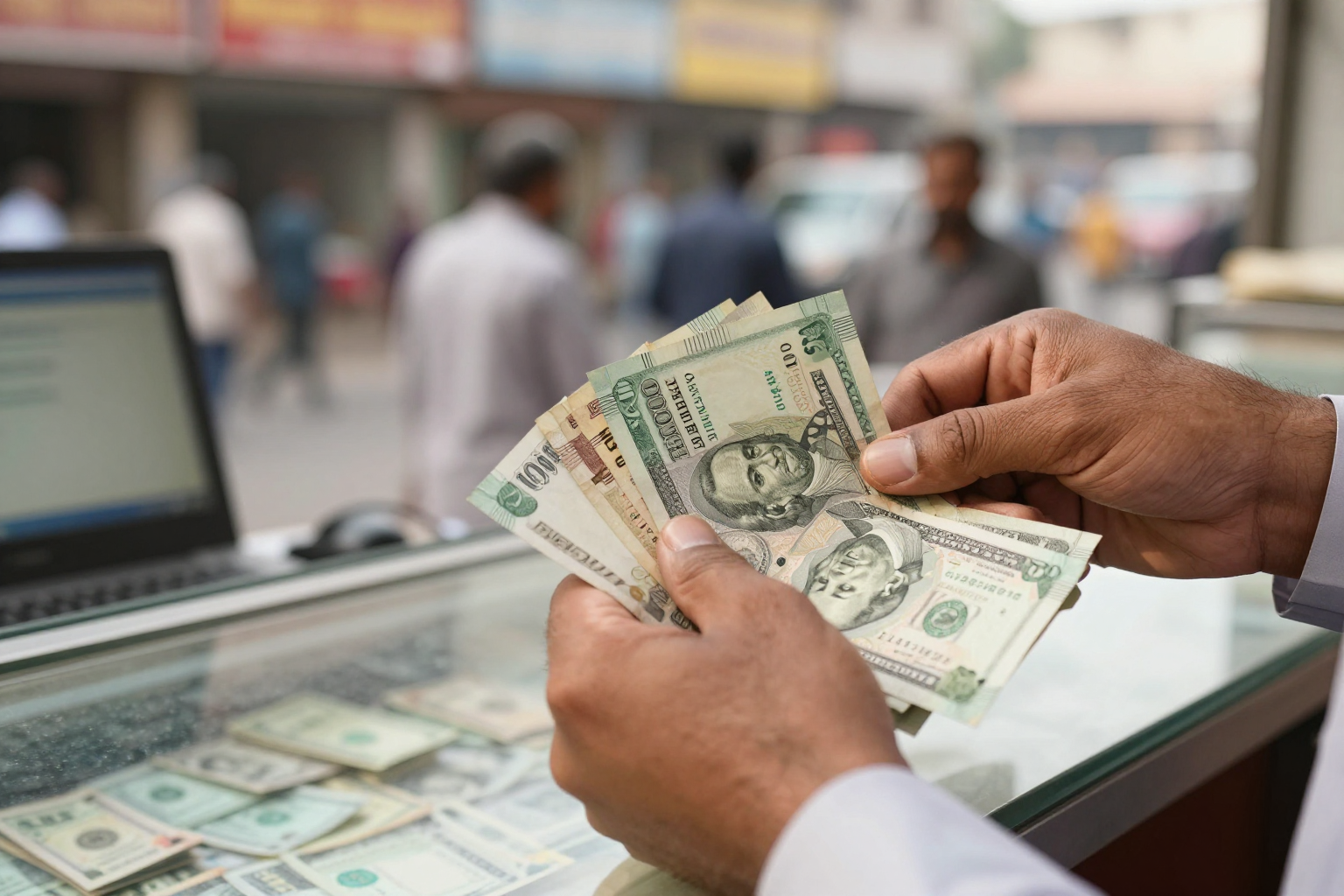
The US dollar exchange rate in Pakistan is one of those numbers that seems simple until you try to use it. You check a currency app, see 278.50, walk into a money changer in Lahore, and the board says something else. The gap isn't a trick. It's the difference between a reference rate and the price you actually pay for cash.
Understanding that gap matters whether you're sending money to family in Peshawar, buying dollars for a trip to Dubai, or paying an import invoice. Here's how the rate works, why it moves, and how to read it before you hand over your rupees.
Two main prices exist for the dollar in Pakistan: the interbank rate and the open market rate. The State Bank of Pakistan publishes the interbank rate, which is what banks use with each other and for large corporate transactions. The open market rate is what you see at currency exchange shops and what most individuals get when they buy or sell cash.
They usually sit close together, but not always. On a typical day, the interbank rate might be 278.50 PKR to the dollar while the open market quotes 279.75. That 1.25-rupee difference is not random. It reflects the cost of handling physical cash, the shop's margin, and the simple fact that supply and demand for bank deposits versus paper notes are different things. The rate on the board at a Pakistani currency counter often tells you more about local cash demand than about the broader economy.
If you're transferring money through a bank, the interbank rate is closer to what you'll get. If you're walking out with dollar notes, the open market rate applies. Mixing them up is one of the most common reasons people feel shortchanged. You Google 'USD to PKR', see the interbank number, then wonder why the money changer offers two rupees less. That's not a scam. It's a different market.
The rupee's value against the dollar changes for reasons that have little to do with what most people are doing that day. Pakistan imports a lot of fuel, machinery, and edible oil, and those payments are made in dollars. When global oil prices rise, importers need more dollars, demand goes up, and the rupee weakens. When overseas Pakistanis send more money home through official channels, dollar supply rises and the rupee can firm up.
Here are the big drivers to watch:
In 2023, the rupee briefly crossed 300 to the dollar before pulling back. Those swings are extreme, but they show how quickly sentiment can shift. For most people, the daily moves of 0.5 or 1 rupee matter less than the spread they pay at the counter.
Every money changer displays two numbers. The buying rate is what they'll pay you for your dollars. The selling rate is what they'll charge you to buy dollars. The difference is the spread, and it's how they make money.
Suppose the board says: buying 278.00, selling 280.00. If you sell $100, you get 27,800 PKR. If you buy $100, you pay 28,000 PKR. That 200-rupee gap is the cost of the transaction. On a small amount it feels minor. On $5,000, it's 10,000 rupees, which is a month's utility bill for many households. The difference between the screen rate and the cash in your hand is exactly this spread, plus any commission.
Search engines and currency apps usually show a mid-market or interbank rate. That number is a reference point, not a retail offer. No money changer will give you the mid-market rate because they'd make nothing. Banks add their own margin too, especially on small transactions. So when you see 278.50 online and the counter offers 276.50, the gap is normal. What matters is whether the gap is competitive compared with other shops nearby.
At around 279 PKR to the dollar, one dollar is not an abstract number. It buys a litre of petrol in most cities, or two kilos of tomatoes, or a cup of chai and a samosa with change. A $100 note is roughly 27,900 rupees, which covers a decent weekly grocery run for a small family or a tank of fuel for a 1.3-litre car. When you think about the exchange rate in those terms, it becomes easier to judge whether a trip to the money changer is worth the effort. The real purchasing power of one US dollar in Pakistan shifts with inflation, but the principle holds: the rate is a conversion tool, not a scoreboard.
You can't control the market, but you can control where and how you exchange. A few habits make a measurable difference.
Before you exchange, it also helps to know what the rate really represents. The meaning behind the USD to PKR quote before you exchange goes beyond the headline number, especially when banks and money changers are pricing in their own risk and liquidity needs.
Nobody consistently times the rupee. If you need dollars for a fixed expense, such as a visa fee or tuition payment, buying in two or three tranches over a few weeks smooths out the risk. If you're selling dollars, the same logic applies in reverse. Waiting for a perfect rate often leads to worse decisions than accepting a fair one.
For overseas Pakistanis, the exchange rate is only half the story. Fees and the receiving bank's rate matter just as much. Sending $500 through a bank that offers 277.50 with a $5 fee nets about 138,750 PKR. A service offering 279.00 with no fee nets 139,500 PKR. That 750-rupee difference is real money for the family receiving it. Business owners dealing with imports often use forward contracts to lock in a rate for future payments, which protects them from sudden swings but also means they don't benefit if the rupee strengthens.
The daily noise of the dollar rate can be distracting. What actually moves the needle for a household or a small business is the all-in cost: the rate, the spread, the fee, and the speed of settlement. A rate that looks 1 rupee better can be worse once the fee is added.
Keep an eye on the State Bank's foreign exchange reserves, the current account balance, and global oil prices. Those three indicators tend to set the tone for the rupee. A steady build in reserves and a manageable current account deficit give the central bank room to smooth out volatility. A spike in oil or a delay in external financing can quickly reverse that. For anyone exchanging regularly, a simple weekly check of the interbank and open market rates is enough to spot a trend without obsessing over daily ticks.
The next time you need dollars, don't rely on the single number on your phone. Ask for the buying and selling rate at two or three counters, calculate the total cost including fees, and compare that with what you actually need. The US dollar exchange rate in Pakistan is a price, and like any price, it's worth shopping around for.
Slot ID: blog-post-bottom