
Loading article...
Slot ID: blog-post-top
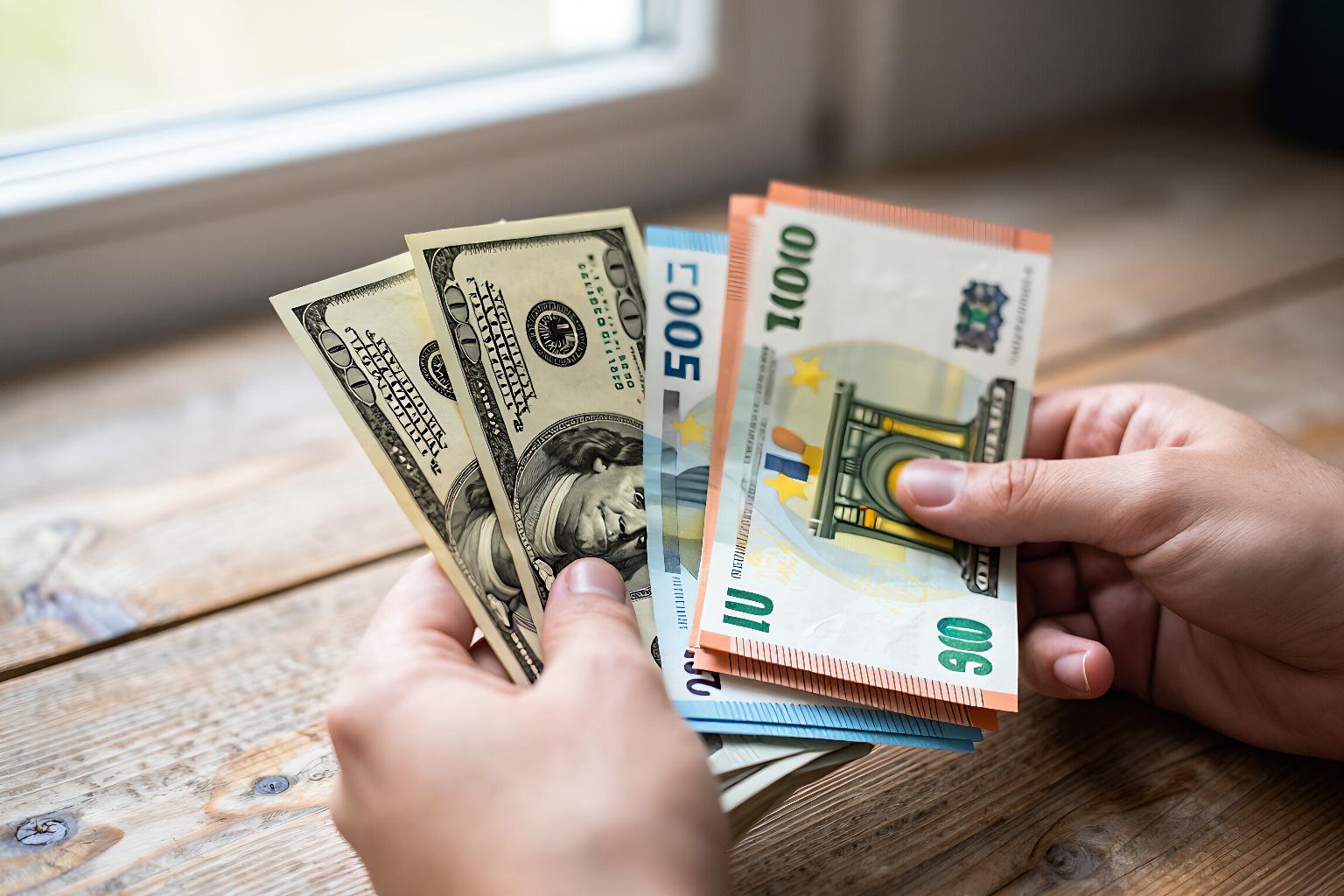
You've finally booked that trip to Portugal, or maybe your client in Germany just sent you an invoice in euros. The next thing on your mind is the dollar to euro exchange rate. And for good reason: a difference of even 2% can mean roughly €20 on a $1,000 transfer. For a small business, that adds up fast.
But the rate you see on Google isn't the rate you actually get. Depending on where you convert your dollars, the real exchange rate can be 3%, 5%, or even 10% worse. In this guide, we'll break down how the USD to EUR rate works, what influences its daily swings, and how to get closer to the mid-market rate when you convert.
The rate is simply the price of one currency in terms of another. When you search 'dollar to euro', you'll usually get a number like 1.10. That means one US dollar buys 1.10 euros. Wait – but is that correct? Actually, if 1 USD = 1.10 EUR, that would mean the euro is weaker? No, because historically 1 EUR was more than 1 USD. Actually, as of 2024, 1 USD is about 0.92 EUR, and 1 EUR is about 1.09 USD. So watch out: 'dollar to euro' can be quoted two ways. The convention in currency markets is EUR/USD (euro per dollar), which means 1 euro buys X US dollars. But when people say 'dollar to euro', they often mean how many euros you get for a dollar. So in this article, I'll use USD/EUR to mean the number of euros you receive for each dollar. For example, if the USD/EUR rate is 0.91, you get 0.91 euros for every dollar.
That may seem trivial, but confusing the two is a common way people end up miscalculating their trip budget. If you see a rate of 1.08 and assume you'll get 1.08 euros per dollar, you're actually looking at the EUR/USD rate. The actual dollar-to-euro rate would be about 1/1.08 = 0.926. So for $500, you'd get around €463, not €540.
Understanding the difference between direct and indirect quotes is central to getting a fair deal on any currency pair. If you prefer the other direction, our guide on how to read EUR/USD walks through the same mechanics in more detail.
The USD to EUR rate is a live auction with millions of participants: banks, hedge funds, exporters, and even central banks. Its daily swings are driven by a few key forces.
The Federal Reserve and the European Central Bank (ECB) set short-term interest rates. When the Fed raises rates, dollar assets become more attractive to global investors, who buy dollars and push the USD higher against the euro. Conversely, if the ECB raises rates while the Fed holds steady, the euro tends to gain. As of late 2024, the Fed has been cutting rates while the ECB has been more cautious, which is one reason the euro has been firming.
Traders look at inflation, GDP, unemployment, and consumer confidence for both the US and the eurozone. A surprising rise in US inflation might increase expectations of higher Fed rates and boost the dollar. Weak German industrial output or rising Italian debt concerns can weigh on the euro. These data points often arrive weekly, so the rate can move noticeably even in a trading session.
For a deeper look at all the factors behind this currency pair, our analysis of what moves the Euro USD exchange rate is a good next read.
Elections, trade talks, and geopolitical events can cause jumps. For example, when the UK voted to leave the EU in 2016, the euro dipped against the dollar in the short term. Similarly, a US government shutdown or a debt-ceiling crisis can put pressure on the greenback. These are hard to predict, but the effect is often temporary.
When you convert dollars to euros at a bank or an airport kiosk, you won't get the mid-market rate. Every provider adds a margin to cover their costs and make a profit. That margin is called the spread. For a small exchange office, the spread can be as wide as 5-8%. Most online money transfer services charge 0.5% to 2% on top of the mid-market rate, plus a fixed fee.
Let's put numbers to it. On a given day, the mid-market rate is 0.92 USD/EUR (that is, $1 = €0.92). If you exchange $2,000 at a bank that gives you 0.90, you receive €1,800. At the real rate, you'd get €1,840. That difference of €40 is your cost. For a large amount, like paying a tuition bill or buying a property in Spain, this can be thousands of euros.
This spread isn't exclusive to the dollar to euro pair. The same mechanics apply when you're moving money between other currencies – you can see the pattern in a guide to Canadian dollars to USD, and the Australian dollar behaves similarly in the AUD to USD market. The takeaway is universal: shop around before you convert.
Some services advertise '0% commission' but slip the margin into the exchange rate. Others show a decent rate but charge a transfer fee that makes the total cost higher. Always calculate the final amount you'll receive in euros, not just the headline rate.
So, where do you actually go? The right option depends on whether you're exchanging cash before a trip or sending money electronically.
Before you lock in a conversion, use an online comparison tool or a rate alert. Set an alert at a level you're comfortable with, then wait for the rate to hit that level. But don't obsess over timing – the market moves in both directions, and a 1% improvement isn't worth missing a payment deadline.
If you're worried about timing the market, convert half now and half later. That way, you average out the rate. It's a simple hedging strategy that can reduce your anxiety and protect you from a sudden shift.
Forecasting exchange rates is notoriously difficult. Even professional economists often get long-term predictions wrong. That said, you can keep an eye on a few indicators: the interest rate gap between the US and the eurozone, the health of the German export sector, and whether the European Central Bank is buying or selling government bonds. If you follow our blog, you'll have a head start on understanding these signals.
For a real-world example, consider a traveler heading to France. If they exchange $1,000 at 0.92, they get €920. If they'd used a provider giving 0.90, they'd get €900. That's enough to cover two nice dinners in Paris. The lesson: even small rate improvements matter.
Now that you know how the dollar to euro rate works, the next step is to compare the costs of transferring money. Pick the method that fits your situation and keep more of your money in your pocket.
Slot ID: blog-post-bottom