
Loading article...
Slot ID: blog-post-top
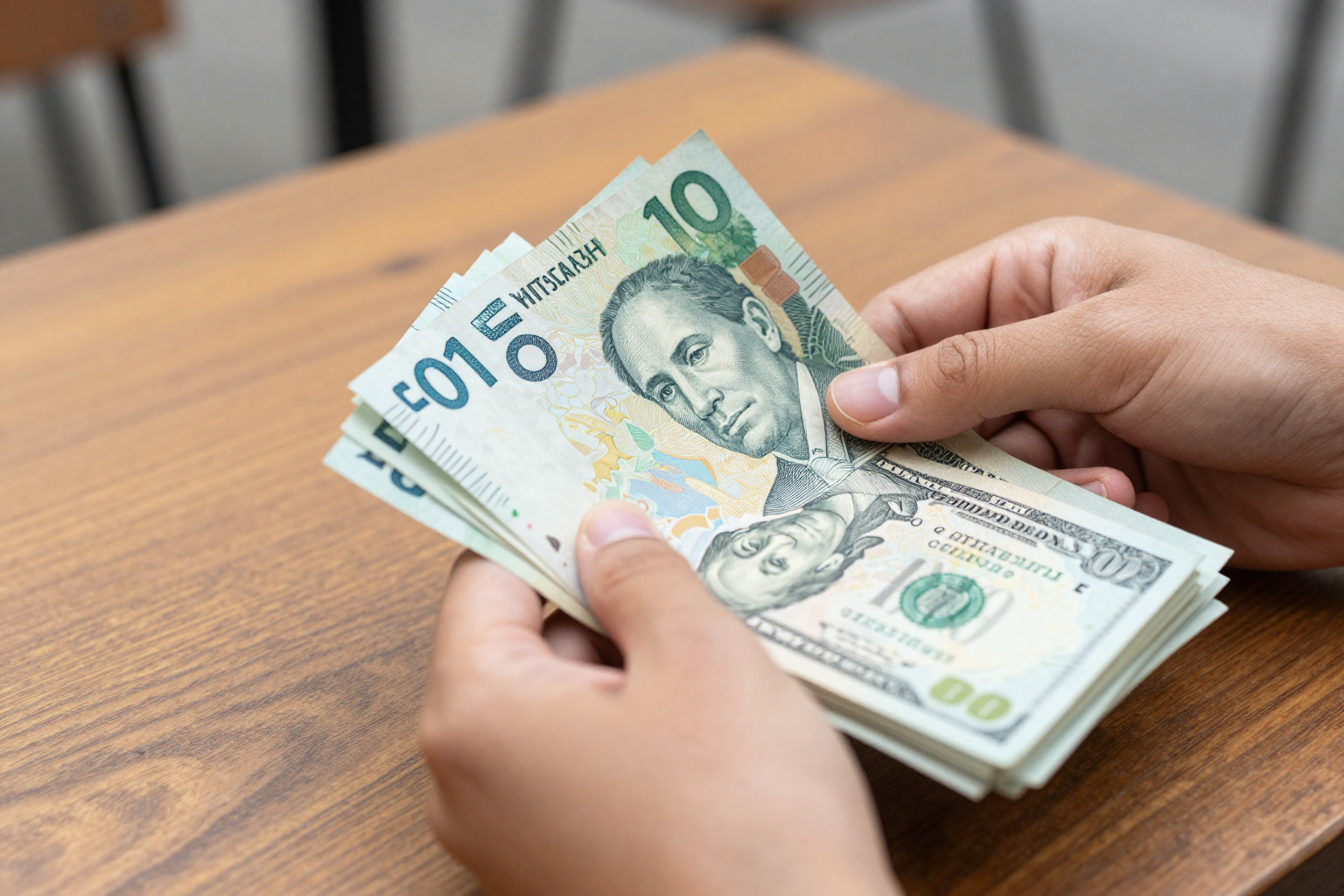
If you're heading to Bogotá, Medellín, or the beaches of Cartagena, the Colombian peso (COP) is about to become very important to you. On paper, the exchange rate between the Colombian peso and the US dollar can look generous: one dollar can buy you thousands of pesos. But the number you see on Google or in a currency converter app is rarely the number you actually get when you change money. The gap between the official rate and the rate handed to a traveler can quietly turn a great deal into an expensive one.
This article walks through how Colombian peso to USD conversions really work, where the hidden costs hide, and how to hold onto more of your money no matter which side of the transaction you're on.
The Colombian peso trades under the currency code COP. Its symbol is the same dollar sign ($) used for US dollars, which creates a lot of confusion for tourists. A price tag that reads $50.000 in Colombia means 50,000 Colombian pesos, roughly $12.50 at an exchange rate of 4,000 COP to USD. If you read it as dollars, you'll dramatically overestimate the price. Always look for the currency code or ask explicitly when someone quotes a price.
Although the peso is technically divided into 100 centavos, you won't see centavo coins anywhere. Inflation destroyed centavo circulation decades ago. Instead, cash comes in denominations of 1,000, 2,000, 5,000, 10,000, 20,000, 50,000, and 100,000 pesos, with smaller coins of 100, 200, 500, and 1,000.
When you search for "Colombian peso to USD" on Google, you get something called the interbank rate or the wholesale market rate. This is the rate at which large banks trade currencies with each other, trading in multiples of millions of dollars. It is not the rate a bank or exchange office offers you. The displayed rate is also a mid-point between the buying and selling price that professional traders use. There is no central authority that forces banks to give this same price to consumers.
The Colombian peso is one of the more volatile currencies in Latin America. It reacts to movements in oil prices, US Federal Reserve interest rate decisions, Colombian monetary policy, domestic politics, and global investor confidence. A rate that seemed stable in the morning can look different by lunchtime.
Because the peso can fluctuate by 50 or even 100 pesos in a day, when you compare rates you need to compare at the same moment and against the true mid-market rate for that exact time, not against the rate you saw last week.
Every currency exchange service, whether it is a bank, a kiosk at El Dorado airport, or an online transfer service, earns money by setting two rates:
Walk into a casa de cambio in Bogotá and the board will usually show both rates. If the mid-market rate is 4,000 COP/USD, the place may offer 3,900 when buying your dollars and sell you dollars at 4,100. The difference between those two numbers is the spread, and that's where the profit lives.
Currency exchange desks inside airports notoriously offer some of the worst Colombian peso to USD conversion rates. They rely on convenience and your last-minute panic. If you exchanged $500 at an airport desk paying you 3,800 pesos per dollar, you would receive 1,900,000 COP. At the 4,000 mid-market rate, you should have received 2,000,000 COP. That one exchange just cost you 100,000 COP, which is roughly $25. For a traveler changing several hundred dollars, airport spreads can turn into a lost dinner or two.
Many exchange offices advertise free transactions or zero commission. That sounds generous, but they can still profit by skewing the exchange rate against you. The spread can be wide enough to generate 5, 10, or 15% profit without a separate fee. You are not avoiding the cost. You are just paying for it invisibly inside the exchange rate.
The same mechanism explains why that compelling quote you see online, described as the rate of the day, never quite matches what appears in your bank statement. It is the same problem you run into when changing US dollars to Philippine pesos, where the rate you see isn't the rate you get.
If you pay with a plastic card issued abroad, you are effectively making a Colombian peso to USD conversion every time you make a purchase. Most American and European cards charge a foreign transaction fee, typically between 2 and 3%, on top of the Visa or Mastercard wholesale exchange rate. On a purchase of 1,000,000 COP, a 3% foreign fee adds roughly $7.50 to your bill when the exchange rate is around 4,000.
You will often be asked whether you want to be charged in dollars or in pesos. If you choose US dollars, you select dynamic currency conversion. The restaurant, shop, or ATM terminal then sets its own exchange rate, often adding an extra 5 to 10% margin. Always choose to be charged in the local currency. The only downside is that your bank will apply its normal foreign transaction fee, but that is still usually cheaper than accepting a merchant's arbitrary exchange rate.
ATMs in Colombia can be a great way to access cash at a reasonable rate, but they are also a common spot for losing money. The ATM will first ask you to accept the bank's own exchange rate. If you hit "Accept", you approve the dynamic currency conversion. Then, the local bank often charges its own ATM usage fee, which is announced on the screen and applies if you accept or decline the conversion. Decline the dynamic conversion, accept the paying with a credit card example already. Use a debit card that reimburses ATM fees if necessary.
When you withdraw, instead of withdrawing 2,000,000 COP, consider the daily limit and the fixed ATM fee. Withdrawing a single small amount can result in a disproportionately high fee. Where it is safe and practical, withdrawing less frequently but in larger amounts reduces the impact of fixed fees.
Let's do some concrete math. You need 3,000,000 COP in cash for a one-week trip to the Coffee Triangle.
Now imagine converting a larger amount for paying a supplier, a freelance invoice, or family transfer. If you send 10,000,000 COP, a 150-peso gap in the rate is the difference between paying about $2,500 and $2,597. That is not trivial, and it explains why more people are choosing to investigate their options before settling on the first conversion they see.
This same kind of sensitivity applies whether you are converting US dollars to Mexican or Philippine pesos, since the underlying fee structures in different countries have more in common than you might think.
If you are sending money internationally, specialist money transfer services like Wise, Revolut, Remitly, and WorldRemit usually offer much better Colombian peso to USD rates than banks. They quote near the mid-market rate and list their fees transparently. Your bank will often be the most expensive channel for an international wire transfer.
If you are traveling, consider using a travel-friendly card that converts automatically at Visa or Mastercard's wholesale exchange rate. These cards also offer better protection than stashing large amounts of cash in your backpack.
Once you are in the city, Casa de Cambio exchange offices typically provide better rates than airports and hotels. They are everywhere in central Bogotá, Medellín's El Poblado neighbourhood, and busy tourist areas. The quoted rate can vary by up to 50 pesos per dollar between two offices just a block apart. Take a minute to look at the glass door rates and compare using your own currency converter app.
Never resort to street hustlers offering "better than the banks" exchange on the sidewalk. Getting counterfeit 50,000-peso notes is a real risk, and there is no recourse if you are shortchanged.
Whether you are dealing with Colombian pesos, US dollars to Thai baht exchanges at tourist hotspots, or any other emerging market currency, the basic discipline is the same:
If you take away the exchange rate figure gave you a rough sense of the value. The true cost depends on who is selling you those pesos, what hidden margin they have embedded, and what fees pile up along the way. The gap between the best and the worst Colombian peso to USD conversion is rarely a rounding error.
Slot ID: blog-post-bottom