 Currencies
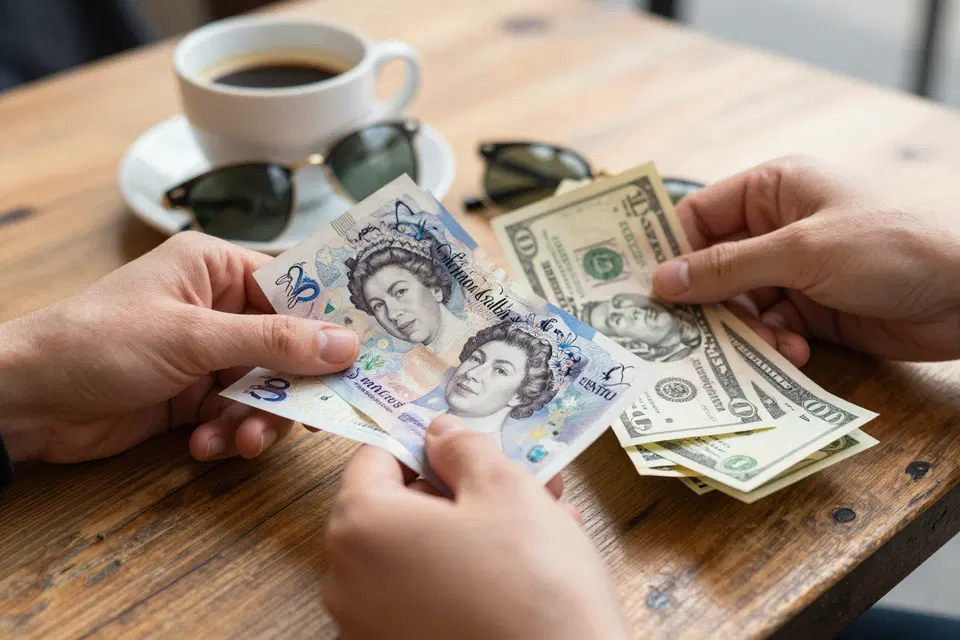
Type £500 into a British pound to US dollar converter and an answer appears before you've lifted your finger: maybe $631, maybe $658, maybe $604, depending on the week. The arithmetic takes no skill. Knowing whether the number on that screen will be the number that lands in your account is the part that actually matters.
Most people treat a converter as a calculator. It's better used as a diagnostic tool. It tells you what the pound is worth in the wholesale market at that second, and everything that follows is a question of how much of the gap between that figure and your final amount you're willing to hand over.
What a British pound to US dollar converter is really showing you
The rate you see is the mid-market rate, sometimes called the interbank rate. It's the midpoint between the highest price buyers will pay for pounds and the lowest price sellers will accept, pulled from the foreign exchange market where banks and funds trade in blocks of millions. Nobody walking into a bank branch or opening an app gets that rate. It's a reference point, not an offer.
GBP/USD has a nickname in the trade: cable, from the days when the rate travelled by transatlantic telegraph. It's one of the most heavily traded pairs on earth, which is good news for you. Deep liquidity keeps the spread tight, so a converter quoting 1.2714 is usually close to the truth rather than a fiction.
Why the rate you're offered is always a little worse
Two costs sit between the mid-market number and your money.
The first is the spread. A provider buys pounds slightly below mid-market and sells them slightly above it. On a good day that's 0.3% to 0.5%. On a bad day, at a bank branch or an airport counter, it's 3% or more.
The second is the flat fee. Some providers quote a near-perfect rate and charge £5 or £20 for the privilege. Others advertise zero commission and bury the cost in the spread instead. You have to compare both things together, which is precisely what the marketing is designed to discourage. There's a fuller explanation in why the rate you see isn't the rate you get, and the logic runs the same in either direction.
The only number that counts
Ignore the headline rate. Ignore the fee. Divide the total dollars you receive by the pounds you're converting and you have an effective rate. Compare that across two or three providers and the choice becomes obvious in about ninety seconds.
A worked example on £1,000
Say the mid-market rate is 1.2700, so £1,000 is worth $1,270 in the wholesale market.
- High street bank: rate of 1.2319, no visible fee. You receive $1,231.90. Cost: $38.
- Travel money kiosk: rate of 1.2100 plus a £4.50 handling charge. You receive $1,204.23. Cost: $66.
- Online transfer service: rate of 1.2660 with a £3 fee. You receive $1,262.20. Cost: $8.
Same pound, same day, a $58 gap between best and worst. On £10,000 that becomes $580, which is a flight, a hotel night, a decent slice of a holiday. If you want the maths laid out further, this breakdown of what your £1,000 really buys in dollars runs the numbers in more detail.
What actually moves GBP/USD
The rate isn't random, though it often looks it. A handful of forces do most of the work.
Interest rate expectations
Money drifts toward higher yields. When the Federal Reserve looks likely to hold rates higher for longer than the Bank of England, dollars tend to strengthen. A shift in the market's expected path, even by a quarter of a point, can move cable half a percent in minutes.
Inflation and jobs data
UK CPI on a Wednesday morning, US non-farm payrolls on a Friday afternoon. These releases are scheduled, public, and regularly produce swings of 0.3% to 0.7% within an hour. If you're converting a large sum, knowing the calendar is free money.
Risk appetite
The pound is a risk-sensitive currency. In a global selloff, sterling usually falls against the dollar, because the dollar is the market's favourite hiding place. If you're converting because markets make you nervous, you already have a currency headwind to deal with.
Timing the market, or not
Nobody calls the top of GBP/USD consistently. Professionals who try get it wrong with expensive regularity. What you can control is your exposure to any single day's rate.
If you need dollars in three months, a forward contract locks in today's rate for a small deposit. If you're flexible within a few weeks, set a rate alert at a level you'd be happy with and let the converter do the watching. Moving a large amount? Split it into three or four conversions across a month, which smooths out the worst-case timing without any forecasting skill whatsoever.
The traps that cost people most
Airport bureaux de change are the loudest offender, routinely 8% to 12% off mid-market. You're paying for convenience and a captive audience. Ordering online for collection, or having cash delivered to your door, typically halves that penalty.
"Commission free" is a phrase, not a discount. So is "best rate guaranteed," which usually means the best of a small set of rates chosen by the seller.
Watch for dynamic currency conversion at card terminals abroad. When a machine offers to charge you in pounds rather than dollars, decline it. The markup is often 4% to 6%, applied by the merchant's bank rather than yours.
Weekend rates deserve a thought too. Markets close on Friday evening and reopen on Sunday, and many providers widen spreads across that window because they're carrying risk. Convert on a Tuesday if the figure genuinely matters.
When you're going the other way
Dollars to pounds brings its own quirks. US providers sometimes quote a rate that looks competitive but apply it to the wrong side of the spread, and receiving banks occasionally take a cut on top. Before you commit, it's worth reading up on what the rate is really costing you on the return leg. Converting from euros or another currency as well? The same habit of comparing effective rates applies to a euro-to-dollar conversion.
The five-minute check before you hit convert
Run through this and you'll rarely be caught out.
- Look up the mid-market rate on a neutral converter, not one owned by the provider you're about to use.
- Ask for the total your recipient will actually receive, in dollars, after every fee has been applied.
- Divide that total by your pounds to get the effective rate, then check it against one alternative.
- Scan the economic calendar for UK or US data due in the next 48 hours.
- Confirm how long the quoted rate is held and what happens if it expires before your money arrives.
- For anything above a few thousand pounds, ask whether a limit order or forward contract is available.
The gap between a careless conversion and a considered one is usually somewhere between 1% and 4%. Barely noticeable on £200. Rather more painful on a house deposit or a year's tuition. A converter is a starting point, and the genuinely useful work happens in the thirty seconds after you read the number, when you ask what it will actually cost.