
Loading article...
Slot ID: blog-post-top
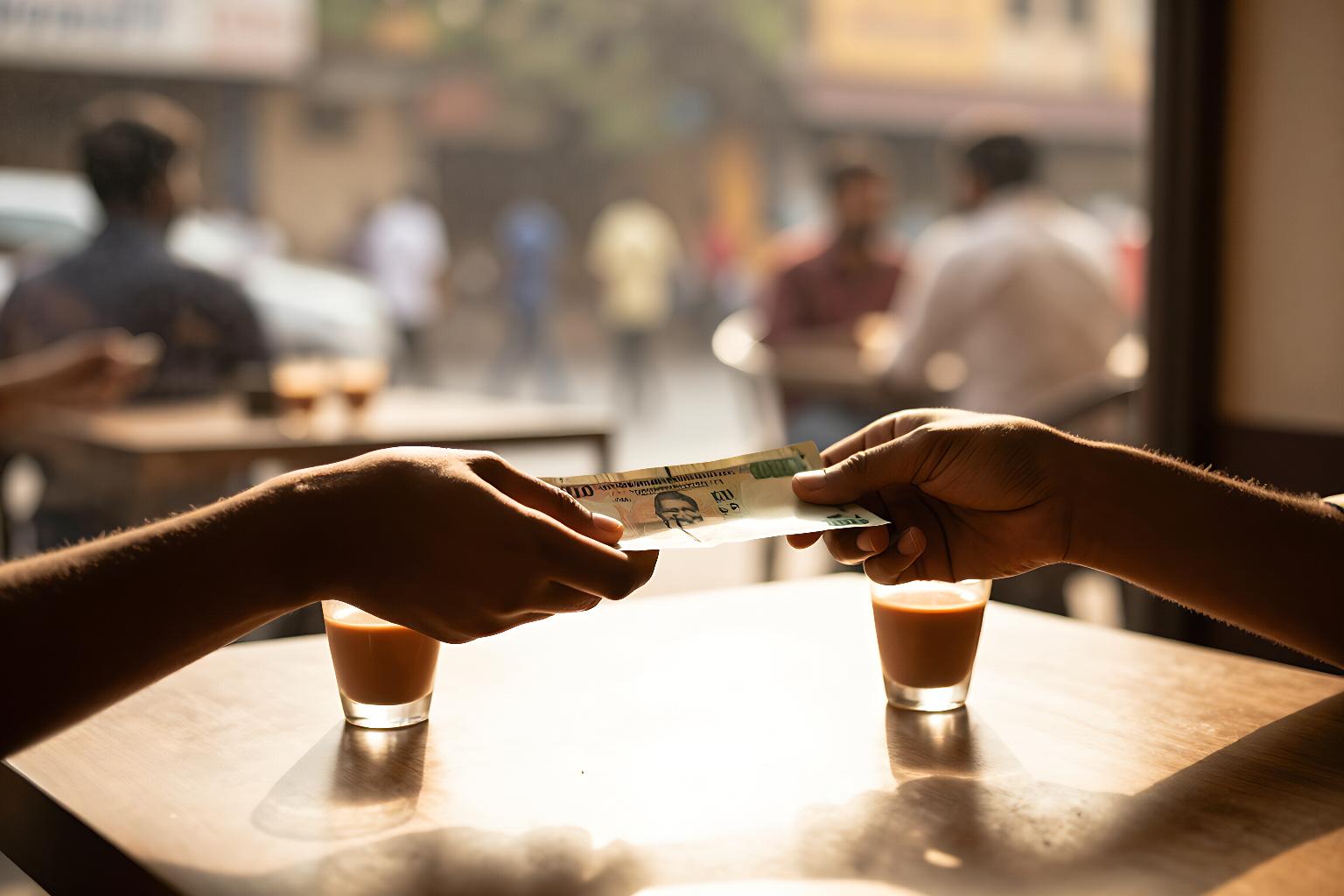
Type "1 US dollar in Indian rupees" into a search bar and you get one clean number, something like ₹86.50. It looks like the whole answer. It isn't. Nobody converts money at that number, and knowing it alone tells you nothing about whether your bank just kept ₹1.60 per dollar or ₹4.
This is a walkthrough of the actual process: find the real rate, do the maths, spot the charges hiding outside the quote, and choose the right channel for the amount you're moving. Every figure below is worked out step by step so you can copy the method with your own numbers.
At the time of writing, the mid-market rate sits near ₹86.50 to the dollar, though it drifts daily and you should treat any number here as an illustration rather than a quote. The mid-market rate is the midpoint between what buyers and sellers of dollars agree on in the wholesale market. Banks and transfer services buy dollars slightly below it and sell slightly above it. That gap is their revenue, and it comes out of your pocket.
The Reserve Bank of India publishes a reference rate around 12:30 pm IST on working days, which is the number used for customs duties, some contracts and official conversions. It tracks the wholesale rate closely. What matters for you is simpler: the rate you're offered is the mid-market rate minus a margin, so your entire job is shrinking that margin.
Before you talk to a bank or open an app, get a benchmark. Check the RBI reference rate, Google's converter, or a service like XE, and note the figure. Two independent sources are enough, and it takes about forty seconds.
This step exists because providers lean on the fact that most people don't have a benchmark. A rate that looks perfectly normal can sit 2% below the market, and 2% of $2,000 is ₹3,460. If a quoted rate ever looks better than mid-market, there's a fee waiting somewhere else in the transaction, a pattern that shows up constantly in how hidden markups get buried inside an exchange rate.
The arithmetic is one line: dollars × the rate you're offered = rupees received. Run it twice, once at mid-market and once at the quoted rate, and the difference is your true cost.
Assume mid-market is ₹86.50 and your bank's inward buying rate is ₹84.90:
Notice how quickly a ₹1.60 gap compounds. A spread that looks trivial at $1 becomes a serious line item at $5,000, and it's the single biggest cost in most conversions.
The spread is only the first layer. Here's what else typically lands on a dollar-to-rupee conversion:
These charges behave identically no matter which pair of currencies you're moving, which is why the same checklist appears in the step-by-step breakdown of converting £1,500 to dollars without losing $180.
Small sums get eaten by fixed costs. A ₹295 handling charge on a $100 transfer is nearly 3.5% on its own. Use your existing bank relationship, skip airport kiosks entirely (their margins run 3% to 6%), and don't stress about optimising a $50 conversion.
This is where online specialists win. Their margins usually land between 0.35% and 0.8%, and many route directly into Indian bank accounts with no receiving charge. The savings against a typical bank spread run into thousands of rupees, and the logic is the same whether you're converting $3,000 or £2,000, as shown in this guide to comparing transfer fees on a mid-size conversion.
Call and ask for a better rate. Banks have discretionary pricing above roughly $5,000 and will usually move if you mention a competing quote. Get the offer in writing, including the total rupees credited, not just the rate.
Mid-market rate: ₹86.50. Sending amount: $500.
Route A, a traditional bank. Inward buying rate of ₹84.90 gives ₹42,450. The receiving branch charges ₹250 plus GST, about ₹295. Final credit: ₹42,155. That works out to ₹84.31 per dollar, or 2.5% below mid-market.
Route B, an online specialist. A margin of 0.45% gives ₹86.11 per dollar, so $500 becomes ₹43,055, and most Indian banks don't charge for these credits. Final credit: ₹43,055.
The gap is ₹900 on a single $500 transfer. Scale that to $5,000 and you're looking at ₹9,000 for what amounts to twenty minutes of comparison shopping. If you're moving money in the opposite direction or via a different corridor, the same framework applies, as laid out in a practical guide to converting $2,000 across borders.
The receiving side has its own paperwork, and it's where transfers get delayed.
The recipient needs a KYC-compliant account with PAN and, for larger amounts, documentation of the purpose. Your bank will assign a purpose code, typically something like family maintenance, salary, or services. Under FEMA rules, inward remittances are straightforward, and there's no TCS on money coming into India, unlike outward remittances under the Liberalised Remittance Scheme.
Credits usually land in one to three working days. If it's taking longer, the correspondent bank is the usual culprit, not the Indian branch. And if the recipient holds an NRE or NRO account, confirm the conversion rules first, because treatment of interest and repatriation differs between the two.
None of this requires expertise, just a repeatable habit. Check the mid-market rate from two sources. Write down what the provider's rate actually is. Multiply your amount by both numbers and look at the rupee difference, not the percentage. Add the flat fees and the GST on the receiving end. Then compare one alternative, and only one, because two options are usually enough to expose an expensive quote.
Do that and the headline rate stops being a piece of trivia you scroll past. It becomes the yardstick you measure every offer against, whether you're converting a single dollar or your entire savings. The number on the screen is just the starting point; the rupees in the account are what count.
Slot ID: blog-post-bottom