
Loading article...
Slot ID: blog-post-top
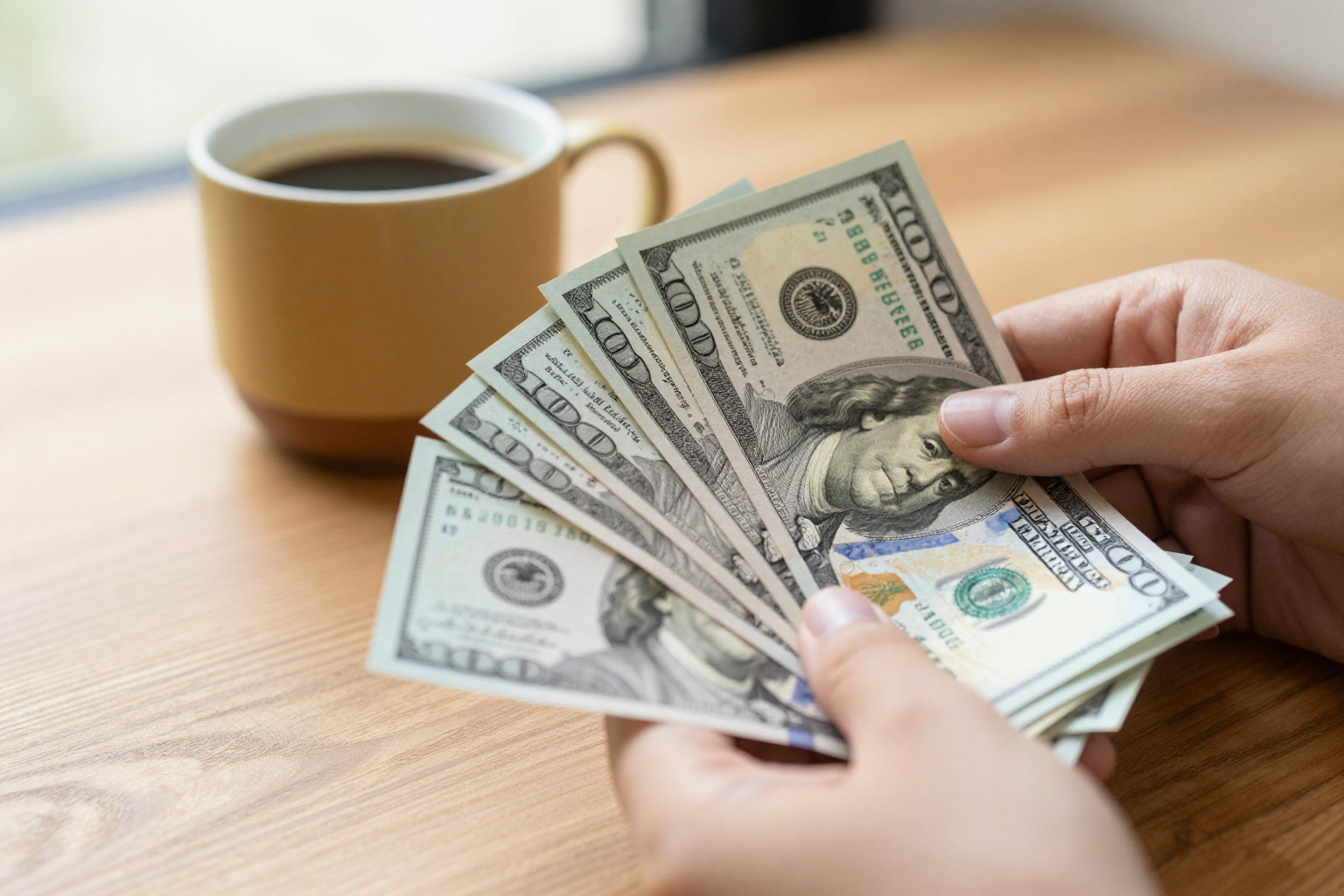
Most people sort out their dollars-to-won conversion about 48 hours before they fly, usually at an airport desk or through a rushed online order with their bank. It works, and it is simple. It also costs somewhere between 4% and 8% of whatever they are changing, which on a $2,000 trip is a night in a decent Seoul hotel.
The process below takes about twenty minutes and uses a $2,000 conversion as the running example throughout. Rates move daily, so treat every figure as a shape rather than a promise. The arithmetic does not change.
The mid-market rate is the midpoint between what buyers and sellers of USD/KRW are paying each other on the global market. Google's currency box, XE and Reuters all publish it. You will never get this rate as an individual, and any provider advertising “zero fees” has simply buried their margin inside a worse exchange rate.
So why look it up at all? Because it turns every quote into a percentage. If mid-market is 1,340 won per dollar and your bank offers 1,308, you are paying 2.4%. If an airport kiosk offers 1,246, you are paying 7%. Compared as percentages, the decision takes five seconds.
Getting quick at this matters far more than finding a perfect rate, which is the same instinct that helps you spot a bad rate in under a minute on any currency pair.
Korea is one of the most card-friendly countries you will visit. Subway gates, convenience stores, taxis and most restaurants take foreign-issued Visa and Mastercard without drama. Cash matters in specific places: traditional markets like Gwangjang, small family restaurants, some temple entries, and topping up a T-money transit card when the machine refuses your card.
A realistic daily cash budget in Seoul runs ₩1,400 for a subway ride, ₩12,000–15,000 for lunch, ₩20,000–30,000 for dinner and ₩5,000–8,000 for coffee. That is ₩60,000 to ₩100,000 per person per day if you paid for everything in notes. Most people don't need that much. Treat ₩200,000–300,000 as a comfortable float for a week and let your card cover the rest.
The spread mechanics barely change from pair to pair. It looks the same whether you are converting USD to AUD or dollars into won: a headline rate, a hidden margin, and a fixed fee stacked on top.
Assume mid-market sits at 1,340 KRW per dollar. Here is what the same $2,000 becomes depending on where you change it.
The gap between the bank and the kiosk is ₩124,000, about $93. Knowing that number before you queue up is the entire exercise. The same creep shows up in reverse and across pairs, which is why a $5,000 CAD to USD conversion can quietly shed a hundred dollars you never agreed to.
At some Korean ATMs and card terminals you will be asked whether to be charged in US dollars or Korean won. This is dynamic currency conversion, and you should always pick won. Choosing USD lets the machine apply its own rate, typically 3%–7% worse than mid-market, before your bank adds anything on top.
Hotels, department stores and some taxi card readers do the same thing. It isn't a Korean quirk, either. The identical prompt appears when you are converting $2,500 from USD to pounds at a London hotel desk. If you are standing in the country and a screen offers you a currency choice, the answer is the local one.
USD/KRW has ranged roughly between 1,100 and 1,450 in recent years, which is wide enough to matter. The won is a risk-sensitive currency: it strengthens when global investors feel confident and weakens when they don't. Three things drive it more than anything else — the interest rate gap between the US Federal Reserve and the Bank of Korea, Korean export data (semiconductors and cars dominate), and the broad strength of the dollar itself.
That doesn't mean you should wait for a perfect entry. It does mean that converting a large sum on the morning of a Fed decision or a US inflation release is avoidable risk. Spreading a big conversion across a few weeks is sensible; trying to pick the exact bottom is a hobby.
If you finish a trip with unused won, the return leg has its own quirks. Converting won back into USD is where most people first notice the fees they paid on the way in.
Monday, at home. Check the rate: 1,338. Confirm you have a no-foreign-fee debit card. Convert nothing yet.
Wednesday, on arrival at Incheon. Withdraw ₩400,000 from a Global ATM, decline the USD option, accept the ₩3,600 machine fee. Total cost lands about 0.9% over mid-market.
Friday, in Seoul. Take $1,200 in clean $100 bills to a Myeongdong changer. The board rate reads 1,332, roughly half a percent off mid-market. Walk out with ₩1,598,400.
The following week. Pay by card wherever it is accepted and withdraw another ₩660,000 when the cash runs low.
Add it up: $2,000 converted, a little over ₩2,650,000 received. Compare that with the ₩2,492,000 the airport desk would have handed over and the difference is about ₩160,000, or $120. Same money, same trip, twenty minutes of planning. The best and worst ways to turn dollars into won are separated by roughly ₩80,000 to ₩160,000 on a $2,000 conversion — which is not a rounding error. It is a night in a Seoul hotel, or three very good dinners at Gwangjang Market.
Slot ID: blog-post-bottom