
Loading article...
Slot ID: blog-post-top
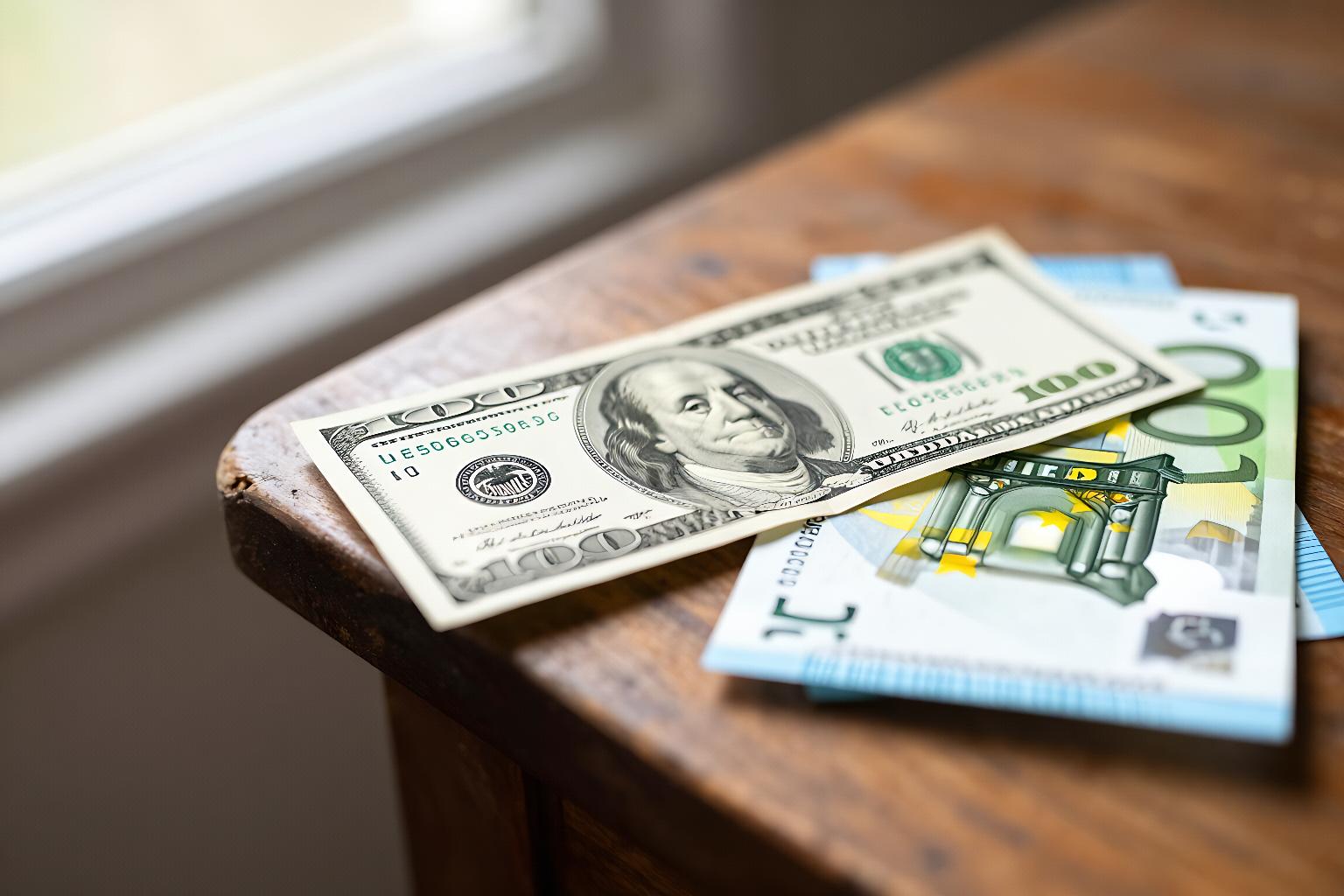
If you're planning a trip to Paris, paying a supplier in Berlin, or moving money to a euro-denominated account, the first thing you'll see is a headline number for the usd to euro exchange rate. But that number is rarely the one you actually get when you exchange your dollars. The gap between the quoted rate and the real rate can quietly cost you hundreds of dollars, especially on larger transfers.
Exchange rates between the dollar and the euro are not fixed. They move in real time, every second, influenced by central banks, inflation reports, elections, and even the mood of traders. Understanding a few of those moving parts helps you time and execute conversions better. And knowing where banks and transfer services hide their profits helps you keep more money in your pocket.
Open any currency converter and you'll see something like 0.92, 0.91, or 0.89. That figure is the mid-market rate, the theoretical midpoint between the price at which banks buy and sell euros. It's also the rate used in news headlines and financial dashboards. The problem is that most consumers never get the mid-market rate.
When you exchange money at a bank, airport kiosk, or traditional wire service, the provider marks up that rate by 1% to 3%, sometimes more. On a $5,000 transfer, a 2% markdown means you lose roughly $100 before you even count the transfer fee. For frequent international spenders or expats, those losses compound throughout the year.
This hidden cost is not unique to the dollar-to-euro pair. The same pattern shows up in nearly every currency corridor, which is why we walk through the details in this guide to converting dollars to Mexican pesos. Once you recognise how the mark-up works, you'll stop accepting bad quotes everywhere.
The dollar and the euro are the two most actively traded currencies in the world. Their exchange rate reflects global supply and demand. If more people and institutions want to hold dollars, each dollar will buy more euros. If Europe is growing faster, the trend flips.
Interest rates are the single biggest force driving this pair. When the U.S. Federal Reserve raises rates, dollar-denominated assets become more attractive to global investors seeking yield. Money flows into dollars, pushing the exchange rate up. When the European Central Bank tightens monetary policy, the euro benefits.
Think about a real-world example: in 2022, the Fed raised rates aggressively to tame inflation while the ECB moved more slowly. As a result, the dollar strengthened dramatically, and at its peak one dollar bought more than €1.03. Less than three years earlier, the same dollar bought only about €0.68. That's a shift of more than 50% in the value of your dollar when converting to euros.
Inflation readings from the U.S. and the eurozone can move the exchange rate within minutes. If U.S. inflation comes in hotter than expected, traders will assume the Fed will keep rates higher for longer, which often strengthens the dollar. Conversely, weak eurozone GDP growth or slowing German factory orders tends to push the euro lower.
Pay attention to monthly reports like the U.S. Consumer Price Index, the eurozone Harmonised Index of Consumer Prices, and the monthly jobs reports. You don't need to predict them. Just knowing that these releases can cause short-term swings will help you avoid converting at a terrible moment right after an unexpected data announcement.
The dollar is considered the world's primary safe-haven currency. During geopolitical tension, recessions, or stock market crashes, investors buy U.S. Treasuries and dollars, which can push the usd to euro exchange rate higher even if the U.S. economy is not in great shape. The euro, by contrast, often suffers during risk-averse periods because it is the second-most-traded reserve currency.
The result is that exchange rates are noisy in the short term. Trying to time a conversion based on tomorrow's news is a losing game. A more reliable strategy is to understand the cost structure of your transfer and then choose a provider that lets you convert at a fair rate whenever you need to move money.
The mid-market rate is calculated from the live interbank market, where large banks trade currencies with each other. It is not available to consumers. But it serves as the benchmark that reveals how much a provider is marking up your trade.
Suppose the current mid-market rate for USD to EUR is 0.92. That means €1 is worth about $1.087. If your bank quotes you 0.9050 for an outgoing transfer, you are paying a spread of about 1.65%. The bank is not necessarily dishonest. It's simply pricing in a margin to cover costs and earn profit. Still, on a $10,000 transfer, that spread costs you roughly $165, and that amount is almost never shown as a separate line item on your statement.
Some providers advertise “zero transfer fees” and then compensate with a much larger spread. Others disclose a fee but quietly give you a worse exchange rate. To make an honest comparison, you must calculate the total cost in euros or dollars, not just the headline fee.
Let's compare two realistic options for someone sending $5,000 to a euro account. For simplicity, assume the true mid-market rate is 0.9200.
The numbers change daily, but the principle stays the same: paying a slightly larger transfer fee can be worth it if the exchange rate is much better and no hidden margin is added later.
You don't need to work on Wall Street to improve your USD-to-EUR conversions. You just need to follow a few repeatable habits.
This advice applies far beyond the eurozone. If you've ever sent money to Asia, you'll recognise the same fee-and-spread problem in our detailed guide to converting dollars to Philippine pesos. And travelers headed to Southeast Asia can see exactly how Thai banks and cards pad the price in our breakdown of the costs when converting dollars to Thai baht. In each case, the three checks are the same: know the mid-market rate, compare the total cost, and avoid buying cash from retail operations that rely on customer ignorance.
For people who only convert a few hundred dollars while on holiday, a 2% spread might cost the price of a coffee. But for remote workers paid in dollars, property buyers in southern Europe, or entrepreneurs importing goods from EU countries, the stakes are much higher. A single $50,000 transfer at an unfavourable rate can mean the difference between paying a car or just an airline ticket.
Most people check the exchange rate once and then ignore it. They choose a bank because it's convenient. That convenience can be expensive. The specialists argue their own hidden costs are financial jargon, but the comparison above proves otherwise.
One of the best ways to stay grounded is to observe how the same dollar performs against other currencies. When the dollar strengthens broadly, you'll see cheaper dollars relative to the euro, the peso, and, in many cases, the Thai baht. But the historical pattern is not linear. You should never assume today's rates will hold for your future transfer.
The next time you need to send dollars to Europe, don't simply accept the first quote. Take a minute to look up the current mid-market rate. Then ask the provider for the exact rate they will apply to your transfer and list every fee in writing. Multiply the amount you plan to send by the quoted rate and subtract the fees to see what actually lands in the euro account.
If you are making the same transfer every month, consider opening a dedicated account that lets you convert at better rates and hold euros until you need them. A rate change of just 1% can change a monthly payment by €50 on a €5,000 transfer, and that quickly turns into a meaningful annual saving.
The exchange rate between the dollar and the euro will keep swinging. Your success does not depend on predicting those swings. It depends on the discipline to compare, the willingness to use better tools, and an eye on the real amount that reaches the other side.
Slot ID: blog-post-bottom