
Loading article...
Slot ID: blog-post-top
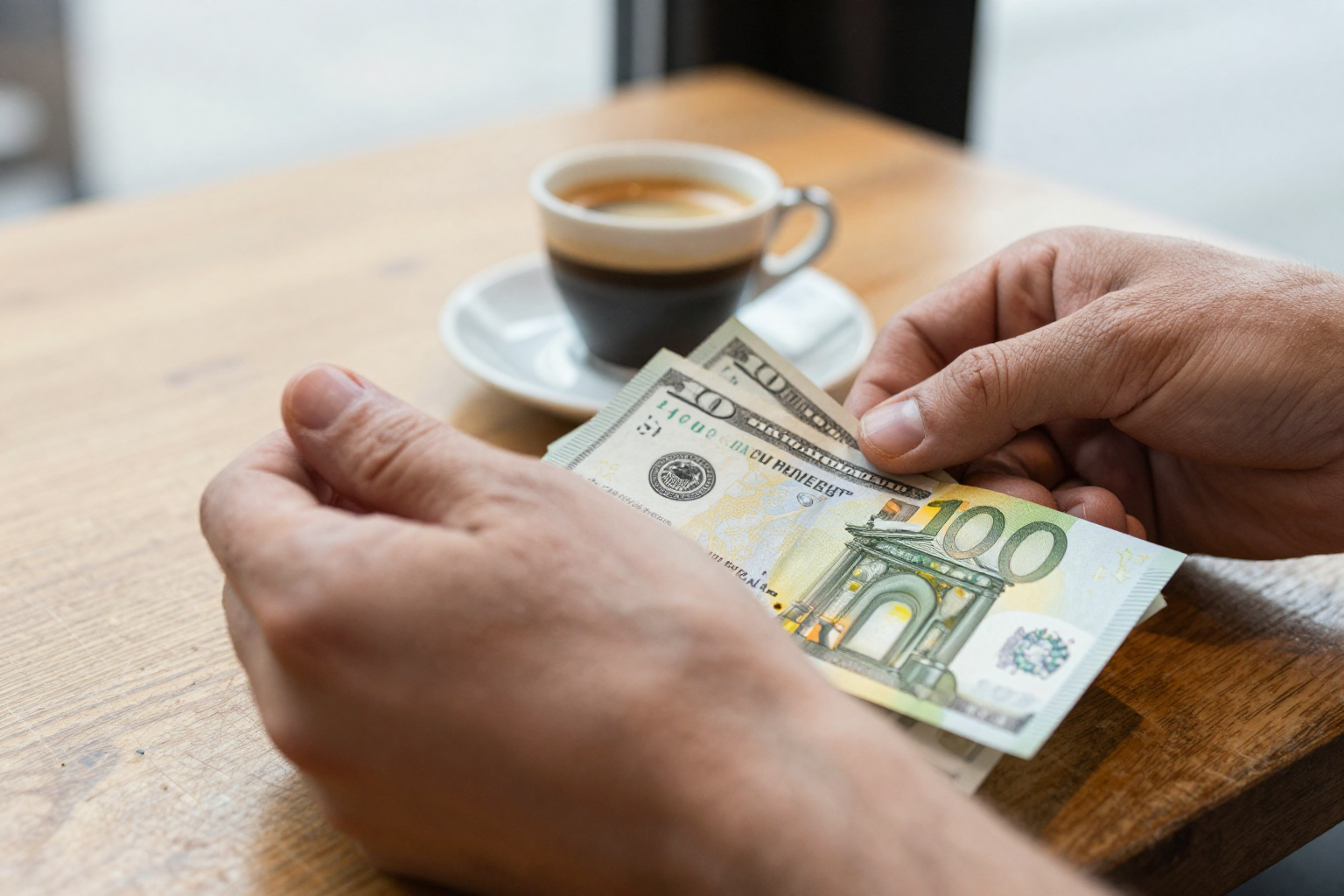
Type "500 USD to EUR" into the OANDA currency converter and you get an answer in under a second. The number is accurate, refreshed constantly, and drawn from a regulated broker's live pricing feed. It's also not the rate you'll be charged when you actually move money.
That gap between the displayed rate and the executed rate is where most people lose money without noticing. A 2.5% margin on a €5,000 transfer is €125, and it never appears as a line item anywhere. Understanding what the OANDA feed represents, and what it deliberately leaves out, is the difference between using it well and using it badly.
OANDA is a foreign exchange broker, not a consumer money transfer service. Its converter publishes what the industry calls the mid-market rate: the midpoint between the bid and the ask on wholesale currency trades. It covers well over a hundred currencies plus metals like gold and silver, and it updates on a rolling basis as quotes come in.
That midpoint is a real price, just not a retail one. It describes what large institutions pay each other when trading millions. Nobody hands you that rate for a €200 transfer or a card tap in Lisbon, because the bank or transfer company still has to cover settlement, hedging, and its own margin.
Think of the OANDA converter and what that currency rate is actually telling you as a thermometer rather than a price tag. It tells you the temperature of the market. It doesn't tell you what the shop is charging.
Here's the concrete version. Say EUR/USD sits at 1.0850 on the OANDA converter. You want to convert $10,000 into euros. At mid-market, that's roughly €9,216.
Your bank quotes you 1.0580 instead. Same $10,000 now buys €9,451 — wait, that's more, so flip it: they're offering you fewer euros per dollar, and you receive about €9,451? No. At 1.0580, $10,000 gives you €9,451 only if you multiply, which you don't. You divide: $10,000 ÷ 1.0580 = €9,451. And $10,000 ÷ 1.0850 = €9,216. The higher the EUR/USD rate, the fewer euros your dollars buy. The bank's lower quote of 1.0580 looks like a bargain but delivers €235 less than mid-market, a 2.5% markup worth roughly €235.
That's the entire trick. A rate that looks "close" to the OANDA number can still hide a margin you'd never agree to if it were presented as a fee. These pieces on why the rate you see isn't the rate you pay and on what that OANDA calculator number doesn't tell you dig into the same problem from different angles.
Every currency pair carries two prices. The bid is what buyers offer, the ask is what sellers want, and the gap between them is the spread. On major pairs during London and New York hours, that spread is razor thin. On exotic pairs, at 3 a.m. on a Sunday, or during a surprise central bank announcement, it can widen sharply.
OANDA's own trading accounts operate on spreads too, which is worth remembering. The converter shows a single mid figure, but the moment you transact through any provider, you cross a spread. For thin pairs like USD/TRY or EUR/ZAR, that crossing cost can quietly exceed 1% before anyone adds a service fee.
This is the practical use case for the OANDA converter, and it's a good one. Open the converter and note the current rate for your pair. Then request an exact quote from whichever service you're considering, for a specific amount, at that same moment. Divide the difference by the mid-market rate to get the margin as a percentage.
Rough benchmarks help: under 0.5% is close to wholesale with a small fee attached. Between 1% and 2% is a typical fair retail markup. Anything above 3% is expensive, and above 4% is where airports, hotel desks, and some high street bureaus tend to sit.
If you'd rather skip the arithmetic, look for a tool that's built to show the all-in number rather than the wholesale one. Our guide to finding a currency converter that shows the rate you'll actually pay covers what to look for.
None of this makes the converter useless. It's excellent for several jobs:
Sanity-checking a foreign invoice. If a supplier quotes €4,000 and you budgeted $4,300, a quick conversion tells you whether you're fine or need to renegotiate.
Sizing a transfer before you commit. Knowing the mid-market figure tells you the theoretical best case, so you can see how far a provider drifts from it.
Historical context. OANDA publishes rate history going back years, which is genuinely useful if you're deciding whether 1.08 on EUR/USD is a good week to send money or a mediocre one.
Pricing work in another currency. Freelancers and small exporters use it constantly to set quotes without building their own rate feed.
For anything involving an actual transaction, treat the converter figure as a benchmark and the quoted rate as the truth. The forex conversion calculator breakdown of what the rate hides from you is worth reading if you want to spot the margin in the wild.
Before you send money, write down two figures: the OANDA mid-market rate at that moment, and the rate your provider actually offers. Subtract, divide, and you have a percentage. That single number is more useful than any comparison table, because it accounts for the spread, the fee structure, and whatever the marketing department decided to call the pricing.
Most people never do this. They glance at a converter, see a rate that looks familiar, and click confirm. The 2% or 3% they never measured is exactly what the business model depends on. Measure it once and the number stops being invisible.
Slot ID: blog-post-bottom