
Loading article...
Slot ID: blog-post-top
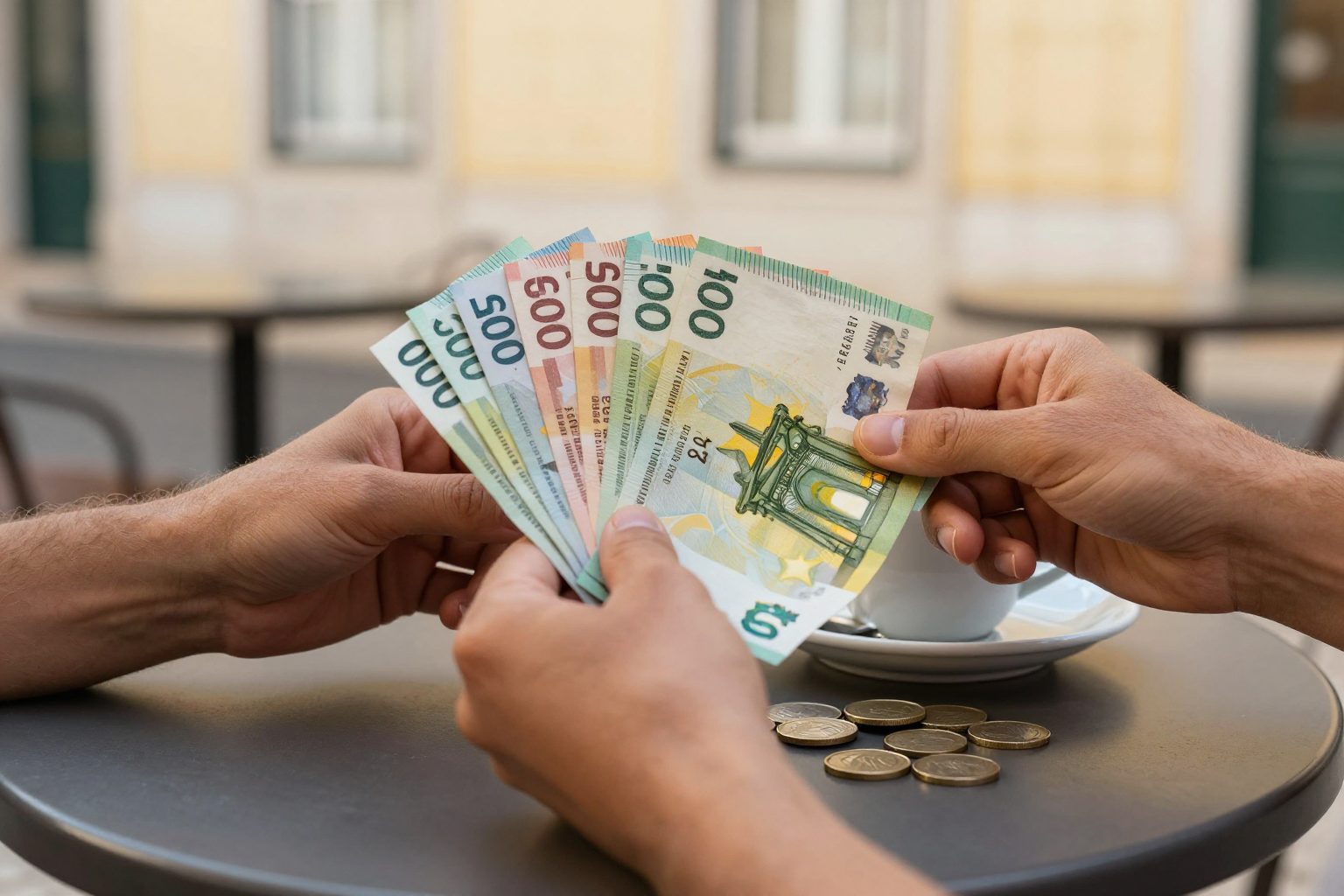
A friend texts you from Lisbon: dinner came to 84 euros each, can you send your share? You type find currency converter into a search bar, tap the first result, and get a number. Twenty minutes later your bank statement shows a charge that's 4% higher than the number you saw. That little gap is what this guide is about.
Every converter you'll come across is showing you one of two things. Either the mid-market rate, which is the midpoint between buy and sell prices on the global wholesale market, or a retail rate with a markup baked quietly into it.
The mid-market rate is the honest one. On a typical Tuesday, EUR/USD might sit at 1.0840. That's the figure you'll see on Reuters, on XE, and in your banking app's fine print. It's also a number no bank will ever give you, because banks and transfer services need to earn something on the transaction.
So the useful question isn't which converter has the most precise number. It's which one tells you the whole cost before you commit.
Any quote you get contains three figures. Most people only look at the first.
This is your benchmark. Write it down before you shop around, because it's the only number that doesn't change depending on who's quoting you.
Take a rate of 152 yen to the dollar. Convert $1,000 at a bank counter and you might walk away with 147,000 yen. That's not a rounding error, it's 5,000 yen gone before you've left the terminal. Why 152 yen per dollar is never the rate you actually get walks through exactly where that money lands.
Divide what you received by what you paid, then compare that to mid-market. If mid-market says your €500 should cost $542 and your card was charged $561, your all-in cost is 3.5%. That single percentage is the only figure worth comparing between providers, because it folds the spread and the commission into one number.
Cross-check the rate against two independent sources. If Google and your bank disagree by more than about 0.5%, one of them is quoting you a retail rate. Not a scandal, but you should know which.
Look for a timestamp. A converter that shows 1.0840 without saying when is showing you a number of unknown age. Rates on major pairs move a few tenths of a percent a day, but on volatile weeks they can move 2%.
Convert in both directions. If a tool says $1 buys 0.92 euros, then €1 should buy roughly $1.087. When the reverse figure doesn't match, you're looking at two separate spreads, one for buying and one for selling, and the tool is charging you on both legs.
Then ask what happens after the number. A converter that displays a clean mid-market rate and adds a "service fee" at checkout has shown you half the picture. The gap between the rate you see and the money you spend is usually where the profit sits.
These are three distinct products, and a converter built for one will mislead you about the others.
Cash is the worst-value option, which is why airport desks can charge what they do. Ordering currency online for pickup a few days ahead typically cuts the spread by half or more. Paying by card abroad usually gets you close to mid-market plus a foreign transaction fee of 0% to 3%, and ATM withdrawals add a flat charge on top, often around $5 plus 1.5%.
The scale matters here. A 3% difference on a $200 weekend withdrawal is $6, irritating but survivable. The same 3% on a $30,000 property deposit is $900, which is a flight, or a month of rent somewhere.
Rates drift. A figure you screenshotted on Monday is only a rough guide by Thursday, and if you're converting a meaningful sum it's worth checking what the currency converter rate today actually represents, since some sites update hourly and others pull a cached snapshot from the previous evening.
If you need a specific rate rather than whatever happens to be live when you click, set an alert. Put it at the level you'd genuinely be happy with, not the level you're hoping for. Most people who wait for a better rate end up converting at a worse one.
Three mistakes come up again and again. Comparing a mid-market figure from a search widget to a bank's total charge, then concluding the bank "gave a decent rate." Trusting a converter with no timestamp. And forgetting the receiving side, where correspondent banks can deduct $15 to $30 in transit before the money reaches the account.
A fourth trap is the arithmetic itself. Some quoted rates are expressed per unit, others per 100 units, and a few currency pairs are conventionally quoted in a direction you don't expect. If you want the step-by-step on working through a quote line by line, how to read a converter rate calculator without getting burned does the sums properly.
It also pays to understand what the underlying number represents rather than just accepting it, which is the point made in this breakdown of what that rate converter figure really costs you once every layer of markup is counted.
For anything above roughly $10,000, a web converter stops being a decision tool and becomes a starting point. At that size you're better off talking to a currency broker, who can lock a rate for a future date using a forward contract. That means agreeing today on the rate you'll get in six weeks when the deposit is due, which removes the guesswork entirely.
You'll also want to ask about the fee structure in writing. Some brokers charge nothing per transfer and take their margin in the spread. Others do the reverse. The all-in percentage is the only fair comparison, and it's the number a good broker should be willing to quote you plainly.
For everyone else, the practical routine is short: check the mid-market rate on two sites, note the timestamp, run the numbers both directions, and work out your all-in cost before you press anything. Four steps, about ninety seconds, and it's the difference between knowing what you paid and finding out later on a statement.
Slot ID: blog-post-bottom