 Currencies
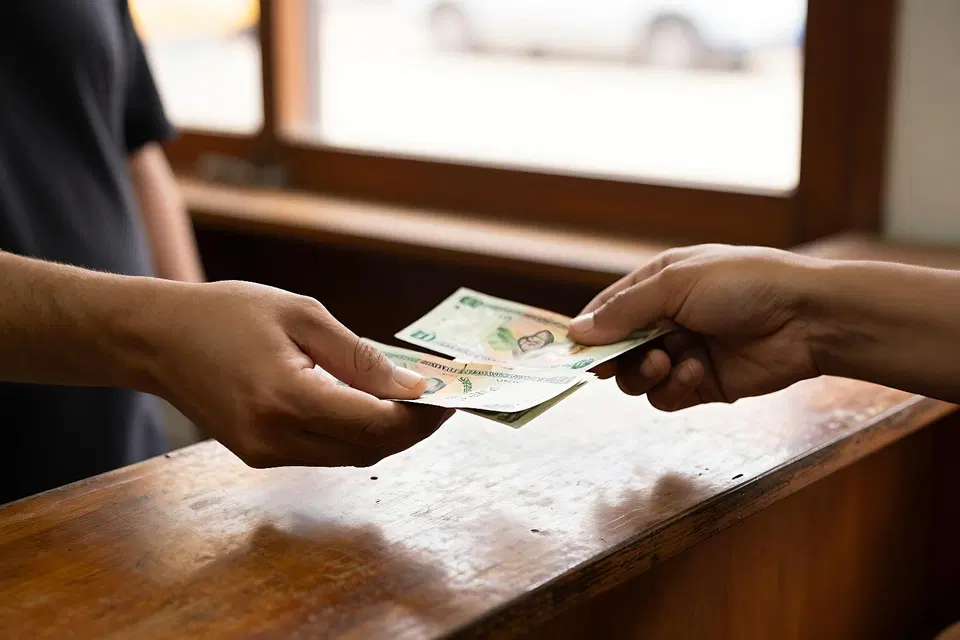
You hand $600 in cash across a pharmacy counter in Chicago, fill in a form with your cousin's name, and about ten minutes later she has a reference number and can collect the money from an agent two streets from her apartment in Manila. No bank account needed on either end. That is the core promise of a MoneyGram money transfer, and it is still the reason millions of people use the service every month.
What that $600 actually ends up costing you is a different story. The fee you're quoted is only one of two prices baked into the transaction, and the second one is never printed on the wall.
How a MoneyGram money transfer actually works
MoneyGram isn't a bank. It doesn't hold customer deposits or run accounts. It's a network that moves value between two agents — one that takes your cash, one that hands it out — and settles up behind the scenes. That's why the company can operate in roughly 200 countries without owning a single branch of its own.
Cash at a counter
You bring cash and photo ID to a participating agent: a Walmart service desk, a pharmacy, a check-cashing shop, a post office depending on the country. You give the receiver's full legal name as it appears on their ID. The agent enters the details, you pay the fee plus the amount, and you get a reference number to pass on.
The receiver then walks into an agent location with that reference number and matching ID. Cash pickup is usually available within minutes for smaller amounts. Bring the wrong spelling of a name and you'll find out how rigid the system is — a missing middle name can hold up a payout for hours.
Online, in the app, or over the phone
Digital transfers work the same way underneath but skip the counter queue. You can fund a transfer with a debit card, credit card, or sometimes a bank account, and choose whether the receiver collects cash, takes a deposit into a bank account, or gets funds pushed to a mobile wallet. A growing share of MoneyGram volume now starts on a phone rather than a paper form, though cash-in-person remains enormous in markets where card penetration is thin.
What a MoneyGram transfer really costs
Two numbers set the price of every transfer: the send fee and the exchange rate. They're quoted separately, which makes them easy to compare in isolation and hard to compare in total.
- The send fee — a flat charge that scales with how much you send and how you pay. Sending $200 from an agent might cost $8; sending $1,500 could be $15 to $25. Online transfers funded by debit are often cheaper than cash at a counter, and credit cards usually carry the highest surcharge because the card issuer takes a cut.
- The exchange-rate margin — MoneyGram sets its own retail rate, which sits a few percent above the mid-market rate you'd see on a currency site. On a $600 transfer to the Philippines, a 3% margin is about $18, quietly folded into the conversion.
- Receive-side charges — most cash pickups are free for the recipient, but bank deposits or mobile wallet payouts can carry a small local fee depending on the partner.
- Payment-method differences — the same transfer can cost $5 more or less purely because of how you funded it.
The logic behind these fee tiers isn't unique to MoneyGram. Our breakdown of Western Union transfer fees walks through the same pattern, including why the cheapest-looking option on the screen is rarely the cheapest overall.
The exchange rate is where the real money hides
People fixate on the $12 fee and ignore the rate. Flip it around. A 3.5% margin on $1,000 is $35 — nearly three times the fee you were so carefully comparing.
MoneyGram publishes a rate at the moment you confirm, and that rate is locked for that transaction. There's no negotiation and no published spread. The practical move is to check the mid-market rate for your currency pair on the day, calculate what your receiver should get at that rate, then compare it to the number MoneyGram actually promises. The gap, expressed as a percentage, is your true currency cost. Our piece on the Western Union exchange rate shows how to run that calculation in about ninety seconds, and the method transfers directly to MoneyGram.
How fast the money actually moves
Delivery speed depends almost entirely on the payout method, not on how urgently you need it.
Cash pickup at an agent is typically the fastest: often within minutes for transfers under a few thousand dollars, though corridors with heavy compliance screening can stretch to a few hours. A deposit into a bank account usually lands the same business day or within one to three business days, depending on the receiving bank's clearing schedule. Mobile wallet payouts sit somewhere in between and vary a lot by country.
Weekends and public holidays in either country matter more than most senders expect. A transfer initiated Friday evening in London may not clear a bank account in Kenya until Tuesday. There's a fuller picture of these timing quirks in our guide to how fast a Western Union transfer moves — the mechanics are near-identical across legacy networks.
Limits, ID checks, and why your transfer got flagged
Every MoneyGram transfer passes through identity verification and anti-money-laundering screening, and the thresholds differ by send country, receive country, and how much history you have with the service.
As a rough guide, an unverified sender in the US or UK is commonly capped somewhere around $1,000 to $3,000 per transaction or per rolling period. Verify your identity — usually a photo ID plus proof of address — and those ceilings rise substantially. Some corridors cap receiving limits too, particularly where local regulators restrict cash payouts. If you're mapping out a large send, it's worth reading up on what really caps transfer limits, because the constraint is often on the receiving end rather than yours.
Flags happen for mundane reasons: a name that doesn't match the ID exactly, a first-time sender wiring an unusually large amount, a receiver collecting from three different agents in a week. Keep the spelling precise and start with a smaller test transfer if you're sending to a new recipient.
When something else is the better tool
MoneyGram wins on reach. Cash pickup in a rural town with no bank branches is a genuine service that app-only providers can't match. But if your receiver has a bank account and you're sending a regular monthly amount, the arithmetic shifts quickly.
Online-only services often charge a lower upfront fee and apply a much thinner margin on the exchange rate, which on a $500 transfer can mean $15 to $25 more landing in your receiver's account. Our comparison of Western Union versus Wise runs the numbers side by side and the conclusions apply almost identically to MoneyGram. The practical split most people land on: cash pickup for emergencies and unbanked recipients, a low-margin online provider for predictable, recurring sends.
Before you walk away from the counter
Four details are worth thirty seconds of your attention, because fixing them afterwards is painful.
Check the receiver's name character by character against their ID. Confirm the destination country is right — a transfer routed to the wrong country has to be cancelled and re-sent, and refunds can take days. Note the reference number somewhere you won't lose it, and give it to the receiver by a channel that isn't a public social media post. Finally, photograph or keep the receipt showing the exchange rate and the exact amount your receiver will collect. If the payout comes up short, that slip is the only thing that resolves the argument.
One last habit worth building: send a small amount first. A $50 test transfer to a new recipient tells you how the corridor behaves — how long the payout takes, whether the agent asks for extra documents, whether the rate holds up — at a fraction of the cost of discovering it with a rent payment.