
Loading article...
Slot ID: blog-post-top
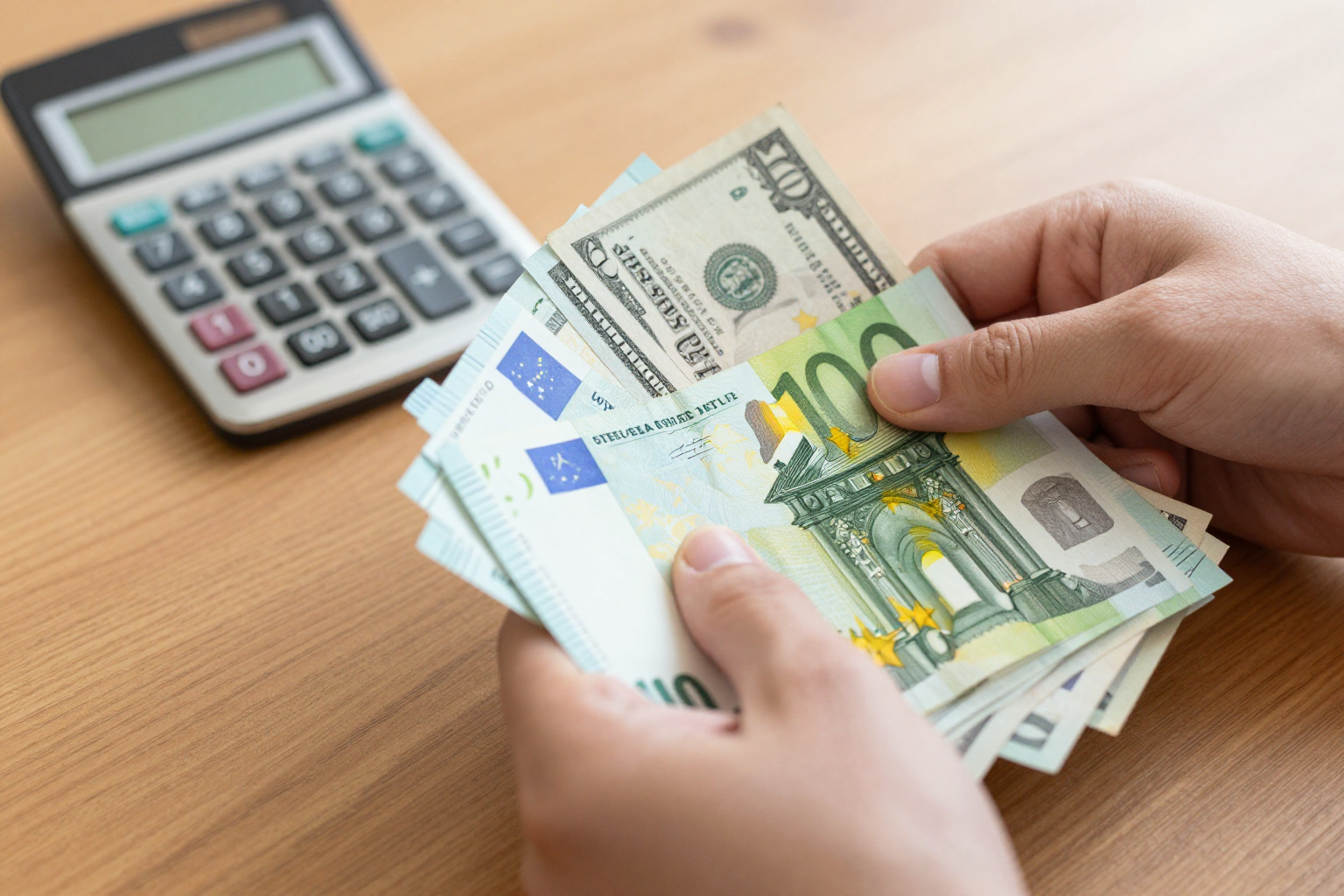
The euro to dollar exchange rate touches more daily transactions than almost any other currency pair. European tourists paying for New York hotels, US businesses invoicing German suppliers, and investors rebalancing portfolios all watch EUR/USD closely. Yet most people who transfer money or convert currencies end up paying far more than the rates they see on their screens. This guide breaks down how EUR/USD really works, what moves it, and exactly how to keep more money when you convert.
EUR/USD is the world’s most traded currency pair, representing roughly a quarter of all forex market volume. That liquidity means tight spreads between the bid and ask prices for institutional players, but individual consumers rarely access those rates. The difference between the mid-market rate (the rate you see on Google) and the rate a bank or exchange service quotes you can be significant.
Take a simple €1,000 transfer. If the mid-market rate is 1.0850, you expect $1,085. But many providers quote 1.0700, leaving you with $1,070. That’s $15 lost without any visible fee.
To make informed decisions about when to convert, it helps to understand the forces that move EUR/USD. The exchange rate responds to several overlapping factors, and they change quickly.
The single biggest driver is the gap between interest rates set by the European Central Bank (ECB) and the US Federal Reserve. When the Fed holds rates higher than the ECB, capital tends to flow into dollar-denominated assets in search of yield. That pushes the dollar up against the euro. When expectations shift, so does the exchange rate.
For example, in late 2023, the Fed’s aggressive hiking cycle pushed EUR/USD back below 1.05, even though the eurozone was also fighting inflation. Every rate hike and central bank speech gets added scrutiny because the effects are felt in travel budgets and transfer amounts.
GDP growth, employment reports, and consumer confidence in both economies change perceptions of long-term currency strength. A strong US jobs report often boosts the dollar. Similarly, a better-than-expected German Ifo business climate index can give the euro a push. The difficulty is that markets have already priced in the forecast data, so surprises matter more than the numbers themselves.
During global turbulence, the dollar has historically acted as a safe haven. The euro, while a deep and liquid currency, carries more exposure to geopolitical shocks that affect energy prices and trade relationships. Wars, election cycles, and trade disputes regularly swing the pair by hundreds of pips.
Open any currency converter app and you’ll see the mid-market rate. That’s the average of what banks and institutions pay for euros when trading among themselves. It is not the rate available to you, but it’s a crucial reference point.
Too many conversions rely on the assumption that the quoted rate is reasonable. The reality is that banks and payment providers mark up the exchange rate, often in addition to charging a transfer fee or commission. The markup is baked into the rate, making it invisible to most customers. A quick glance at your bank’s exchange rate table might show a rate 2% lower than the mid-market rate, and that percentage is pure profit for the bank.
We documented the same pattern with US dollars to Indian rupees, where the unexpected charges eat a meaningful part of the transfer. Much of what happens with USD/INR also applies to EUR/USD, simply with different numbers.
It’s tempting to type “eur to usd” into Google and assume that’s the conversion you’ll receive. That search gives you the interbank rate, but retail customers almost never qualify for it. Banks apply their own spread, typically 0.5% to 2%, depending on the amount and your relationship with the bank.
This isn’t a matter of a bad bank or a clever trick. There are costs to running ATMs, maintaining branch networks, and managing currency risk. Still, you can choose providers who work with slimmer margins. Just don’t assume the Google result is something a bank can, or will, match.
The effect is even more pronounced in other currency pairs. For US dollars to Indian rupees, the gap between the search result and the real quoted rate is often much larger than for EUR/USD because of liquidity differences and local regulations. But the lesson remains: always compare the actual offered rate against the mid-market rate before agreeing to a conversion.
Getting closer to the real exchange rate requires a little effort, but the savings can be substantial on larger transfers. Here’s what actually works.
Before you convert, search for the live interbank rate and multiply the euro amount yourself. Then compare that to the rate from the provider. The difference is your hidden fee.
Digital-first currency exchange platforms typically offer much tighter spreads than traditional banks. Because they have lower overhead and don’t maintain thousands of branches, they can pass the savings on. A wise move is to verify whether the service uses the mid-market rate and charges a transparent fee, or builds its markup into the rate.
When paying by card abroad, the terminal may offer to charge you in euros instead of dollars. This sounds convenient, but the exchange rate used in dynamic currency conversion is usually terrible. Always choose to be charged in the local currency and let your own bank or card issuer handle the conversion. For a euro-based card, that means paying in USD when in the US.
Similar principles apply when moving money the other way. Those transferring from dollars to euros will want to shop around for the best USD-to-EUR rate and be aware that many US banks have fee schedules that are far from obvious.
People spend hours trying to predict whether the euro will strengthen overnight. That’s speculating, and it works about as well as any other form of short-term forecasting. Unless you are transferring millions, the daily volatility of EUR/USD is usually not worth the risk of waiting.
That said, it can be useful to focus on recurring payments. If you have a quarterly obligation in dollars, look at the rate a week or two before you need to pay. If it suddenly moves in your favour, locking in that rate might be worth it. Setting up a market order with a currency broker can let the transfer execute automatically when the rate hits a level you choose.
The security of the euro versus the US dollar is not the question. Both are heavily traded, stable currencies. The problem is the unnecessary cost that comes from using the wrong channel. This is a broader issue in FX conversions, and you’ll see the same dynamics if you look at US dollars to Canadian dollars or even Mexican pesos to US dollars. Each currency pair has its own quirks, but the strategic principles stay consistent.
On a €5,000 transfer, a 1% markup costs you about $54 at current rates. Over several years of regular remittances or business payments, that quickly adds up to hundreds of dollars, simply for the privilege of using a bank that obscured its fees.
The same applies to the mid-market gap. Take the moment when EUR/USD trades at 1.0850 and you need to convert €3,000. One provider offers 1.0820, another offers 1.0750. The first gives you $3,246, the second $3,225. The $21 difference is real money, and you haven’t changed the market at all.
For those who handle both the European and American sides, it also pays to understand that the euro side of the equation isn’t the only one with a hidden commission. As we wrote in our breakdown of the gap between Google’s USD/INR rate and the actual transfer rate, quoted rates can look attractive online only to fall short when you check the final receipt.
Next time you need to convert euros to dollars or the other way, take three minutes to compare the actual offered rate against the interbank rate and audit any separate fees. Choose an FX service that provides a transparent mid-market rate and a clear fee, not one that hides its earnings in a stingy exchange rate. That simple habit will protect your money across all international transactions, whether you’re sending a security deposit to a New York landlord, buying stock in a US company, or paying a freelancer in California. The process is no different from what travellers face when exchanging currency at street kiosks, and the smartest approach is always to be informed about the true cost before you press send.
Slot ID: blog-post-bottom