 Currencies
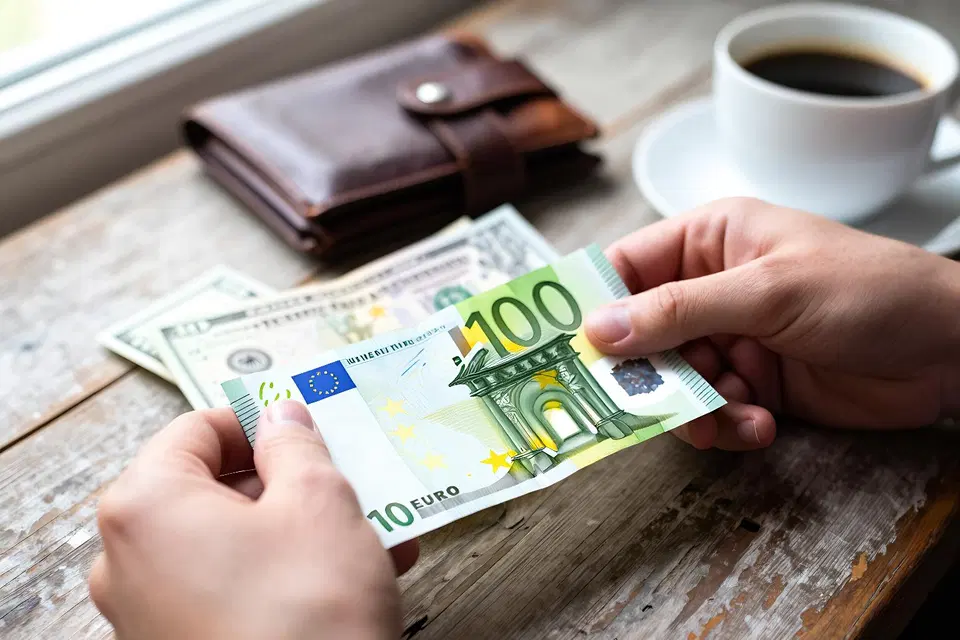
You type 1,000 into a converter, hit the button, and get an answer in a quarter of a second. The maths is correct. The problem is that no one will sell you euros at that price.
That gap between the number on your screen and the money that lands in your account is where most people lose track of a few dozen dollars without noticing. It's worth understanding before your next transfer, holiday, or property payment — especially if the sum is large enough that a 2% difference actually stings.
The rate you see is not the rate you get
Every public converter — Google, XE, Reuters, your banking app — is showing you something close to the mid-market rate. It's the midpoint between what banks are willing to buy and sell euros for on the wholesale market, where the players trade in millions and the spreads are measured in fractions of a cent.
Retail customers don't get that market. Your bank, your card issuer, or the kiosk at the airport all buy euros at one price and sell them to you at another, keeping the difference. That difference is the spread, and it's usually expressed as a percentage rather than a fee, which is exactly why it's easy to miss. If you want to see how this plays out at the counter rather than on a screen, this breakdown of why the rate on your screen isn't the rate you get is a decent primer.
A typical example with real numbers
Say the mid-market rate is 1.0850 USD to EUR — meaning $1.0850 buys €1.
- Converting $2,000 at mid-market: $2,000 ÷ 1.0850 = €1,843.32
- Converting $2,000 at a bank rate of 1.0570: $2,000 ÷ 1.0570 = €1,892.15... wait, that's the wrong direction. Let me redo it properly.
Here's the cleaner way to think about it. The bank sells euros to you at a higher dollar price per euro — say 1.1130 instead of 1.0850. Now:
- Mid-market: $2,000 ÷ 1.0850 = €1,843.32
- Bank rate of 1.1130: $2,000 ÷ 1.1130 = €1,796.95
- Cost of the spread: €46.37, or roughly 2.6% of your money
No fee was mentioned anywhere on the receipt. The €46 simply never existed as far as you were concerned. That's the part worth internalising: a 2.5% spread on a $20,000 transfer is $500 gone.
How to calculate the true cost of a conversion
Ignore the headline rate for a moment and work backwards from what you receive. Three numbers matter:
- The amount debited from your account, in dollars, including any transfer fee
- The amount credited in euros, after every charge has been applied
- The mid-market rate at the moment you clicked confirm — check a neutral source, not the provider's own site
Divide the euros received by the dollars spent. That gives you your effective rate. Compare it to mid-market, and the percentage difference is your real cost. This is the only comparison that works across banks, brokers, and apps, because it sidesteps the creative ways providers present their pricing. There's more on reading a quote properly in reading the rate, not just the number.
Banks, brokers, and airport kiosks: the spread varies wildly
Broadly, here's what you're dealing with in 2024-era retail FX:
High-street banks
Convenient, familiar, and usually the most expensive. Spreads of 2.5% to 4% are common on cash, sometimes more on odd denominations or small amounts. Transfer fees of $15–$40 on top are standard for international wires.
Airport and tourist-strip kiosks
Somewhere between 6% and 12% once you account for the rate and the commission. They're selling speed and location, not price. Buying $200 worth of euros before a trip is fine; buying $2,000 there is an expensive habit.
Online brokers and multi-currency accounts
Typically 0.3% to 1% above mid-market, with a small fixed fee. Wise, Revolut, and similar services have made this the default for anyone sending meaningful sums. For anything above about $1,000, the savings versus a bank are usually worth the ten minutes of setup.
Credit and debit cards abroad
Most cards add a 2.5% to 3% foreign transaction fee. Some premium travel cards waive it entirely. If you're spending rather than transferring, the card often beats carrying cash — but check the fee schedule before you rely on it.
Watch out for the conversion question at the till
Pay with a card in Paris or Berlin and the terminal will often offer to charge you in dollars instead of euros. This is called dynamic currency conversion, and it's almost always a bad deal — the merchant's processor applies a markup of 3% to 6% and frames it as a convenience.
Decline it. Choose to be charged in euros and let your own bank handle the conversion at its rate. The same logic applies at ATMs abroad: if the machine asks whether you want to be debited in USD or the local currency, pick the local currency. This is the single most common way travellers quietly lose money.
For a fuller picture of how hidden margins work in the other direction, this piece on what the EUR to USD number is really hiding covers the same mechanics from the euro side.
Does timing matter?
Honestly, less than people think for everyday amounts. EUR/USD moves maybe 5–8% over a typical year, and day-to-day swings are usually under half a percent. If you're converting $500 for a holiday, obsessing over timing is not a good use of your attention — the spread you pay will dwarf the rate movement.
For larger sums, timing starts to matter. Two practical tools:
- Rate alerts. Most brokers let you set a target rate and email you when it's hit. Set one slightly above current levels and forget about it.
- Forward contracts. If you know you'll need €50,000 in three months for a property deposit, you can lock in today's rate now and settle later. You give up the upside if the euro weakens, but you remove the risk of it strengthening 4% before completion.
Spreading a large conversion across two or three tranches over a few weeks is another common approach. It won't beat the market, but it stops you from having your entire outcome decided by a single Tuesday afternoon.
Converting USD to EUR, step by step
Here's the sequence that keeps you from overpaying:
- Check the mid-market rate on a neutral source and note it down
- Get a live quote from two or three providers for your exact amount
- Calculate the effective rate for each — euros received divided by dollars spent
- Compare, then check whether any provider charges an additional receiving fee at the other end
- For cash, order in advance rather than buying at the airport
- Keep the confirmation; you'll want it for tax or expense records if the sum is significant
That's roughly ten minutes of work. On a $5,000 transfer, doing it properly versus taking the first quote you're offered is often the difference between €4,600 and €4,480 — a €120 swing for the sake of checking a couple of tabs.
When the sum is large enough to negotiate
Above roughly $50,000, pricing stops being a menu and starts being a conversation. Currency brokers who handle high-net-worth clients will frequently shave 0.2% to 0.5% off their published spread if you ask, particularly if you're moving money regularly or bundling it with an ongoing relationship. A private banking client sending six figures can often get closer still.
The ask itself is simple: "What's your best rate on this amount, and can you confirm the all-in cost as a percentage of mid-market?" A provider who can answer that second question crisply is usually one worth using. One who deflects into talk about "no commission" is telling you where the margin lives.
One last habit worth building: after every conversion, write down the mid-market rate at the time, the rate you got, and the difference in euros. Do it three or four times and you'll have a personal benchmark — a clear picture of what your bank, your broker, and your card actually cost you. That number is worth more than any converter's output, because it's the only one that reflects your real situation.