 Currencies
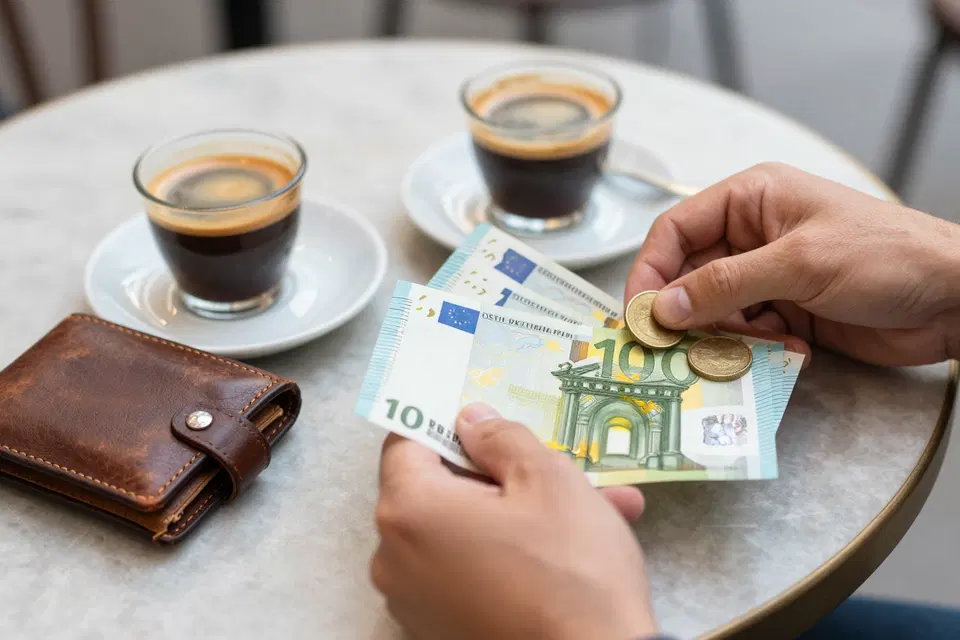
Type "1 usd to eur calculator" into a search bar and you'll have an answer before you finish blinking: something like 0.9214. That figure is current, publicly verifiable, and a poor guide to what a single dollar will actually get you when you tap a card in Lisbon, pull cash from an ATM in Milan, or pay a supplier in Berlin.
The calculator isn't wrong. It's answering a narrower question than most people realise. Getting that distinction straight is worth real money: on a €5,000 transfer, a single percentage point between the quoted rate and the mid-market rate is €50 that quietly vanishes.
What the calculator is actually doing
Nearly every free currency tool pulls from the same well: the mid-market rate, sometimes called the interbank rate. It sits halfway between what banks will buy euros for and what they'll sell them for at wholesale volume. No ordinary customer gets it. It's a reference point, a blank canvas.
Plenty of calculators source the European Central Bank's daily reference rate, published around 16:00 CET on working days. So on a Sunday evening, the number you're looking at is Friday afternoon's snapshot. There's a fuller explanation of why the rate on your screen isn't the rate you get once a real provider enters the picture.
Why one dollar is enough to start
The rate is a multiplier, so it scales cleanly. If 1 USD = 0.92 EUR, then $50 is €46, $740 is €680.80, and $12,500 is €11,500. A single-dollar conversion works as a mental yardstick: the price of one dollar, expressed in euros. Just don't mistake the yardstick for the till receipt.
The gap between 0.92 and what lands in your account
Here's where the arithmetic gets interesting. Suppose the mid-market rate reads 0.9200 and you convert $1,000.
- At a mid-market quote: €920.00
- At a bank with a 2% markup (effective 0.9016): €901.60, so €18.40 disappears
- At an airport kiosk quoting 0.8600: €860.00, a 6.5% haircut
- On a card with a 3% foreign transaction fee stacked on the network rate: €892.40
None of those providers lied. They applied a spread, and spreads are how currency businesses earn a living. The awkward part is that the spread is invisible: you see one rate, not a rate plus a line item. If you want to understand how that missing 3% gets rebuilt into a quote, there's a useful breakdown of how to convert EUR to USD without losing 3% in the spread.
Costs that never appear in the rate at all
Rate markup is only half the story. The rest turns up as separate charges, which is exactly why comparing two providers on rate alone fails so often: a flat $5 fee on a $100 transfer stings as much as 5% on the exchange rate. Smaller conversions get eaten by fixed costs, while large ones get eaten by spreads. Read what the number on your screen leaves out and you'll spot the pattern quickly.
Two quick checks that expose a bad quote
The implied-rate test
Ask a provider for the amount you'll receive, not the rate they're advertising. Then divide. Send $500 and get told you'll receive €455? Your implied rate is 455 ÷ 500 = 0.91. Compare that against the mid-market figure. If the market says 0.9200, you're paying roughly 1.1% for the privilege.
The round-trip test
Convert in both directions and multiply. If USD to EUR gives 0.9200 and EUR to USD gives 1.0700, a round trip leaves you with 0.9200 × 1.0700 = 0.9844, or 98.44% of your starting money. Losing 1.6% on two clicks is a warning sign. There's more on deciphering these figures in what the EUR to USD number is really hiding.
Cash, card, or transfer: three different calculators
The same 1 USD to EUR figure means different things depending on how the money actually moves.
Cash for a trip
Order euros from your bank a week ahead and you'll typically see a 2–4% markup over mid-market. Airport desks at 6–12% are a last resort, not a strategy. Withdrawing from an ATM abroad often beats both, provided you decline the machine's offer to charge you in dollars.
Cards abroad
The Visa or Mastercard network rate tracks close to mid-market and refreshes daily. Your bank then adds its own foreign transaction fee, usually somewhere between 0% and 3%. The costly mistake is dynamic currency conversion: when a terminal or ATM asks whether to charge in USD or EUR, picking USD hands the merchant a markup that commonly runs 3–5%.
Bank transfers and remittances
This is where the largest absolute sums are at stake, and where the spread is most negotiable. Specialist providers often quote within 0.5% of mid-market plus a small fixed fee; high-street banks can sit 2–3% above it. On a $10,000 payment, that gap is $200–$300. Before you commit, it's worth reading up on what the USD to EUR rate really means before you exchange.
How much the rate actually moves
EUR/USD drifts about 0.3–0.6% on an ordinary trading day. Central bank decisions, inflation prints and US payrolls data can shove it past 1%. Over a $1,000 conversion, a 0.5% swing is roughly €4.60 — real money, but usually smaller than the fees you're paying.
That ordering matters. Fixing your costs beats forecasting the market. If you're converting anything under a few thousand dollars, the spread you accept will dwarf the rate movement you're trying to time. For bigger sums, splitting the conversion across two or three transfers over a few weeks smooths out the noise without requiring a single prediction.
Getting the number to work for you
A few habits turn the calculator from decoration into a tool.
- Bookmark a mid-market calculator and treat its output as the benchmark, never the price.
- Always ask a provider for the final amount received, then work backwards to the implied rate.
- Decline dynamic currency conversion every time it's offered abroad.
- Compare total cost, flat fees included, on the exact amount you plan to move.
- Check whether the calculator's figure is live or a once-a-day reference fix.
The one-dollar number tells you the shape of the market on a given day, and that's genuinely useful. Everything that decides your actual outcome sits between that number and the amount that lands in your account: the spread, the fixed fee, the timing, the currency you're billed in. Once you know to look there, quotes get much easier to read and considerably easier to push back on.