
Loading article...
Slot ID: blog-post-top
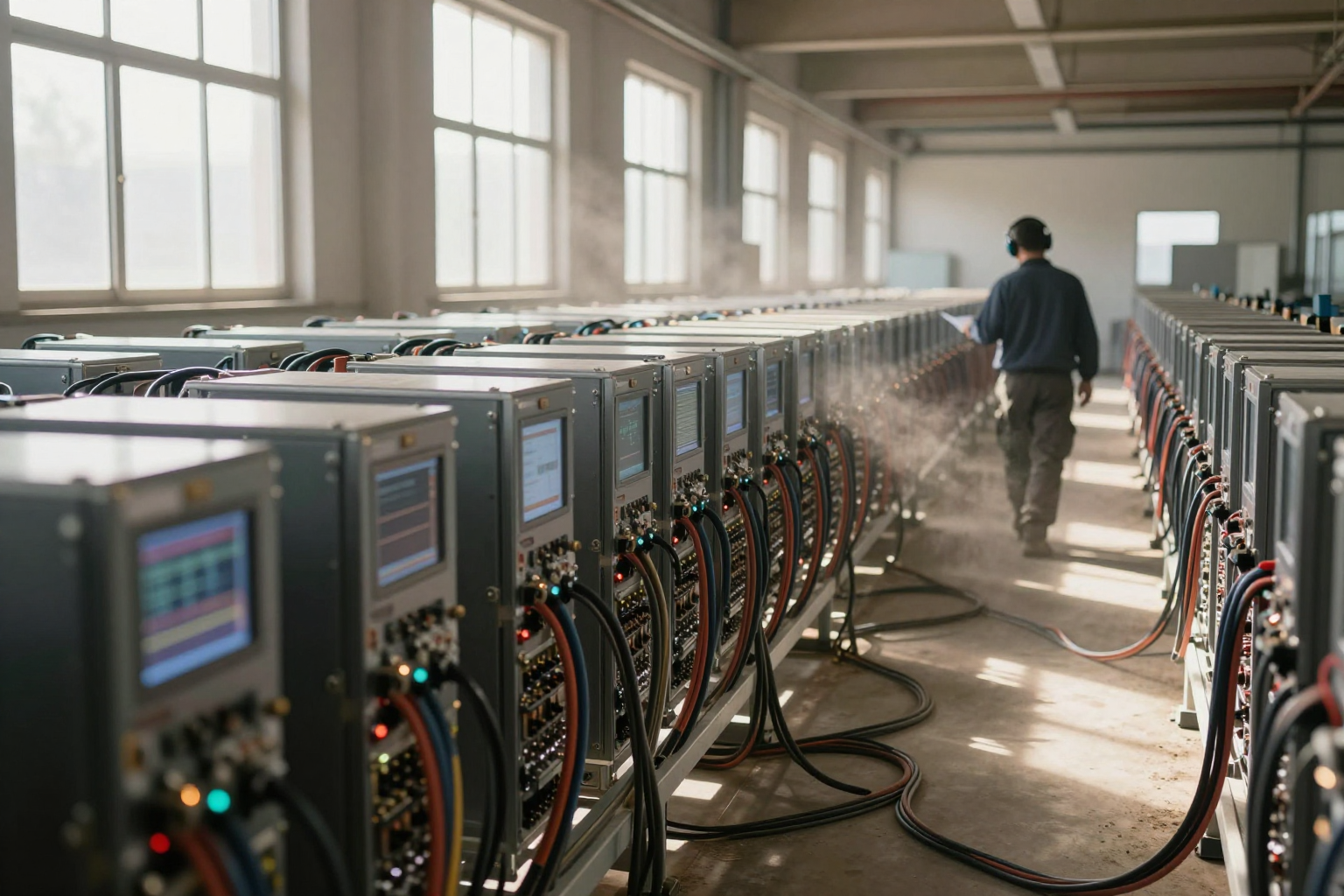
A bitcoin mining rig is a box that does one thing: it guesses numbers, billions of times a second, hoping to land on one the network will accept. There is no cleverness in it, no market analysis, no judgement. It is an industrial appliance that converts electricity into lottery tickets, and the whole industry built around it is really a story about the price of power.
That framing matters, because most explanations of bitcoin mining start with cryptography and end with "and that is how new coins are created," which leaves out the part people actually care about: whether it makes money, who is doing it, and why it happens where it happens.
Bitcoin's blockchain is a chain of blocks, each holding a batch of transactions. To add a block, a miner has to produce a block header whose SHA-256 hash falls below a target number. The header contains a field called the nonce, and there is nothing to do but try nonce values until one works. Change the nonce by one and the hash comes out completely different, with no relationship to the last one.
The target is set so the whole network finds a block roughly every ten minutes. If miners collectively get faster, the target tightens. That is the difficulty adjustment, and it recalculates every 2,016 blocks, which works out to about two weeks.
So the work in proof of work is measurable. A miner is not proving it solved something clever. It is proving it burned a specific, verifiable amount of computation, and that cost is what makes rewriting history expensive. To reverse a block six deep, you would have to out-hash everyone else for that stretch.
Early miners used CPUs, then graphics cards. Both were hopeless once ASICs arrived in 2013. An application-specific integrated circuit does nothing but SHA-256 hashing, and it does it at a scale general hardware cannot approach.
Three specs decide almost everything downstream:
Two machines with the same hash rate can differ by 40% in running cost, and running cost is the only number that matters in a thin-margin business. They are also loud, around 75 decibels at a metre, with a fan whine that carries through walls. A handful of rigs will warm a small building in winter and make it unbearable in summer.
Here is the arithmetic that governs the industry. Take that 3,250-watt S19 Pro. Run it for 24 hours and it consumes 78 kilowatt-hours. At 6 cents a kilowatt-hour you pay $4.68 a day. At 12 cents, $9.36. Same machine, same output, double the cost.
Revenue depends on network hash rate, the block subsidy, transaction fees, and the price of bitcoin. At a network hash rate in the hundreds of exahashes per second and a 3.125 BTC subsidy, a 110 TH/s machine earns on the order of $5 to $8 a day in block rewards before pool fees, depending on where the price sits. Put those figures side by side and you can see why miners chase 3-cent power, and why a 10-cent operation is the first to be wiped out when the market turns.
It is also why mining gravitates towards energy that has nowhere else to go. Flared natural gas at a wellhead, curtailed wind in west Texas, hydro during a wet season in Quebec or Sichuan. A miner is a buyer of last resort: it can show up, take power only when it is cheap or otherwise wasted, and shut off in seconds when the grid needs it back. Some operators earn more from demand-response payments than from hashing on certain days.
A single machine finding a block solo is a lottery ticket with terrible odds. One block at a recent price is worth a couple of hundred thousand dollars, and the chance of a home miner hitting one in a year is vanishingly small. Hence pools, where thousands of miners combine hash rate and split the reward.
The payout scheme matters more than most people realise:
Pool fees typically run 1% to 3%. On a 3% margin operation, that is not a rounding error.
Two forces erode mining economics on a schedule, and neither asks permission. The first is the halving, which cuts the block subsidy in half roughly every four years. It dropped to 3.125 BTC in April 2024 and lands at 1.5625 BTC around 2028. Miners who planned around the old reward suddenly earn half as much per block, and the least efficient operations switch off. The mechanics of what actually changes at a halving are worth understanding before you build a spreadsheet around block rewards.
The second is difficulty. When inefficient miners drop out, total hash rate falls, the target loosens, and the machines still running earn more per terahash. It is a self-correcting loop that tends to drag the marginal miner back towards break-even. Nobody keeps a permanent edge from being early, and nobody escapes the adjustment for long.
The United States became the dominant location after China's 2021 ban, with Texas as the centre of gravity thanks to a deregulated grid and abundant wind and solar. Kazakhstan drew miners with cheap coal power, then ran into grid strain and regulatory pushback. Iceland and Norway offer geothermal and hydro alongside cold air for cooling. Argentina and the Permian Basin host flare-gas operations that turn a waste stream into revenue.
What those places share is not cheap electricity in the abstract but electricity that is cheap for a specific reason, usually because it is intermittent, remote, or stranded.
Bitcoin mining uses a lot of energy, and the debate around it is often conducted with numbers chosen to support a conclusion. The honest version is messier. Grid mix matters enormously: a miner plugged into Icelandic geothermal has a different footprint from one on a coal-heavy grid. Flare-gas operations arguably cut emissions by burning methane that would otherwise vent, and methane is a far more potent greenhouse gas over a 20-year horizon. E-waste is a genuine problem, since ASICs have short productive lives and are rarely recycled well. Heat reuse schemes, where a miner warms a greenhouse or a district heating loop, exist and are small but growing.
What is not in dispute is that the consumption is large and intentional. Whether that is a fair trade for a permissionless settlement network is a judgement call, not a fact.
Profitability calculators are only as good as their inputs, and the inputs move constantly. A calculator assuming 5-cent power, today's network hash rate, and today's BTC price will be wrong within a quarter.
Two habits help. First, model hash rate growth. If the network adds 30% of capacity in a year and you do not, your share of the reward shrinks by roughly 23%. Second, treat price assumptions as assumptions. Anyone showing you a projection built on bitcoin tripling should show you the same projection with it halving. Reading Bitcoin forecasts critically pays for itself here, and so does knowing that the BTC to USD number you see isn't the number you get once spreads and fees are applied.
Hardware pricing deserves the same suspicion. Used S19s trade at a discount to new machines for a reason: they sit closer to the efficiency cliff. When the price of bitcoin falls far enough, a 29.5 J/TH machine on 8-cent power stops covering its electricity bill, and optimism does not change the meter reading. The bitcoin exchange rate you see quoted is only half the cost picture once you factor in the infrastructure wrapped around the machine.
If you are still interested after all that, build the model yourself rather than trusting a page with a green profit column. Start with your real all-in power rate, including demand charges and time-of-use tiers, then work through four things:
Check the boring physical constraints too. A single S19 needs about 3.25 kW of dedicated capacity plus cooling, and it produces heat and noise continuously. Whether your panel, your lease, and your neighbours can handle that is a question no calculator answers. The miners who survive cycles are the ones with power contracts signed years out, machines paid off before the last halving, and a willingness to switch off the moment the margin disappears. Everyone else is buying lottery tickets at a price set by someone with cheaper electricity.
Slot ID: blog-post-bottom