
Loading article...
Slot ID: blog-post-top
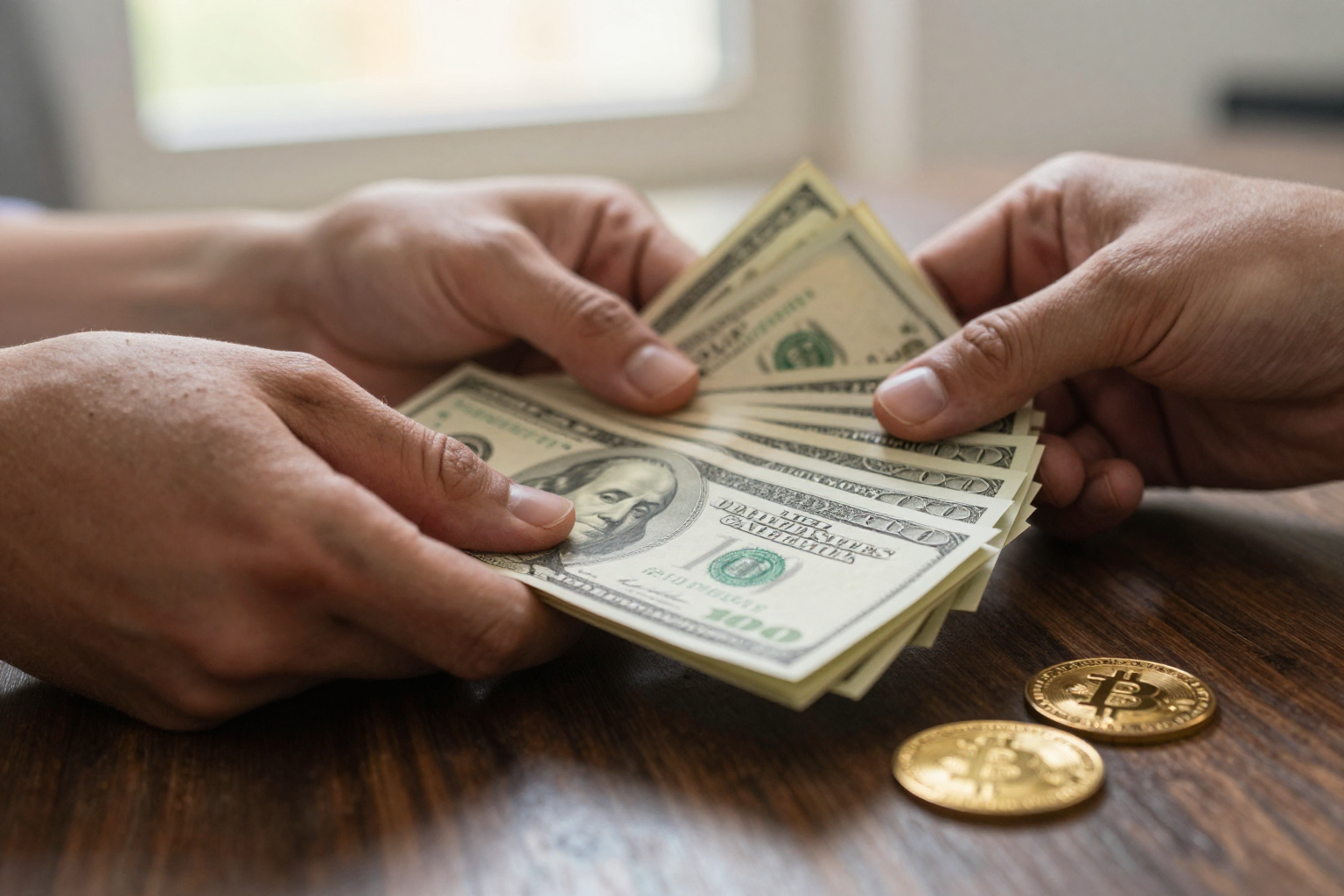
The screen said $68,000. You sold 0.1 BTC expecting $6,800. What landed in your bank account was $6,714, and nobody sent an itemised bill for the missing $86. That gap — repeated across millions of trades every day — is what "btc to usd" really describes. Not a number on a chart, but a chain of quotes, order books, and fees that ends with actual money in an actual account.
Understanding that chain takes about ten minutes. It can save you a few percent every time you cash out, which on a five-figure position is not a rounding error.
Bitcoin doesn't have a price in the way a loaf of bread does. It has a market. When you convert BTC to USD on a centralised exchange, you're selling into an order book — a queue of buyers who've posted what they're willing to pay and how much they want. The number you see at the top of the app is usually the last trade that cleared, or the best bid if you're selling at market.
Those are two different things, and the difference matters. The last trade already happened. The best bid is what someone is offering right now, for a limited quantity. Sell more than that quantity and your order starts eating into lower bids, which is why big sells fill at worse average prices than the headline suggests.
Aggregators and news sites quote a mid-market price — roughly the midpoint between the best bid and the best ask across several large exchanges. It's a useful reference point, like the interbank rate for foreign currency. It is not a rate anyone will honour for you. Your broker's quote will sit below it, sometimes a little, sometimes uncomfortably far.
Exchanges are separate marketplaces with separate order books. Arbitrage traders close the gaps, but not instantly, and not always. A few reasons the same bitcoin is worth $67,900 on one venue and $68,300 on another:
For a small purchase, none of this matters much. For a $20,000 conversion, a 0.5% difference between venues is $100.
This is the part most people underestimate. A clean breakdown of what a bitcoin-to-dollar conversion actually costs involves five or six separate charges, and they compound.
You sell 0.25 BTC. The spot rate on a major exchange is $68,240, which implies $17,060. You use a broker-style app instead, which quotes you $67,220 — about 1.5% below spot. That's $16,805. A $25 outgoing wire and a $15 receiving fee bring it to $16,765. Against the headline figure, you've lost just under 1.7%.
Now run the same trade on an exchange charging 0.1% with a tight spread. You'd clear somewhere near $17,020 before the bank fee. Same bitcoin, same minute, roughly $255 difference.
Prices on dashboards move constantly, and most of that movement is noise. A $400 swing on a $68,000 asset is 0.6% — unremarkable, yet it'll generate a dozen breathless headlines. Knowing how to read a bitcoin price today means knowing which venue it came from, whether it's a 24-hour change or a rolling one, and whether the figure is a last trade or a mid-market average.
One practical habit: check the price at more than one source before you sell anything meaningful. If three venues agree within 0.2%, you're looking at a real rate. If one is noticeably out of line, that venue is either thin or pricing in its own fees.
Bitcoin trades around the clock, including weekends and holidays, which is unusual for a financial asset. Spot ETFs, futures open interest, and leverage on derivatives venues all feed into short-term price action. Longer term, the drivers are duller and more powerful: supply issuance, demand for a non-sovereign store of value, and global liquidity conditions. A useful primer on what actually moves the bitcoin price explains why a Federal Reserve meeting can matter more to your conversion rate than any crypto-specific news.
A market order executes immediately at whatever the book offers. A limit order sits at your chosen price and fills only if the market reaches it. If you need the dollars today, use a market order and accept the slippage. If you can wait a few days, a limit order at a realistic price — say 1% above spot — often fills during a normal week of volatility and saves you the difference.
Converting a large position all at once is a bet on that day's price. Selling in tranches over several weeks spreads the risk. It won't beat the best possible timing, but it removes the chance of picking the worst.
People converting in the other direction face the same mechanics. If you're working out how to start buying crypto without losing your first $200 to fees and spreads, the logic is identical in reverse: the platform's headline rate is marketing, and the all-in cost is the number that counts.
Every BTC to USD conversion is a taxable event in most jurisdictions, even if you immediately buy back in. That means you need the date, the amount of bitcoin sold, the USD value at the time, and your original cost basis for those coins. Exchanges provide this, but their records vanish if the platform shuts down, so export a CSV at least once a year and keep it somewhere you control.
Holding periods matter too. In the US, coins held over a year are taxed at long-term capital gains rates rather than ordinary income rates — a meaningful difference that sometimes justifies waiting a few weeks before selling. Rules vary widely elsewhere, and whether cryptocurrency is legal where you live depends on your residency, the way you're using it, and how your local regulator classifies it.
Selling $500 of bitcoin is trivial. Selling $500,000 is a logistics problem. The order book on even a large exchange may only have a few hundred thousand dollars of bids within 1% of spot, so a single market order will chew through several price levels and land you a noticeably worse average rate.
The rough rule traders use is to keep any single order under 1% of the venue's daily volume for that pair. Above that, split the order across hours or days, use limit orders, or contact an over-the-counter desk. OTC desks quote a single all-in price for the whole block and settle off the public order book, which keeps your trade from moving the market against you. The minimum is usually somewhere around $100,000, and the spread is negotiated — worth asking for a quote even if you assume you won't qualify.
One last detail that costs people real money: liquidity thins out overnight and at weekends. A conversion at 3am on a Sunday in a quiet market can fill several tenths of a percent worse than the same order on a Tuesday afternoon when US and European desks are both open. If the timing is yours to choose, choose it deliberately.
Slot ID: blog-post-bottom