 Currencies
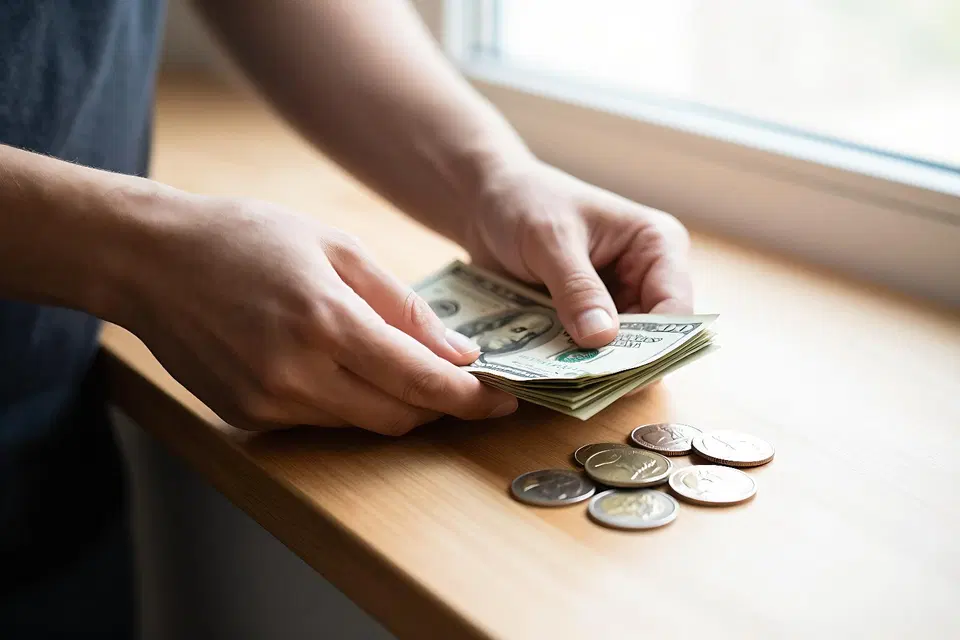
A single US dollar is worth roughly $1.37 in Canadian money right now. That's the figure that pops up when you type "1 us dollar in canadian dollars" into a search bar, and it's the one quoted in news headlines whenever the loonie slips or climbs. It's also a number that tells you almost nothing about what that dollar will cost you in practice.
The rate on the screen is one thing. The rate you actually get at a bank counter, an airport kiosk, or through your credit card is another. The space between those two numbers is where real money quietly disappears, and understanding it is the whole game.
What the Number Means on Paper
An exchange rate of 1.37 means one US dollar buys 1.37 Canadian dollars. Flip it around and one Canadian dollar is worth about 73 US cents. So a $20 US bill converts to roughly $27.40 in Canadian currency, and a $100 US bill lands near $137.
That figure is the mid-market rate, sometimes called the interbank rate. It's the midpoint between what large institutions are willing to buy and sell US dollars for at any given moment, and it's the fairest benchmark that exists. If you want to see how that headline number filters down into everyday purchases, this breakdown of what one US dollar really gets you in Canada is a useful reality check.
Here's the catch: no bank, credit union, or currency booth will give you the mid-market rate. They all build in a margin. The honest ones show it to you as a fee. The less honest ones fold it into a worse rate and call the service free.
Why One US Dollar Isn't Always Worth the Same in Canada
USD/CAD moves constantly, and not by trivial amounts. Over the past five years it has ranged from about 1.20 to 1.47. On a $10,000 conversion, that's a difference of $2,700 depending purely on timing.
Three forces do most of the pushing and pulling.
Oil prices
Canada is a major crude exporter, so the loonie tends to strengthen when oil is expensive and weaken when it's cheap. A rough rule traders use is that a sustained $10 move in a barrel of West Texas Intermediate can shift USD/CAD by several cents.
Interest rate gaps
Money flows toward higher yields. When the Federal Reserve keeps rates above the Bank of Canada's, US dollar assets look more attractive and the loonie usually softens. When the gap narrows, the Canadian dollar often recovers.
Risk appetite and jobs data
In nervous markets, investors pile into the US dollar as a safe haven, which pushes USD/CAD up regardless of what's happening in Canada. Monthly employment reports on both sides of the border can move the rate half a cent in minutes. If you want to read the day-to-day noise more confidently, there's a good primer on what the USD/CAD rate is really telling you.
The Fees That Hide Inside the Rate
This is where most people lose money without noticing. The markup on a currency conversion typically looks like this:
- Major bank branches: 2% to 4% below mid-market, sometimes more for small amounts or less common currencies.
- Airport kiosks: 8% to 12%. Convenience is expensive, and the rate board rarely shows the real spread.
- Credit cards: roughly 2.5% on top of the mid-market rate for foreign transactions, which is actually competitive for small purchases.
- PayPal and similar platforms: about 3% to 4%, baked into a rate you don't get to compare easily.
- Specialist transfer services: 0.4% to 1%, with a small flat fee depending on the amount.
None of these are scams. They're just priced differently, and the difference compounds fast. A closer look at what the US dollar exchange rate in Canada actually costs you shows how much of the headline number survives the trip to your account.
A Real Example: Converting $500 US
Say you come back from a trip with $500 US in cash and want Canadian dollars.
At a mid-market rate of 1.37, that $500 is worth $685. At a bank counter offering 1.3350, you'd walk out with $667.50. You lost $17.50 and nobody handed you a receipt for it. At an airport kiosk offering something closer to 1.24, you'd get $620, and the missing $65 is the price of not planning ahead.
The reversal matters too. If you're a Canadian buying a $1,000 US item online, the sticker price converts to $1,370. Add a 2.5% card fee and it's $1,404. Add provincial sales tax at the border and possible duty, and the real cost can climb well past $1,500. That's the difference between reading a rate and understanding it, which is exactly the gap this analysis of what 1.38 in USD/CAD actually costs you digs into.
Where This Number Shows Up in Daily Life
Cross-border shopping
Groceries, gas, and outlet malls in the US look cheap until you apply the rate and the card fee. A $4.00 US gallon of milk is $5.48 Canadian before fees. Multiply that across a full cart and the savings often shrink to a rounding error, especially once you count the drive.
US subscriptions and services
Streaming plans, software licences, and app store purchases are priced in US dollars. A $15.99 US monthly subscription costs about $21.90 Canadian, or roughly $263 a year. Ten dollars of that annual total is pure conversion cost.
Sending money to family
If you send $300 US to a relative each month, a 3% spread costs about $9 every time. That's $108 a year for a service that a 0.6% provider would handle for around $22.
Getting Closer to the Real Rate
You can't beat the mid-market rate, but you can get within half a percent of it if you're deliberate.
Compare the all-in cost, not the advertised rate. Ask a simple question: if I convert this exact amount today, how many Canadian dollars land in my account? That single number makes providers comparable. Avoid dynamic currency conversion at card terminals and ATMs, where you're offered the choice to pay "in your own currency" at a marked-up rate. And for amounts above roughly $5,000, look into Norbert's Gambit, which converts USD to CAD through interlisted shares for the cost of two trading commissions. On $20,000, that can save several hundred dollars compared with a bank's posted rate.
For a fuller walkthrough of the mechanics, this guide on how to read the USD to CAD rate and keep more of your money covers the practical side in more depth.
A Sixty-Second Rate Check Worth Doing
Before any conversion above a couple hundred dollars, run through this. Pull up the mid-market rate. Get a quote for the exact amount you're converting from two or three providers. Compare the Canadian dollars you'd actually receive, not the percentages. Then check whether the amount is large enough to justify a specialist service over your bank.
Do it once for a vacation, and it probably saves you $30. Do it consistently for freelance income, cross-border rent, or a US dollar savings account, and it saves thousands over a few years. The rate quoted for one US dollar in Canadian dollars is a starting point, not a price. Treat it that way and the number stops being trivia and starts being useful.