 Currencies
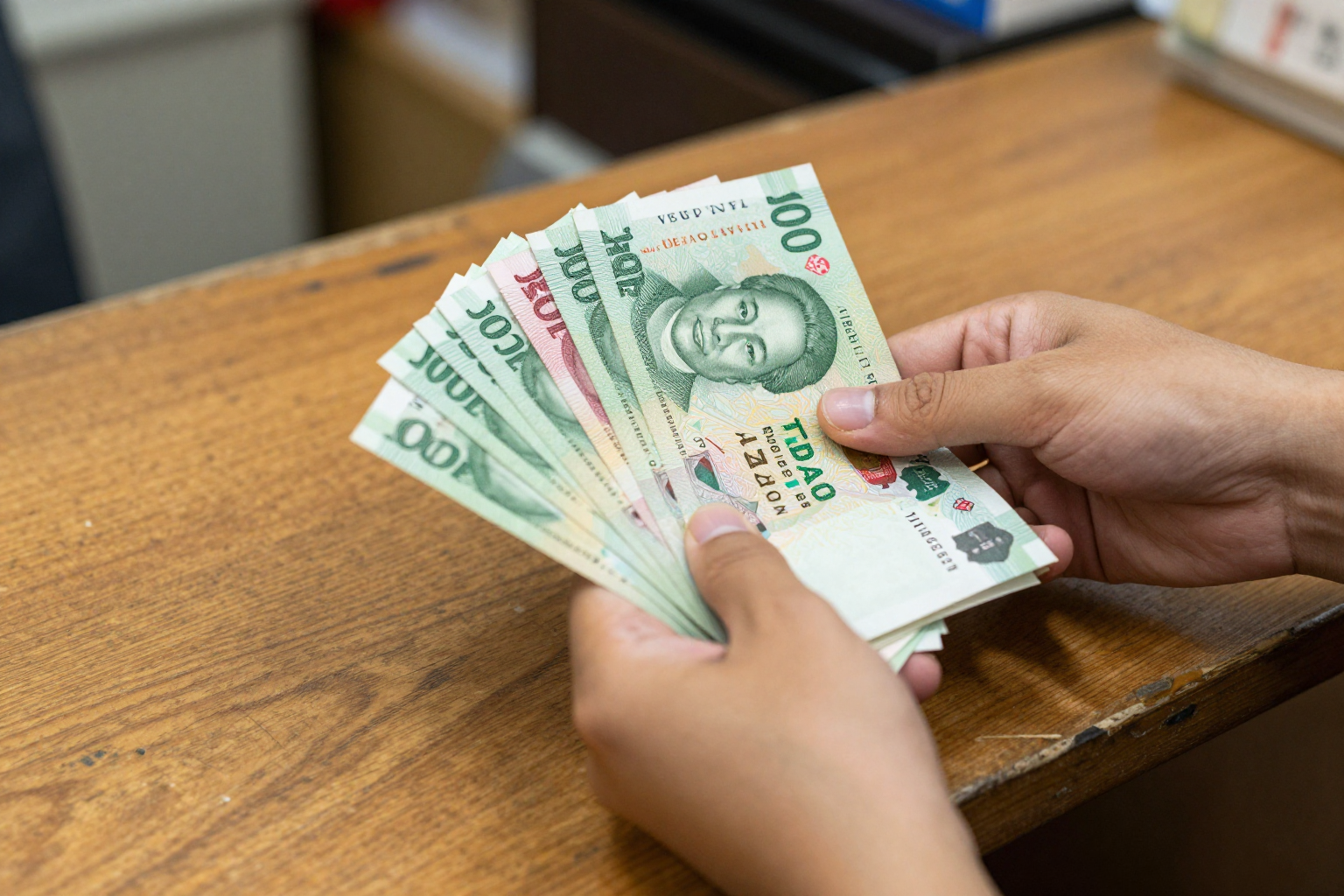
Type "100 dollars in yuan" into a search bar and you'll get something like 720. That single figure hides a surprising amount of machinery: a midpoint rate announced in Beijing every morning, a trading band, two different versions of the same currency, and a stack of interest-rate maths that decides whether your holiday money goes further this year than last.
Here's how to read the US dollar to Chinese yuan exchange rate properly, and what it means for anything you're actually trying to do with it.
What the number on your screen is telling you
The USD/CNY rate is simply a price: how many yuan one US dollar buys. At 7.20, one dollar gets you ¥7.20, so $500 converts to ¥3,600. Flip it and a single yuan is worth about $0.139.
That reciprocal trips people up constantly. A higher USD/CNY quote means the dollar has strengthened and the yuan has weakened. When a headline says the yuan "slid to 7.30", it's telling you the dollar bought more yuan than before, not less. Read the currency pair left to right and the direction stops being confusing.
Two yuan, not one: onshore CNY and offshore CNH
Most converters show the onshore rate, CNY, which trades inside mainland China. There's a second version called CNH, traded in Hong Kong and other offshore centres, and it moves far more freely because it isn't fenced in by capital controls.
The gap between the two is usually a few hundredths of a yuan. During stress it widens. In late 2022 and again in 2023, offshore yuan traded persistently weaker than onshore, a signal that global investors were more bearish than Beijing was comfortable with. Traders watch that spread closely, because a sudden widening often precedes official intervention.
The daily fix, and why Beijing bothers
Every trading morning the People's Bank of China publishes a central parity rate, the midpoint around which the onshore currency may move by up to 2% in either direction. It isn't a pure market price. The fixing blends bank submissions with policy judgment, and analysts compare the published number against forecast models to spot intent.
If the fix comes in noticeably stronger than the market expected, it usually means the authorities are pushing back against depreciation. In 2023 the PBOC leaned on this tool repeatedly, setting fixes well above where models suggested the market would have landed.
What actually moves the rate
Interest rate differentials do most of the work
This is the big one. Money drifts toward higher yields. When the Federal Reserve lifted rates from near zero to 5.25–5.5% between 2022 and 2023 while the PBOC eased, the dollar-yuan pair climbed from roughly 6.35 to above 7.30 in about eighteen months. Nothing about Chinese exports changed that dramatically in that window. The yield gap did.
Watch the spread between 10-year US Treasury yields and Chinese government bond yields. It correlates with USD/CNY more tightly than almost any other single indicator.
Trade flows and exporter behaviour
China runs large current account surpluses, and exporters converting foreign earnings into yuan create steady demand for the currency. But conversion is optional and timing is everything. When exporters expect the yuan to keep weakening, they sit on dollar balances instead of converting, and a source of support quietly disappears. Monthly settlement data from China's foreign exchange regulator is worth following for exactly this reason.
Growth data and the property slump
GDP prints, PMI surveys, retail sales and property investment all feed into the rate. China's property downturn has weighed on domestic confidence and kept yields low, which in turn has kept the yuan under pressure. A convincing run of stronger activity data tends to firm the currency, at least briefly.
Politics, tariffs and reserves
Tariff announcements, export controls and sanctions threat move the pair fast. China holds more than $3 trillion in foreign exchange reserves, and the market reads changes in that stock as a hint about how actively the central bank is defending a level.
What a weaker yuan does, and what it doesn't
A cheaper yuan makes Chinese exports cheaper in dollar terms, which sounds like an instant boost. In practice the benefit is muffled. Chinese manufacturers import plenty of components priced in dollars, so a weaker currency raises their input costs at the same time it flatters their pricing abroad. Competitors in Vietnam, Mexico and Bangladesh devalue too.
For anyone buying from China, the effect is more direct and more welcome. A 5% drop in the yuan against the dollar knocks roughly 5% off a dollar-denominated invoice, assuming the supplier passes it through. Plenty don't, especially on long-term contracts.
Running the numbers on a real conversion
Small rate differences look trivial until you scale them up.
• $1,000 at 7.10 = ¥7,100
• $1,000 at 7.25 = ¥7,250
• $10,000 at 7.10 = ¥71,000
• $10,000 at 7.25 = ¥72,500
That's ¥1,500, or roughly $207, on the same ten grand. Add a 3% markup from an airport kiosk and you've handed over several hundred dollars for the convenience of not walking ten minutes down the road.
How to get a rate closer to the mid-market one
The rate you see on Google is the mid-market rate, the halfway point between buying and selling prices on the wholesale market. Nobody sells it to consumers. Your job is to get close.
• Compare total cost, not the headline rate. Multiply the rate you're offered by the amount, then subtract every fee. That's the only number that matters.
• Skip airports and hotel desks. Their spreads routinely run 5% to 10%.
• Use a multi-currency card or a bank that charges the network rate. Revolut, Wise and similar services typically sit within 0.5% of mid-market.
• Batch your transfers. Fixed fees hurt more on small amounts, so sending $5,000 once beats five transfers of $1,000.
• Ask about forward contracts if you're importing and the invoice is six months out. Locking a rate removes the guessing game entirely.
• Withdraw local currency at ATMs rather than accepting dynamic currency conversion at the terminal. Always choose to be charged in yuan, not dollars.
Signals worth watching if you need to convert soon
Forget daily headlines and follow four things instead.
The first is the daily fix and how far it deviates from analyst estimates. Persistent strength in the fix tells you the ceiling is being defended. The second is the CNH–CNY spread, since offshore weakness tends to lead onshore moves. The third is the US–China ten-year yield gap; when it narrows, the yuan usually firms. The fourth is China's monthly trade and FX settlement data, which reveals whether exporters are converting or hoarding.
If you have a large payment or a big trip coming, set a rate alert at a level that works for your budget rather than trying to catch the bottom. Currency markets are capable of remaining irrational for far longer than your invoice deadline allows. A rate that makes your numbers work is a good rate, whatever the chart says the following week.