
Loading article...
Slot ID: blog-post-top
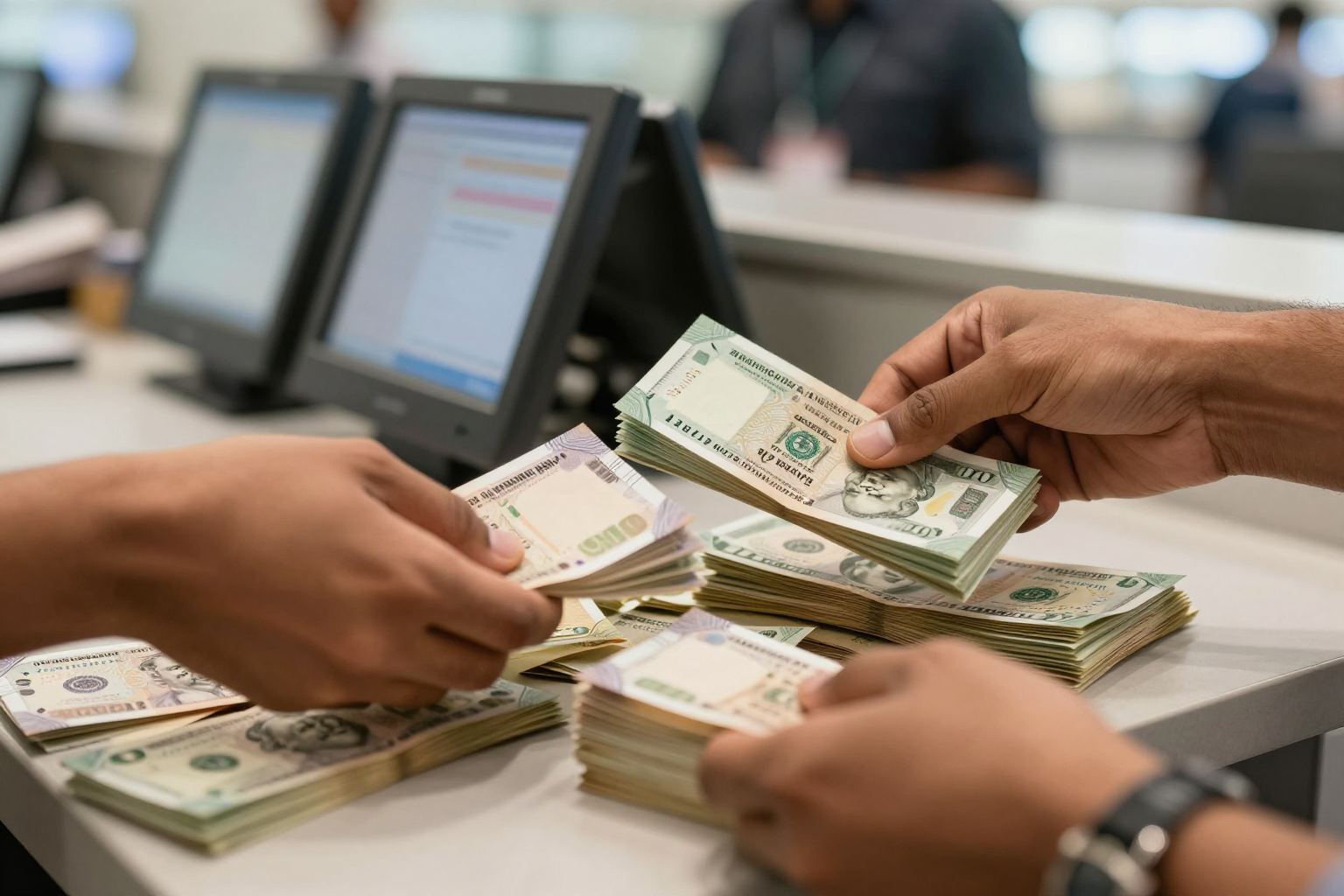
If you're wiring money to family in Hyderabad, paying a freelancer in Bengaluru, or just planning three weeks in Rajasthan, the number that decides everything is the same one: how many rupees your dollars turn into. The figure you see on a search result is rarely the figure that lands in anyone's account. The gap between them is where most people quietly lose money.
Here's how the US dollar to Indian rupee conversion actually works, what it costs at today's levels, and what you can realistically do about it.
One US dollar currently buys somewhere around ₹86. Treat that as a rough anchor rather than a promise, because it changes daily.
The rate quoted on Google, Reuters or XE is the mid-market rate, the midpoint between what banks will pay for rupees and what they'll sell them for. It's a wholesale number used between institutions. No branch will hand it to you, and no remittance app will either. It's a reference point, useful mainly for measuring how much you're being charged.
Zoom out and the direction is unmistakable. Twenty years ago a dollar bought roughly ₹45. Today it buys nearly double. Some of that reflects stronger US growth and higher American interest rates, but a big chunk comes from inflation: Indian prices rise faster than US prices, and the rupee weakens over time to reflect it.
At ₹86 to the dollar, here's what common amounts convert to:
The maths never changes: multiply dollars by the rate. Just remember India counts in lakhs and crores, so ₹2,15,000 reads as "two lakh fifteen thousand." If you think in thousands and millions, the comma placement shifts, and it's worth a second look before you confirm a transfer.
A handful of forces dominate the pair, and knowing them makes the daily noise easier to ignore.
India imports more than 80% of its crude, and oil is priced in dollars. When crude spikes, Indian refiners need more greenbacks, demand rises, and the rupee softens. This is one of the most reliable short-term drivers there is.
When global funds buy Indian stocks and bonds, dollars flow in and the rupee firms up. When they retreat, as they did during the 2022 Fed tightening cycle, the currency takes the hit. Foreign investors hold a large slice of Indian equities, so their mood matters.
The RBI doesn't defend a specific level, but it does smooth volatility. With reserves north of $700 billion, it can sell dollars when the rupee falls too quickly. That's why the pair almost never moves in a straight line, even during a bad month.
Fed policy matters as much as anything India does. Higher US rates pull capital toward dollar assets, and the rupee generally pays the price.
Suppose the mid-market rate is ₹86 and your bank quotes ₹84.20. That 1.8-rupee gap looks trivial until you scale it. On $5,000, it's ₹9,000 gone, about $105. Most banks bury this as a margin rather than a visible fee line, which is why the true cost of a transfer is often double what the fee suggests.
The mechanics repeat across every currency pair, and the fees most people miss on major currency conversions are the same ones that erode a dollar-to-rupee transfer.
Run the numbers on a real transfer. You send $2,000 through your bank.
The loss comes to roughly ₹7,000, or about $81 on a $2,000 transfer. A specialist remittance service would typically charge under $20 for the same job, and many quote the mid-market rate with a transparent fee on top. Over a year of monthly transfers, that gap adds up to nearly $1,000.
The discipline is the same regardless of where the money is going: fix the amount, convert at the real rate, subtract every fee, and compare the final number that lands. That's the step-by-step approach to seeing exactly what lands after converting $2,500, and it applies to rupees just as cleanly.
Plenty of people need the reverse. Students paying US tuition, exporters invoicing American clients, families repatriating savings. The problem mirrors itself, and the losses do too.
A ₹5,00,000 transfer routed through the wrong provider can lose about $187 to spreads, wire charges and a poor rate. That specific scenario is worked through in this guide on converting ₹5,00,000 to USD without losing $187, and the fix is always the same: compare the net amount received, not the headline rate.
The rupee rarely moves alone. When the dollar strengthens globally, the rand, the real, the peso and the yuan usually weaken alongside it, because the same capital flows are driving all of them. If you regularly move money between emerging and developed markets, watching one currency gives you a decent feel for the rest. The logic behind converting ¥100,000 to dollars step by step holds up for rupee transfers without much adjustment.
Sometimes waiting helps. In the short term the rupee can recover several paise on a softer US inflation print or a surge of foreign buying. Over longer stretches, though, the trend has run one direction for decades.
For anyone sending regular remittances, timing is close to a coin flip and rarely worth the stress. Spreading transfers across a few weeks smooths out the bad days, which matters more than catching the exact top. Businesses with large, dated obligations have a better tool available: a forward contract from your bank, which locks today's rate for a future date and removes the guesswork entirely.
You won't get the exact mid-market rate, and you don't need to. Getting within half a percent is very achievable.
The difference between a careful and a careless conversion on $5,000 is usually around $100. That's a return flight, a month of school fees, or two good nights in a decent hotel. It's decided in the ten minutes you spend choosing where to send the money, long before any of it reaches India.
Slot ID: blog-post-bottom