 Currencies
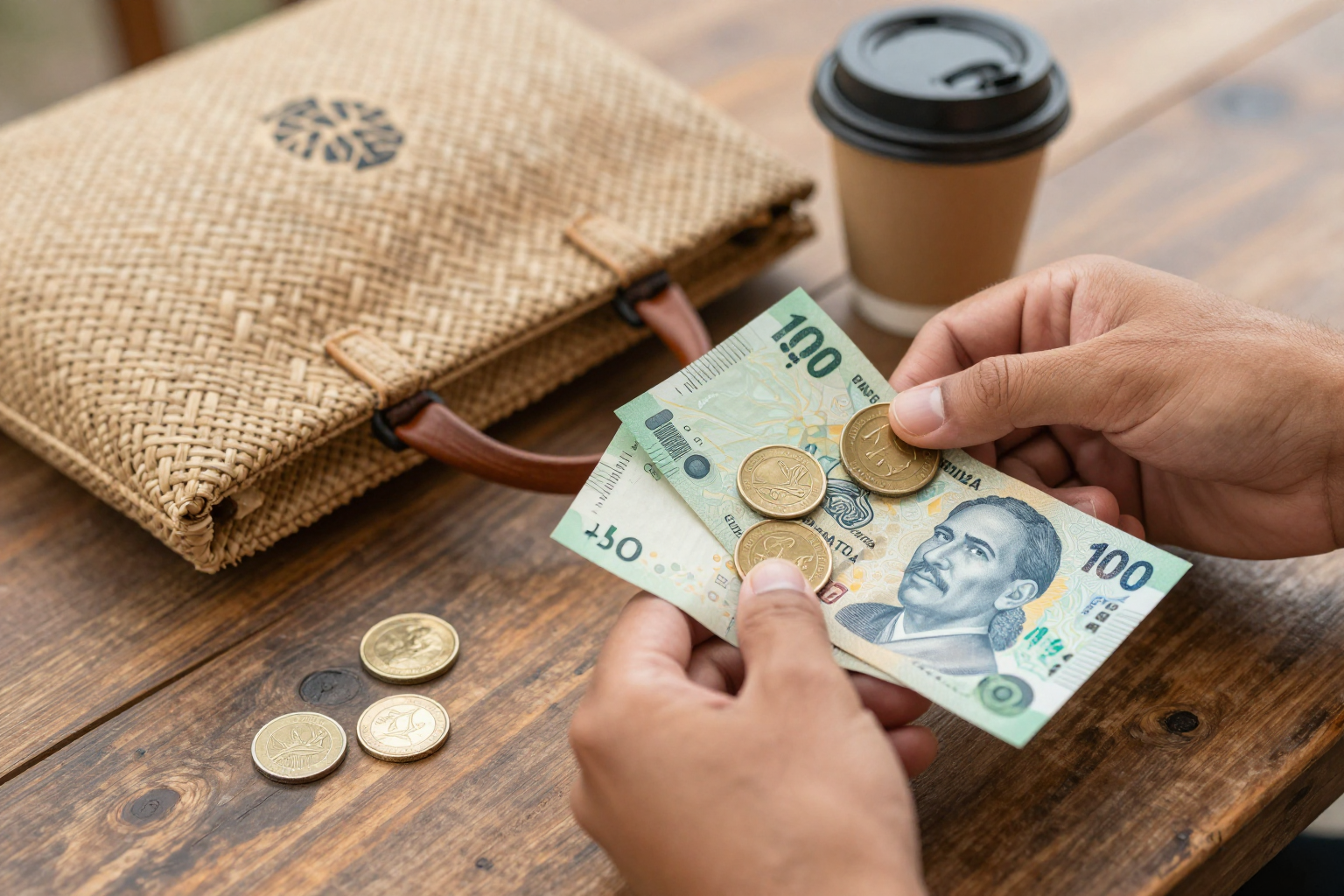
You are standing in an Oaxaca market, holding a woven bag priced at 480 pesos, and your phone says that is about 26 dollars. The card reader later charges 27.15. Neither number is wrong. One uses a clean midpoint rate; the other includes a bank spread or a foreign transaction fee. A Mexico currency to USD converter gets you close fast, but the useful part is knowing which rate you are actually looking at.
What a Mexico currency to USD converter does
The converter translates Mexican pesos into US dollars using an exchange rate. The core formula is simple:
USD = MXN ÷ the number of pesos per US dollar.
If the rate is 17.80 pesos to 1 dollar, 1,000 MXN becomes 1,000 ÷ 17.80 = $56.18. To go the other way, multiply: $50 × 17.80 = 890 MXN.
Most online converters show the mid-market rate. That is the midpoint between buy and sell prices, not necessarily the rate you will receive. Treat it as a baseline, then compare it with the number on your receipt.
Mid-market rate vs. the rate at the counter
Suppose mid-market is 17.80. A bank or card network might settle at 18.05 when you spend pesos, so 1,000 MXN becomes $55.40, about 78 cents less. An airport booth might effectively use 18.60, leaving $53.76. Same purchase, three outcomes. A good converter reveals the baseline; your statement reveals the real cost.
How to use a converter in five seconds
• Enter the peso amount exactly, including cents. A missing zero turns 350 MXN into 3,500.
• Check the timestamp. Rates move through the day, especially around central bank news.
• Look for a fees-included option if you are comparing a transfer or ATM withdrawal.
• Compare the converter result with your card foreign fee. Add 1% to 3% if your card charges one.
• Round the result for budgeting, but use exact numbers for big purchases.
The formula and the mistake almost everyone makes
The direction matters. Pesos per dollar is around 17 to 18. Dollars per peso is around 0.055 to 0.059. If you see 0.056, that is dollars per peso. At that rate, 1,000 MXN × 0.056 = $56. Multiplying 1,000 by 17.80 gives 17,800, a common slip caused by using the wrong side of the pair.
For quick mental math, divide by 18. A 250-peso lunch is roughly $13.89. A 1,200-peso hotel night is about $66.67. The shortcut is slightly conservative when the rate is 17.50, which is fine for keeping a travel budget in check.
Why your converter and your receipt disagree
Fees hide in the spread
Banks and exchange booths rarely publish a single fee. They build margin into the rate. If mid-market is 17.80 and you are offered 18.40, that gap is cost. On 5,000 MXN, 5,000 ÷ 17.80 = $280.90 versus 5,000 ÷ 18.40 = $271.74, a $9.16 difference.
ATMs and card fees
An ATM may charge 34 to 120 MXN per withdrawal, and your home bank may add $3 to $5. Withdraw 5,000 MXN instead of 1,000 to spread fixed costs. If offered conversion to your home currency, decline. Pay in pesos and let your bank or card network convert.
Dynamic currency conversion
Some terminals ask if you want to pay in USD. The displayed rate often adds 3% to 8%. A 2,800 MXN dinner at 17.75 is $157.75. A terminal offering $168.00 is charging about 6.5% extra. Press cancel or choose pesos.
Cash, cards, ATMs, and exchange booths
No single option wins everywhere. The best choice depends on amount, location, and your bank.
• Airport exchange booths: useful for a small amount on arrival, expensive for larger sums. Spreads can reach 8% to 12%.
• Bank ATMs: often close to the card network rate plus a fixed fee. Use ones attached to banks during daylight and decline conversion.
• Credit cards: strong for hotels, restaurants, and larger purchases. Check the foreign transaction fee, usually 0% to 3%.
• Debit cards at ATMs: good if your bank reimburses fees. Set a daily limit and use a backup card.
• Hotel desks and street cambio: convenient but compare the effective rate. A booth quoting 18.30 pesos per dollar is poor if mid-market is 17.80.
Reading Mexican prices without panic
In Mexico, the dollar sign often means pesos. A menu showing $180 is 180 MXN, not 180 USD. At 17.75, that is about $10.14. Context helps: tacos for $35, a coffee for $65, a nice dinner for $450. If a price looks like a US price but has the same symbol, check the currency label.
Useful anchors at roughly 17.75 MXN per USD: 100 MXN ≈ $5.63, 500 MXN ≈ $28.17, 1,000 MXN ≈ $56.34, 5,000 MXN ≈ $281.69. At 18.00, the same 1,000 MXN is $55.56. That 2.5% shift matters on a week-long trip.
A real budget example
Imagine five days in Mexico City. You book four nights at 2,400 MXN, eat on 700 MXN a day, spend 250 MXN daily on transport, and set aside 1,500 MXN for museums and a day trip.
• Lodging: 4 × 2,400 = 9,600 MXN
• Food: 5 × 700 = 3,500 MXN
• Transport: 5 × 250 = 1,250 MXN
• Activities: 1,500 MXN
• Total: 15,850 MXN
At 17.75, that is $892.96 before card fees. Add a 2.5% foreign transaction fee and the real cost is about $915.28. If you bought cash at an effective 17.20, the same pesos would cost $921.51. The card wins here, but only because the fee is modest. A 3% fee with a weaker rate could flip the result.
When the rate moves
The peso is sensitive to Banxico interest rate decisions, US economic data, trade headlines, and remittance flows. A move from 17.50 to 18.20 changes 10,000 MXN from $571.43 to $549.45, a $21.98 difference. For a vacation, a few cents does not justify carrying huge amounts of cash. For a rent payment, a car purchase, or a large transfer, compare providers and watch the rate over a week.
Which converter to trust
Google, XE, OANDA, Wise, and your bank app are fine for a quick mid-market check. For money transfers, use a provider calculator that shows fees and the final received amount. For card spending, check Visa or Mastercard currency converter for the network rate that may apply. Download an offline converter before rural travel; signals in Copper Canyon or the Oaxaca mountains can disappear.
Smart habits that save real money
• Use a no-foreign-fee card for most spending and keep 1,000 to 2,000 MXN in cash for small vendors.
• Withdraw larger amounts less often to reduce fixed ATM fees, but only from bank branches.
• Always choose pesos when a terminal or ATM offers to convert. Check the screen before pressing accept.
• Compare the total cost, not the headline rate. A zero-fee transfer with a poor rate can cost more than a small fee with a fair rate.
• Keep a daily budget in both currencies; it stops 700-peso meals from feeling like 70.
A converter is a tool, not a promise. Use it to understand the midpoint, then look at the actual cost from your bank, card, or ATM. That extra 30 seconds turns a vague sense of Mexico being cheap into a number you can plan around.