 Currencies
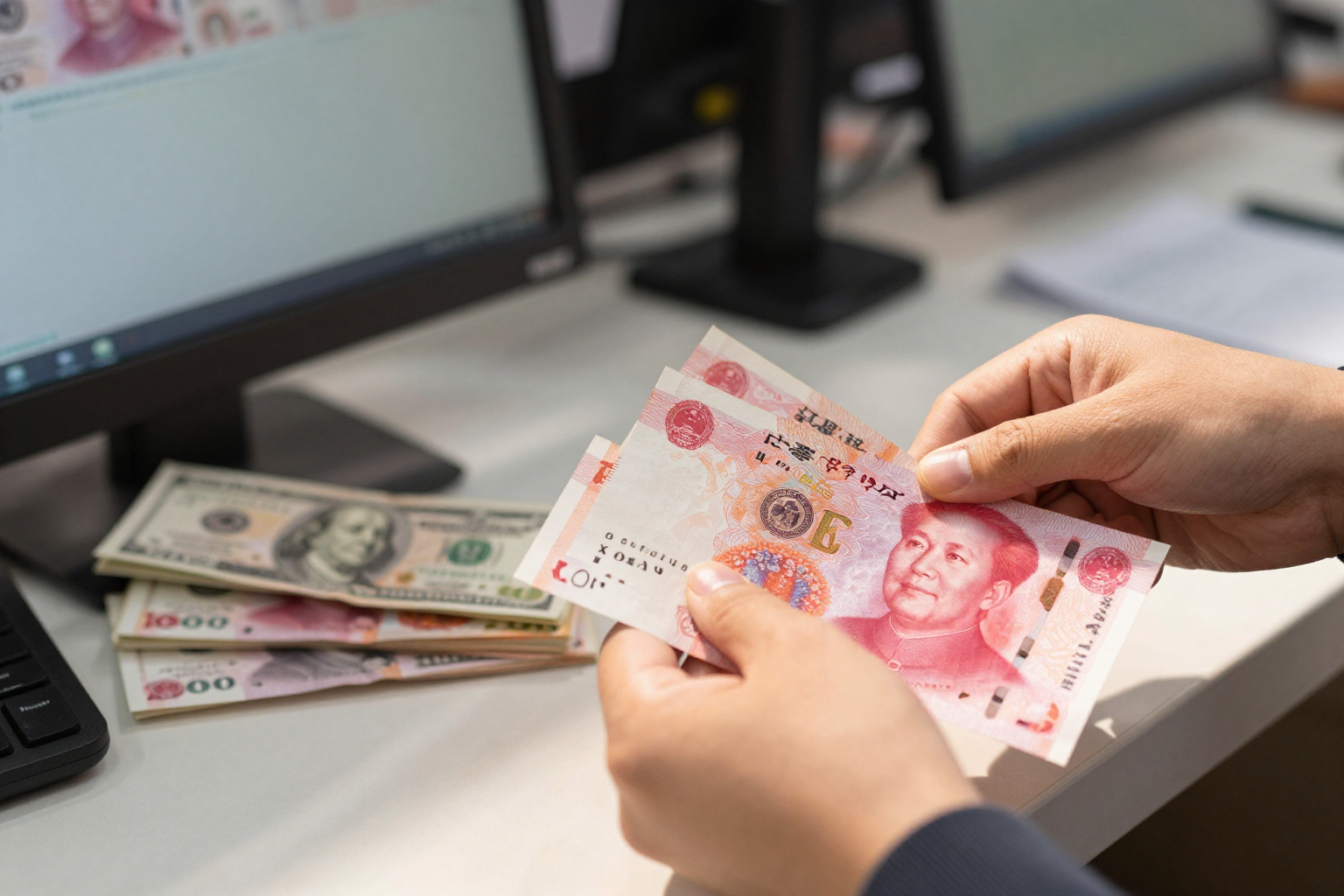
If you are checking the dollar rate in China today, the first surprise is that there is not one single number. The rate depends on whether you are looking at the central bank’s reference point, the onshore market, the offshore market, or the quote your bank will actually give you. For a traveler changing $500, that difference might buy lunch. For an importer paying a six-figure invoice, it can be worth thousands.
Here is a practical way to read the rate, spot the traps, and understand why USD/CNY moves.
What the dollar rate in China today really means
China’s currency is the renminbi (RMB), and its main unit is the yuan. In global markets you will see it written as USD/CNY, meaning how many yuan one US dollar buys. A quote of 7.20, for example, means $1 costs 7.20 yuan. Chinese bank boards sometimes quote per 100 US dollars, so a screen showing 720 is the same rate. That small detail trips up plenty of visitors.
The three numbers worth knowing
• PBOC central parity: The People’s Bank of China publishes a daily reference rate, often called the fixing, around 9:15 a.m. Beijing time. It guides the onshore market but is not a rate you can walk in and get.
• Onshore USD/CNY: The rate traded inside mainland China. It is allowed to move within a band around the fixing, so it is managed, not completely free.
• Offshore USD/CNH: The rate traded outside the mainland, mainly in Hong Kong. It responds faster to global news and can trade at a premium or discount to the onshore rate.
Then there is the bank counter rate, which is the one that affects your wallet. It includes the bank’s spread and any fees. That is why the number on a currency converter rarely matches the number on your receipt.
How to check the rate without chasing noise
Use a mid-market quote as your baseline. Google, Reuters, Bloomberg and most banking apps show one. Check the timestamp, because a page cached from yesterday can be badly wrong after a big market move. Then compare it with the quote your bank or payment provider offers. The gap is your real cost.
In China, the PBOC fixing is published on weekday mornings. During Chinese public holidays, there is no new fixing, but offshore CNH still trades. If you land in Shanghai during Golden Week, the onshore market may be quiet while the offshore rate is moving. Your bank’s quote will reflect the market it can access, not necessarily the last fixing.
What moves the dollar rate in China
USD/CNY is not a random number. It reacts to policy, trade and the wider dollar.
Interest rate gaps
When the US Federal Reserve keeps rates high and the PBOC keeps rates low, holding dollars can pay more interest than holding yuan. That can pull USD/CNY higher. When the gap narrows, the yuan often gets support. Traders watch this relationship closely because it shapes where global money wants to sit.
Trade flows
China runs large trade surpluses. Exporters earn dollars and convert them into yuan to pay wages and suppliers, which supports the Chinese currency. A weak export month or a surge in imports can change that flow. Apple suppliers, electric vehicle makers and clothing exporters all affect the same currency market when they convert earnings.
The PBOC’s signals
The daily fixing is more than a calculation. A fixing that is stronger than traders expect can signal that Beijing wants to slow the yuan’s fall. A fixing that is weaker than expected can signal the opposite. The PBOC also uses other tools, such as adjusting foreign exchange reserve requirements or speaking through state media.
Global risk sentiment
The dollar is a safe haven. When markets are frightened, money often moves into US Treasuries and the dollar. When investors are optimistic about China, they may buy yuan. A strong US dollar index can push USD/CNY up even if nothing in China has changed.
Onshore and offshore: why the two rates split
The onshore rate is shaped by mainland rules and the daily fixing. The offshore rate is shaped by anyone who can trade CNH in Hong Kong, Singapore or London. During stress, the two can diverge sharply. In 2016 and again in 2022, offshore CNH moved faster than onshore CNY as investors reacted to headlines. For a company hedging payables, that spread matters. For a tourist buying yuan at a bank, it is mostly background noise.
If you are sending money into China, the onshore rate and local bank rules are what you need to watch. If you are trading or holding CNH outside the mainland, the offshore rate is your market.
What rate will you actually get?
Suppose the mid-market rate is 7.20. A bank might buy your dollars at 7.16 and sell you dollars at 7.24. That spread is the bank’s margin. Airport kiosks and hotel desks often add another 3% to 5%, which is painful on a $2,000 exchange.
• Compare at least two banks or licensed payment providers before a large transfer.
• Ask whether the quote includes fees, and whether the rate is per dollar or per 100 dollars.
• For small amounts, convenience can beat a tiny rate difference. For large amounts, even 0.2% matters.
• Avoid unofficial exchangers. The rate may look attractive until something goes wrong.
• If you are a business, ask about forward contracts to lock a rate for a future payment.
A quick reality check for travelers and businesses
Travelers should focus on total cost, not the headline rate. A no-fee card that gives a near mid-market rate can beat a bank counter with a “commission-free” sign. Withdrawing cash from an ATM in China can be convenient, but your home bank may add a foreign transaction fee and the Chinese ATM operator may add its own.
Businesses need a policy. An importer paying $100,000 at 7.15 versus 7.20 is a difference of 5,000 yuan, which is real money. Exporters with dollar receivables face the opposite risk. Many companies use forwards, options or natural hedges, such as matching dollar costs with dollar revenue.
The small habit that keeps you accurate
Before you act on the dollar rate in China today, check three things: the timestamp, whether it is onshore CNY or offshore CNH, and the all-in quote from your bank or provider. That takes two minutes. It is also the difference between guessing and knowing what your money is really worth.