 Currencies
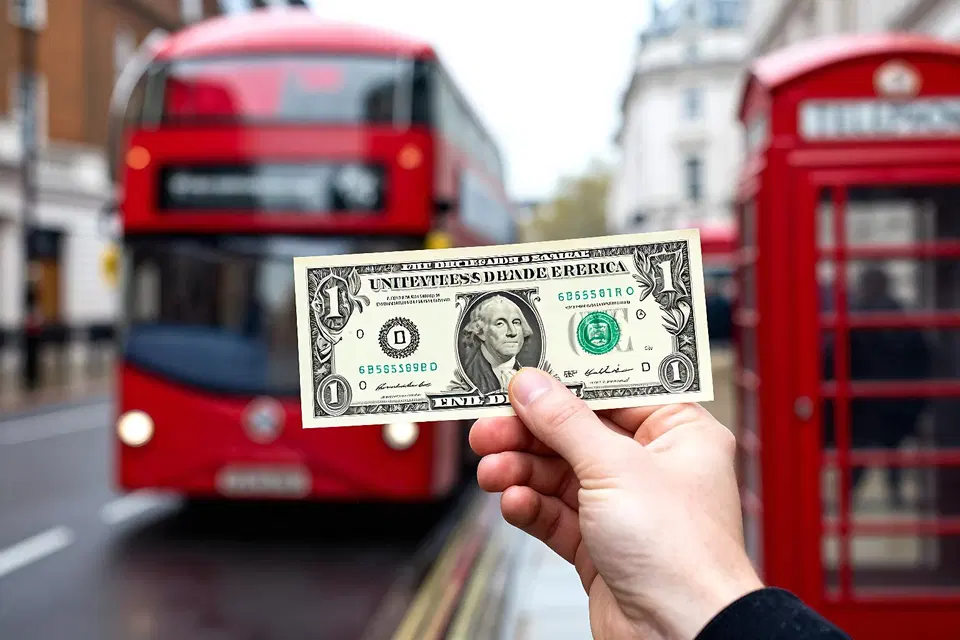
Type “1 us dollar in british pounds” into a search box and you'll get a number. At the time of writing it sits near 0.75, which means one US dollar buys roughly 75 pence. That single figure carries a lot of weight, and it also misleads a fair number of people. It moves every trading day, it isn't the rate most travellers or senders actually receive, and on its own it tells you almost nothing about whether a trip to Britain looks cheap this year or next.
Here's what sits behind the number, why it has swung so violently over the past two decades, and how to get something close to the rate you see on a screen.
What the conversion actually represents
A USD/GBP quote of 0.75 means $1 = £0.75. Flip it and you get GBP/USD at about 1.33, which is how the financial press usually reports it: “the pound is trading at $1.33.” Same information, opposite direction, and a common source of confusion when you compare a Google result with a newspaper headline.
The rate you see is the mid-market rate, the midpoint between the highest price buyers will pay and the lowest price sellers will accept, taken from interbank trading. No consumer gets it. It's a reference point, not an offer. If you want a fuller breakdown of how these quotes are constructed and reported, there's a useful explanation of what the dollar rate in the UK actually means before you start comparing providers.
Why one pound buys more than one dollar
People read the 0.75 figure as a verdict on the two economies. It isn't. A currency's unit size is a historical accident as much as anything else. Sterling was a large-value medieval unit tied to a pound of silver, which is why British prices look small in number terms and wages look enormous to an American visitor. The US dollar was deliberately created as a smaller unit.
What has changed is relative value. Under the Bretton Woods system in the 1950s, £1 was fixed at $2.80. Through decades of inflation, devaluations and shifting trade patterns, that slipped to roughly $1.33 today. The pound has lost about half its dollar value since the postwar peak, which is why a $1,000 holiday budget bought £357 worth of spending in 1955 and buys around £750 now.
Two decades of swings worth knowing about
The rate is not a slow, gentle curve. Some reference points make the scale obvious:
- 2007: £1 hit about $2.00, so $1 bought roughly 50p. Americans in London were paying double for everything.
- June 2016: the Brexit referendum result pushed sterling from around $1.50 to the low $1.20s within days.
- September 2022: the mini-budget sent the pound briefly to $1.07, its weakest on record. At that moment $1 bought about 93p.
- 2025: the pair has hovered in the $1.30–$1.36 range, putting $1 somewhere around 74–77p.
Between the 2007 peak and the 2022 trough, the purchasing power of a dollar in Britain nearly doubled. Anyone who booked a London hotel in 2007 and again in 2022 was effectively staying in two different countries, price-wise. That's the practical consequence of a number most people glance at and forget.
The rate on the screen is not the rate you get
Banks and bureaux de change make money on the gap between the mid-market rate and the rate they hand you. On a currency card that gap might be 0.5%. At a bank branch it's often 2–4%. At an airport kiosk in Heathrow or JFK, it can easily reach 8–12%, plus a flat commission on top.
Run the numbers on a $2,000 conversion at a 3% markup and you've quietly paid $60 for the privilege. On $200 at an airport counter with a 10% spread, you've lost $20 and probably didn't notice. There's a good walk-through of where those costs hide in why the rate you see isn't the rate you get, including the “pay in dollars or pounds?” question at card terminals that adds another 3–5% if you pick wrong.
What 75 pence actually buys in Britain
Prices vary sharply between London and, say, Newcastle or Swansea, so treat these as a rough guide.
A supermarket own-brand tin of baked beans runs about 45p. A chocolate bar is 65–85p. A pint of milk is roughly £1.45, so your dollar covers half of it. A London bus fare is £1.75. A first-class stamp is £1.70. A flat white in a café is £3.20–£4.00, and a pint of beer in a city-centre pub is £5.50–£6.50.
What that means in practice: one US dollar gets you a snack, not a journey, and certainly not a coffee. For a more detailed sense of how far a dollar stretches across everyday British spending, this piece on what a dollar really buys you in Britain is worth a read before you budget.
Getting closer to the mid-market rate
A few habits reliably shave 2–5% off the cost of converting dollars into pounds:
- Use a multi-currency account or a specialist transfer service for anything over a few hundred dollars, and compare the total received rather than the headline fee.
- Always decline the terminal's offer to charge you in dollars. Paying in sterling lets your bank or card do the conversion at a far better rate.
- Avoid airport and ferry-terminal counters unless it's a genuine emergency. Withdraw from an ATM instead, and refuse the ATM's own conversion offer too.
- For large sums, split the conversion across a few days or weeks rather than betting everything on one morning's rate.
- Check whether your bank charges a foreign transaction fee of 2.75–3% on every card purchase. A travel card with no fee can save more than rate shopping ever will.
What pushes the dollar and pound around
Interest rate expectations do most of the heavy lifting. When the Federal Reserve looks likely to hold rates higher for longer than the Bank of England, dollar assets yield more and money flows toward the US, strengthening the dollar and pushing USD/GBP up. UK inflation prints, wage data and gilt market moves do the same work in the opposite direction.
Two other forces matter more than most people assume. Energy prices hit the pound harder than the dollar because the UK is a net energy importer, which is part of why the 2022 gas shock coincided with sterling's record low. And the dollar is the world's default safe haven: during a global scare, it strengthens regardless of what's happening in Britain. A banking crisis in Asia can make your London hotel more expensive.
Watching the rate without letting it run your life
Set a rate alert with your bank or transfer provider at a level that genuinely changes your plans, and then stop checking. For most people that threshold is meaningful only within a few percent, and daily noise rarely crosses it. If you're sending money regularly, a recurring transfer on a fixed date beats trying to time the market, and businesses with predictable future payments can lock in a rate with a forward contract instead of gambling on the spot market.
The one thing worth doing is checking the total you receive, in pounds, from two or three providers each time you convert something substantial. The gap between the best and worst option is usually far larger than the gap between today's rate and next Tuesday's, and it's the part you can actually control.